To close the 2021 year on news about the F-35 Joint Stealth Fighter updates, Naval News reached out to the F-35 Lightning II Joint Program Office with questions in December 2021 and received a reply from Laura M. Seal, Public Affairs Lead, F-35 Lightning II Joint Program Office. Naval News asked the Joint Program Office about future weapons that the F-35 might carry, such as the Raytheon “Stormbreaker,” AIM-260 Joint Advanced Tactical Missile (JATM), LRASM or any new gun pods, and the F-35 Joint Program Office referred Naval News to the branch services and International Partners of the F-35 for answers; therefore, look for F-35 armament update stories from Naval News in the future.
“The F-35 enterprise is bringing the world’s most advanced fighter capabilities to bear from the Middle East to the Arctic. To date, the F-35 enterprise has delivered more than 730 aircraft, 11 services worldwide have declared initial operational capability, and five countries have conducted operational F-35 missions.”
Laura M. Seal, Public Affairs Lead, F-35 Lightning II Joint Program Office
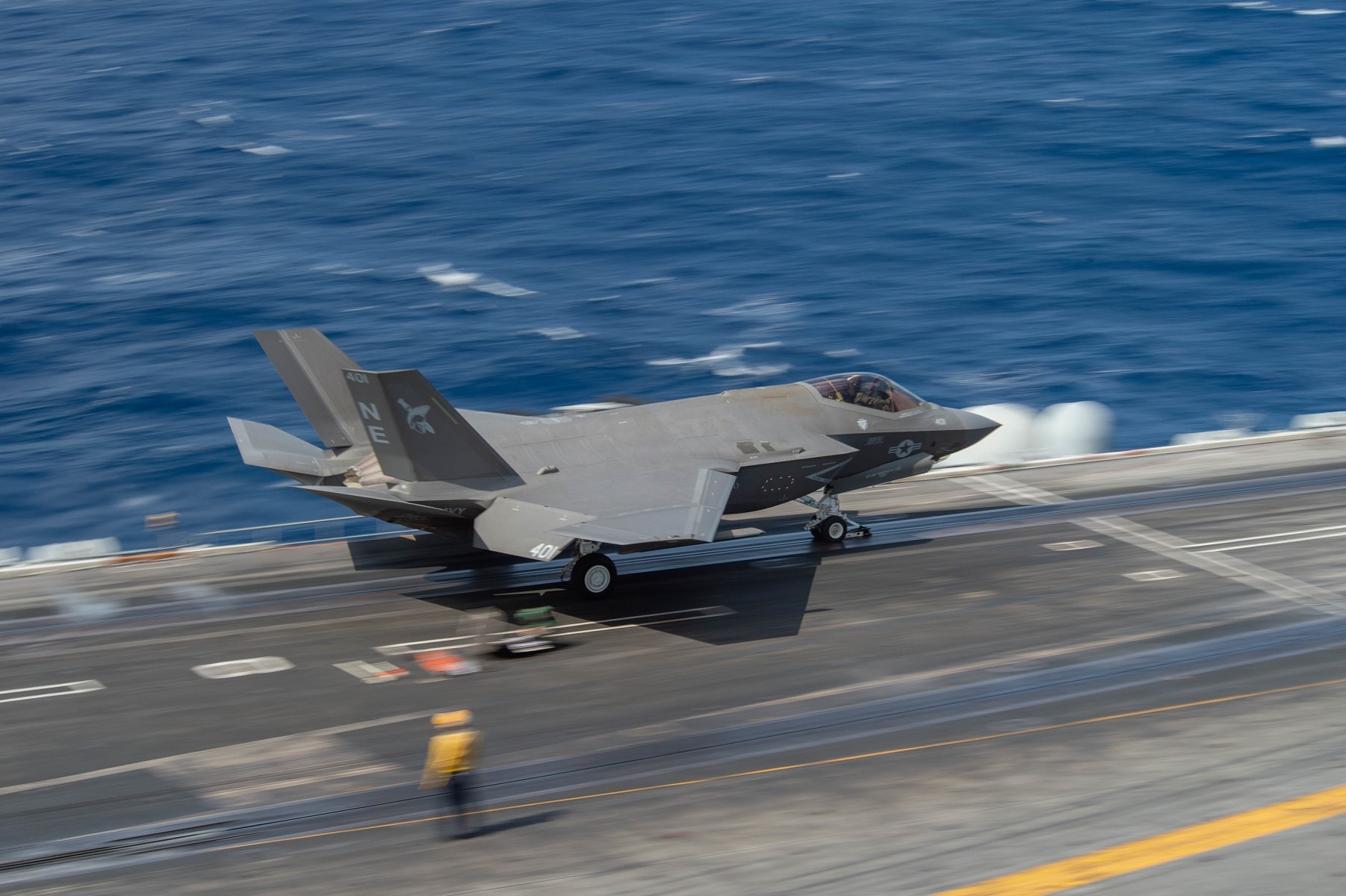
According to the Lockheed Martin’s “F-35 Fast Facts”, as of December 1, 2021, the F-35 stealth fighter’s Short-Takeoff and Vertical Landing (STOVL, or F-35B), and folding-wing aircraft carrier variant (F-35C) have achieved 8 out of 16 carrier activations and are active in 21 out of 30 bases around the world. The F-35s have achieved 463,000+ flight hours (and that number includes the conventional takeoff F-35As used by the Air Forces) in 267,263 sorties with 14 services flying the single engine, single pilot stealth fighter with 11 services declaring Initial Operating Capability (IOC) in nine nations. F-35s have seen six operational missions and 254+ detachments and deployments completed.
Meanwhile, production unit costs have shrunk for all variants as has the cost per flight hour while reliability and “maintenance man hours per flight” have steadily improved.
Aircraft carriers that currently have and are planned to operate the F-35Bs and F-35Cs are:
- USS Wasp (LHD 1)
- USS Essex (LHD 2)
- USS America (LHA 6)
- HMS Queen Elizabeth (UK)
- USS Carl Vinson (CVN 70)
- ITS Cavour (Italy)
- USS Makin Island (LHD 8)
- USS Abraham Lincoln (CVN 72)
- USS Tripoli 2021 (LHA 7)
- USS George Washington 2022 (CVN 73)
- USS Boxer 2023 (LHD 4)
- USS Theodore Roosevelt 2023 (CVN 71)
- USS Iwo Jima 2024 (LHD 7)
- USS Bataan 2025 (LHD 5)
- USS Gerald Ford 2025 (CVN 78)
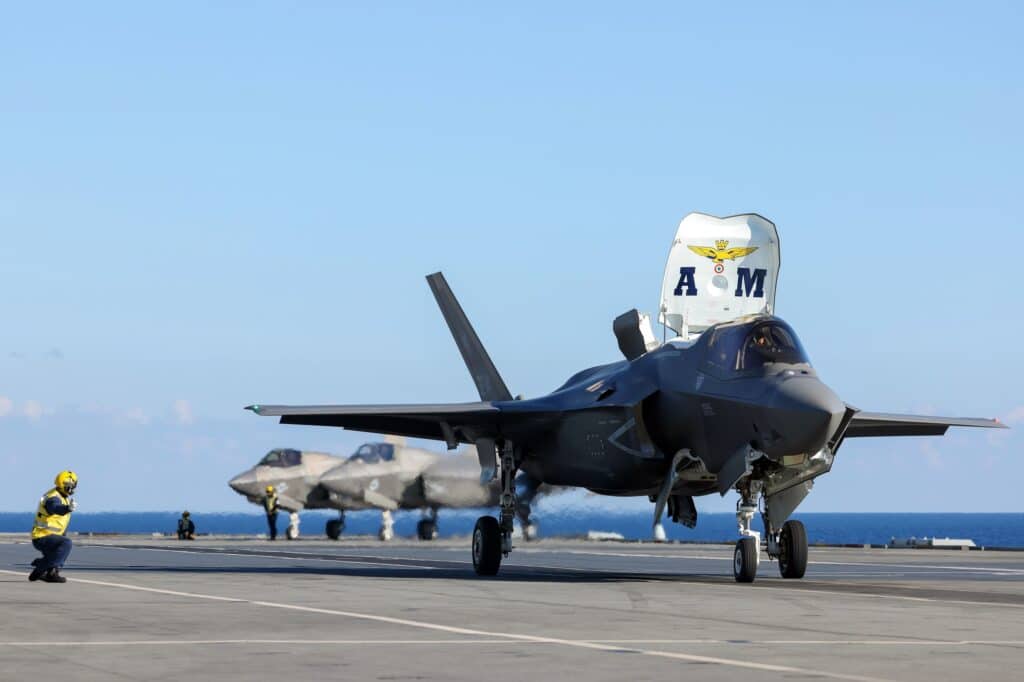
“The deployment of U.S. Marine Corps F-35Bs alongside British F-35Bs aboard UK’s HMS Queen Elizabeth is just one of many demonstrations of the F-35’s unmatched interoperability and deployability.”
Laura M. Seal, Public Affairs Lead, F-35 Lightning II Joint Program Office
Through various legal and illegal means, peer nations have copied the U.S.’s F-35 stealth fighter with copycat designs of their own that closely resemble the Lockheed Martin design. Some improvements to the original Lockheed Martin’s F-35 fighter design were made by the peer nations, such as twin-engines and possibly twin ejection seats, whereas analysts have determined weaknesses and areas of interest in other features of these F-35 stealth fighter copycats. Naval News has asked the U.S. Joint Program Office for comments on these peer nation copies.
“We are aware of China’s technology development.
The F-35 is unquestionably dominant on today’s battlefield. The F-35 Joint Program Office’s mandate is to preserve and grow that hard-earned combat edge and deliver game changing capability through the life of the program that is at every step more advanced than the ever-evolving capabilities of our competitors. We are doing that today through the development and integration of what we call the Block 4 suite of capabilities into the F-35. Once fully implemented, Block 4 will bring approximately 70 advanced, hardware-enabled and software defined capabilities, including 14 new weapons, to our global fleet. The rapid development and delivery of capability sets will continue beyond Block 4 throughout the lifetime of the program.”
Laura M. Seal, Public Affairs Lead, F-35 Lightning II Joint Program Office