Watching what lies beneath
Commander Submarines NATO (COMSUBNATO) operates within Allied Maritime Command (MARCOM) based in Northwood, UK, and serves alongside peer commands NATO Maritime Air and NATO Surface Forces to form the operational backbone of NATO maritime activities.
Rear Admiral Bret Grabbe assumed command as COMSUBNATO at the end of August 2024. Previously serving as Chief of Staff and Deputy Commander for the US Submarine Force, Pacific Fleet, his career as a US Navy submariner – stretching back more than 30 years – has involved multiple overseas deployments and strategic deterrent patrols in support of US, joint and coalition submarine operations in the Indo-Pacific, European, Central, and Africa Commands.
Speaking at the Navy Tech 2024 conference in Helsinki on 12 February, Rear Admiral Grabbe outlined his role within the broader MARCOM construct. “As COMSUBNATO, my primary role is coordinating and managing all the NATO submarines that are opconned to us, and also anti-submarine warfare [ASW]. But one of my secondary roles is as a Maritime Component Commander.”
He expanded: “My boss, Vice Admiral Mike Utley [Commander, Allied Maritime Command], is the three-star Combined Force Maritime Component Commander. He’s the primary and principal advisor on all things maritime to SHAPE [Supreme Headquarters Allied Powers Europe] .
“Then there are five one-star officers that work for him, of which three have an operational role as the Maritime Component Commanders for the Joint Operations Areas [JOAs]. I am one of those, with responsibility for JOA Southeast [encompassing the Mediterranean].
“So it’s very important for me to not exclusively focus on anti-submarine warfare [ASW] or submarine operations, because at any given moment I might be called into action as the Maritime Component Commander for my respective area.”
Submarine nations

There are 14 submarine operating nations within the alliance, and on average COMSUBNATO has between three and five submarines opconned to his command at any given time: in time of crisis, this may grow to more than 30 boats if all regional plans are activated.
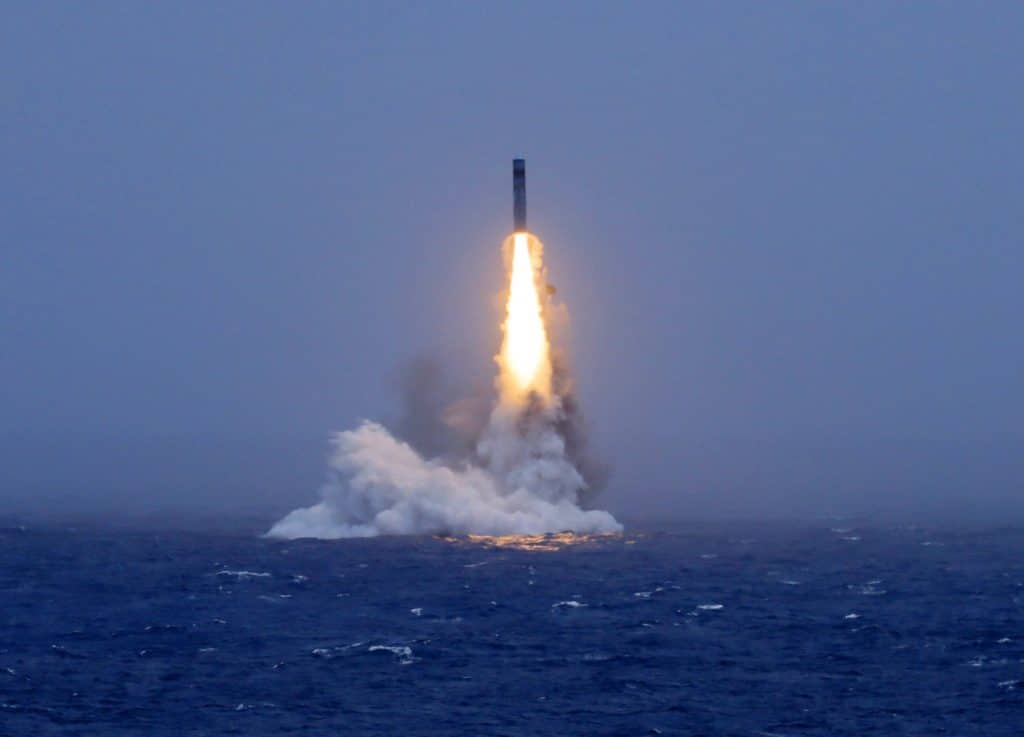
Submarines therefore continue to make a vitally important contribution to NATO operations. According to Rear Admiral Grabbe, this reflects their unique combination of stealth, sensing and firepower.
“We have a lot of systems across all domains,” he told Naval News. “Some are overt and obvious, and some are covert and less obvious. And it’s the covert piece I think that helps add to our deterrent effect.
“When you have [submerged] vessels that are moving around with capability to take out any target, whether it’s on the surface of the sea, below the surface, or on land, you know that’s [having] a deterrent effect.
“We can also gather intelligence and maintain good situational awareness on the adversary’s activities below the surface of the sea. So you can put a submarine in place ‘up close and personal’ where you just can’t put a surface ship. It means we are able to get into some places and create doubt for the adversary, create dilemmas for the adversary, and then have that deterrent effect of being able to strike from anywhere. I think that’s very important aspect of our deter, defend and assure culture.”
At the same time, Rear Admiral Grabbe acknowledged that the submarine has its own limitations. “When we’re talking ASW, the submarine itself is not a good search tool,” he said. “It’s a good sensor once you have contact. It’s definitely the best platform to take out another submarine…the heavyweight torpedo is the best kill tool.
“But from the search perspective…surface ships and submarines are our big wide area sensors. So it’s the packaging of all these different assets together is what gives us in NATO our big ASW capability.” He continued: “In my nine months in MARCOM we’ve been able to accomplish hundreds of days of submarine tracking. From my desk, not only are we operating as a CTF with all the NATO submarines that are working with us, but anytime the adversary gets underway submerged it’s our responsibility for ASW track of the adversary. In this theatre, it’s mostly Russia, although we’re prepared for anyone who comes in.”
Adversary challenge

The adversary challenge in the Euro-Atlantic is becoming more complex and diverse. At a peer level, the challenge comes from a qualitatively improving Russian submarine force. “You know, the Cold War may have ended quite a long time ago, but the Russians never stopped putting energy and effort into their capital ship, which is for them the submarine,” said Rear Admiral Grabbe. “In my career, I have not seen any change in their desire to maintain a competent submarine force, and that continues to this day. Their submarine force puts a lot of effort and energy into that.”
Nation states are also facing a growing hybrid – or ‘grey zone’ – challenge. “These are actions that someone takes to try to keep us off our game,” Rear Admiral Grabbe explained. “So we’re paying close attention to this, and monitoring closely.
“But for gray zone activities, we’re largely there to help monitor, to provide information, to change behaviour, and to assure partners, and to able to defend and deter. It is, however, individual nations who are doing the investigation and attribution.”
Critical undersea infrastructure (CUI) security is emblematic of the gray zone challenge, and a vulnerability that has been occupying minds in NATO for some time. Recent months have seen its profile increased after a series of incidents in northern European waters in late 2024, said COMSUBNATO. “From a NATO perspective at MARCOM, its irrelevant to us whether this is intentional or accidental. It’s up to the individual nations to investigate at a national level, but from a NATO perspective we’ve put ‘Baltic Sentry’ together at short notice in order to start training the appropriate behaviour in our mariner traffic.
“The critical point for us [at NATO] from an attribution perspective is timely reporting. Within minutes of something happening, we were getting reporting from the nations.”
He added that ‘Baltic Sentry’ is predominantly employing assets from the mine countermeasures community. “This is a group of people used to operating ROVs for a living, and surveying at an exquisite level of detail. That capability is easily translatable.” Read Admiral Grabbe acknowledged that the crewed submarine has a relatively small role to play in CUI security, while noting the potential of uncrewed systems going forward. ”The adversaries all operate their own programmes which deal with things on the seabed, and so we can use manned submarines to mark where and when that’s happening,” he said. “But I would not say that is its primary role. What I do see a growing role for robotic and autonomous systems in [surveillance and protection of] critical undersea infrastructure.”
Baltic focus

The Baltic Sea is an area of increased focus for COMSUBNATO. It is a busy area for commercial maritime traffic, with approximately 2,000 vessels in its waters daily. It presents a complex and challenging operating environment given its unique geography, temperature and salinity. And it is the maritime ‘backyard’ of Sweden and Finland, NATO’s two newest members.
Sweden is the latest submarine operator to join NATO, and Rear Admiral Grabbe is fulsome in his praise for its contribution. “This is a force multiplier with exponential gains for us,” he said. “Sweden, as a submarine force, was opconned to NATO on their first day in the alliance. That was quite an impressive feat. You can imagine, just on the administrative front, all the things that had to come together for that.
“But I say that because it expresses the motivation and support that Sweden has given, not just to NATO, but to the submarine force in particular.
“Sweden has operated in the Baltic since the beginning of their submarine force. They’re experts in this area, they contributed a submarine to our first ‘Merlin’ exercise, and they’re great partner to have on board.
“They also contribute staff. We had Swedish officer into the office the day they joined NATO, and we have another one coming this summer, just in the council. So we’re certainly happy to have them on our side.”
Although not a submarine operator, Finland’s accession to NATO has also changed the dynamic in the Baltic, said Rear Admiral Grabbe. “The Finnish Navy brings other strengths that may not be so obvious with regard to their knowledge and experience base, and their support structure. They also bring an outstanding capability in mine warfare.
“So Sweden and Finland together have essentially turned the Baltic into a NATO lake. Their knowledge and experience of this environment is the thing that kind of tips the scale when you add them into the mix.”
It is a reflection of the growing importance of the Baltic that MARCOM has established ‘Merlin’ as its third annual ASW-focused regional exercise alongside the long-standing ‘Dynamic Mongoose’ (North Atlantic/High North) and ‘Dynamic Manta’ (Mediterranean). The first ‘playbook activity’, ‘Merlin 24’, ran in waters off Sweden over a four-day period in November last year and involved participation from 10 NATO navies.
“These exercises are not just good for the 14 nations that have submarines, but they’re also good for all 32 of our allies in NATO because it gives opportunity to train in the ASW realm,” said Rear Admiral Grabbe. “With the addition of Sweden and Finland to NATO last year, we’ve added ‘Merlin’ in the Baltic.
“So before ‘Merlin’, the individual countries had the experience, but we just didn’t have it as NATO. What you have to remember is that the environment really matters when you are doing ASW. So we need to build our knowledge together in this operating area.”
He continued: “There is some planning and process to go through to formally establish [‘Merlin’ as] a NATO exercise, and we’re still working through that. But despite the fact that we’re still going through those formal steps, we were able to have a very robust ASW exercise in the Baltic at the end of last year. “And we’re actually learning a lot immediately. The nations that are there all know how to operate in the Baltic, but when you put them together with some ASW and submarine capability, and you expose that to the rest of us, it becomes a great learning opportunity. It is removing any space where the adversary could hide in the NATO area of responsibility…there’s no corner where we are not able to watch what’s happening.”