Lockheed Martin successfully delivered the first Aegis System Equipped Vessel (ASEV) shipset comprised of four AN/SPY-7(V)1 radar antennas to the Japan Ministry of Defense (JMOD).
Lockheed Martin press release
The delivery was facilitated through Mitsubishi Corporation under a Direct Commercial Sale arrangement after rigorous acceptance testing.
“The successful on-time delivery of all antennas for the first ASEV showcases the maturity and scalability of the SPY-7 radar as well as production capacity, while also demonstrating Lockheed Martin’s dedication and expertise in system integration,” said Chandra Marshall, vice president of Multi-Domain Combat Solutions at Lockheed Martin.
The JMOD is acquiring two ASEVs, and both are on track for commissioning in Japan Fiscal Year 2027 and 2028. Marshall continued, “We will continue full system integration and testing with all four antennas at the Production Test Center in Moorestown, New Jersey this year, prior to equipment delivery to Japan, which will significantly reduce integration risk and enable commissioning on schedule.”
The SPY-7 Advantage
With advanced detection and tracking capabilities, SPY-7 effectively counters complex threats, enabling simultaneous engagement of multiple targets and delivering a robust 21st century security capability that enhances the effectiveness of naval forces in an increasingly uncertain and dynamic environment.
In addition to Japan’s ASEVs, the SPY-7 radar is also being produced for Canada’s River-Class Destroyers, Spain’s F-110 Frigates, and the land-based version has been deployed by the Missile Defense Agency for the Guam Defense System (TPY-6) and the Long-Range Discrimination Radar. The selection of Lockheed Martin’s solid-state radar by both the U.S. and multiple international allies demonstrates the world-class capability and maturity of the radar. In December 2024, Lockheed Martin’s land-based version of the SPY-7 radar, known as TPY-6, successfully intercepted a mid-range ballistic missile as part of the Aegis Guam System during a flight experiment Flight Experiment Mission-02.
-End-
Naval News comments:
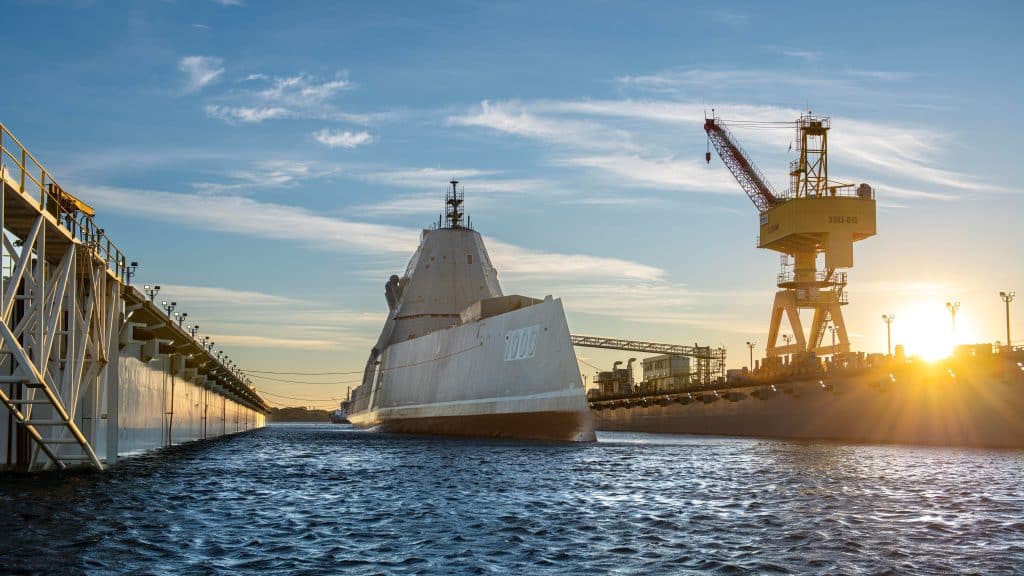
According to the Japanese MoD, the size of the ASEV is 190 meters in length, 25 meters in width, and a standard displacement of 12,000 tons. In comparison, the JMSDF’s latest Aegis ship, the Maya-class, is 170 meters in length, 21 meters in width, and has a standard displacement of 8,200 tons. The ASEV is also 1.7 times larger than the U.S. Navy’s latest Aegis ship, the Arleigh Burke Flight III, in tons.
The ASEV vessels will feature an impressive 128 Vertical Launch System (VLS) cells. This is more than the Maya-class destroyer’s 96 cells of Mk41 VLS (64 cells forward and 32 cells aft).
Check out our interview with Lockheed Martin on ASEV and SPY-7 at DSEI Japan: