The UK Royal Navy (RN) is aiming to push forward three uncrewed systems programmes at sea over the next two years, as it looks to autonomy to help accelerate warfighting readiness and scale, the head of the naval service told the DSEI UK defence exhibition in London.
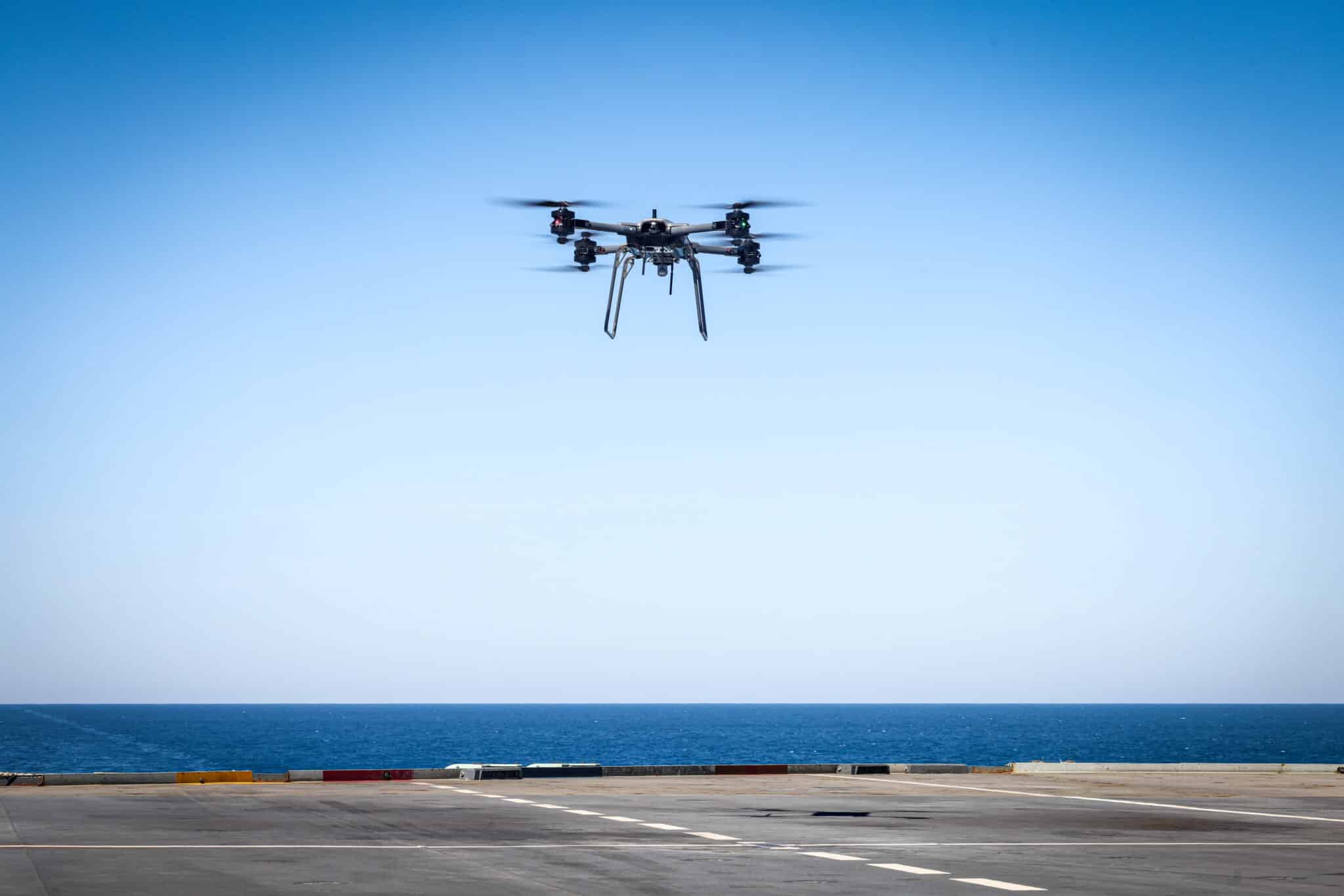
The developments will include testing of an uncrewed aerial vehicle (UAV), development of an uncrewed surface vessel (USV), and deployment of uncrewed underwater vehicles (UUVs), General Sir Gwyn Jenkins – First Sea Lord and Chief of the Naval Staff – told the DSEI audience, in his keynote address.
These developments illustrate the multi-domain impact maritime uncrewed systems will have on RN operational outputs. They also underscore what will be a key tenet of the RN’s focus during his tenure as First Sea Lord, said Gen Jenkins – namely, the role of innovation in what the navy uses and how it uses it, to adapt at the pace of technological change.
“We need to do things differently to grow and diversify the fleet, to speed up the development of new capabilities and technologies by working with [industry] to improve the flexibility with which we create, operate, and improve the means we need to be able to fight and win,” said Gen Jenkins.
This emphasis is reflected in the three uncrewed system developments, that reflect in turn the UK Strategic Defence Review (SDR) direction that the RN will evolve into a crewed/uncrewed ‘hybrid’ navy.
SDR, published in June, trailed the RN’s development of a hybrid airwing for the UK’s carrier strike group (CSG). The RN has been trialling UAVs from its carriers for some time, and the currently underway CSG25 deployment has included UAV testing for at-sea re-supply. “We will have a hybrid airwing by the end of this decade,” said Gen Jenkins. A next step in this development process is the aim to launch a jet-powered UAV as a concept demonstrator from a Queen Elizabeth-class carrier next year, he added.
In the future, the CSG will include the Type 26 anti-submarine warfare (ASW) frigate. The Type 26 will also be used for independent surface action group activities. Here, Gen Jenkins said, “Imagine in the future a Type 26 [in] the North Atlantic … sailing in company with two uncrewed escorts using artificial intelligence (AI) to work in tandem with the warship. Together, they provide a three-ship task group.” The USVs will bring sensors, weapons, and decoys to augment the frigate’s capabilities, he explained.
“It is my aim to have the first of our uncrewed escort ships sailing alongside our RN warships within the next two years,” said Gen Jenkins. “We will then begin scaling across the navy.”
Underwater – again, as heralded in SDR – the RN will look to bring UUVs together to provide massed sensing capability to support its ‘Atlantic Bastion’ operational concept. The concept is designed to blend crewed and uncrewed platforms in a ‘system of systems’ network stretching from the Mid-Atlantic Ridge to the Norwegian Sea to find, track, and (if needed) act against underwater targets, Gen Jenkins explained. “We will have our first Bastion sensors in the water next year,” he added.
These three examples illustrate the RN’s wider concept for using uncrewed systems.
“We will be guided by a simple but powerful principle: uncrewed wherever possible; crewed only where necessary,” said Gen Jenkins. “We will move to a dispersed but digitally connected array of crewed, uncrewed, and autonomous platforms that will redefine military power.”
“But let me be really clear. This is not an aspiration for some distant point in the future. It is a necessity now,” he concluded. “This will create a larger and more lethal fleet with greater agility and resilience, and it is a move that will start while I am First Sea Lord.”