Syos, a tech startup originating from New Zealand but also with offices in the UK and Ukraine, has rapidly honed in on unmanned surface vessels (USV) as an area of growth for the company. It has produced dozens of craft for customers in the past year alone.
This was exemplified in a recently conducted demonstration with the Royal Navy (RN). In the trial lasting three days, five 7.2m-long Rattler USVs creating a “wolf pack” successfully escorted two RN offshore patrol vessels pretending to be interloping Russian warships.
After departing Portsmouth, the five RHIB-based USVs provided by Syos had travelled to Scotland by sea, before swarming and escorting HMS Tyne and HMS Stirling Castle off the coast of Scotland.
Furthermore, these USVs were commanded by personnel located 800km away at Portsmouth Naval Base. For the sake of this trial, each USV was operated by two personnel – one piloting the vessel and the other monitoring onboard systems.
The RN described it as a milestone demonstration of how it could utilise such technology in a real-life scenario. The demonstration was a culmination of months of trials by the navy’s Disruptive Capabilities and Technology Office and the Fleet Experimentation Squadron.
Of the event, Brigadier Jaimie Roylance, RN Chief Technology Officer, said it was “an important moment in the history of the Royal Navy. It’s the first time we’ve been able to field a capable, mission-ready, deployable uncrewed system at sea…”
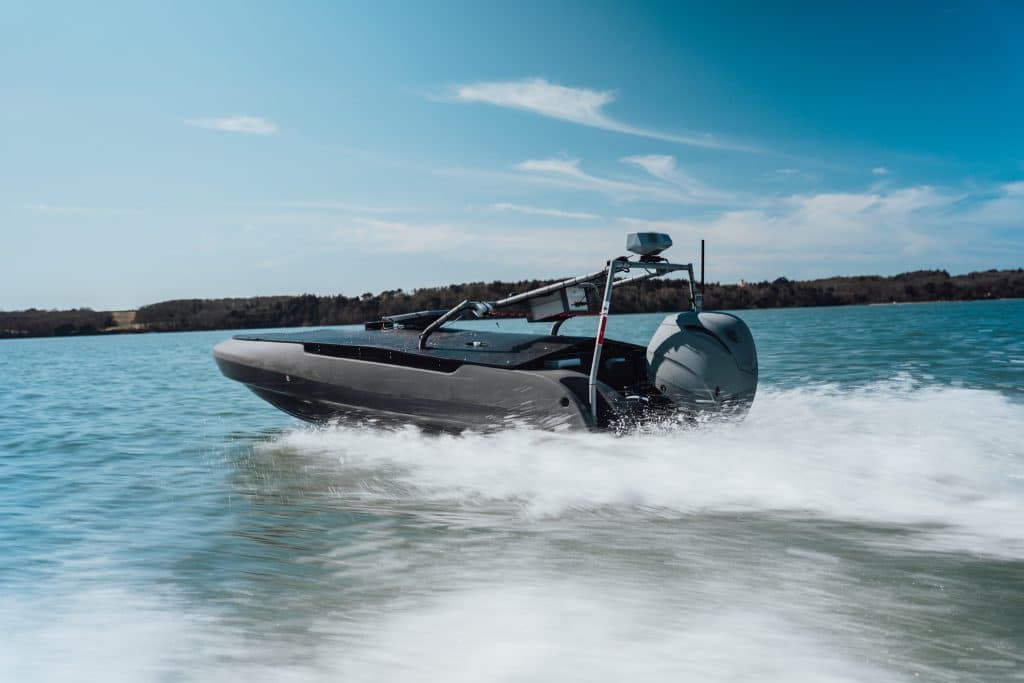
What makes it even more remarkable is that it took Syos just two months to develop and ready the USVs. Furthermore, Syos only moved into USV development two years ago, on the back of previous success with unmanned aerial vehicles.
Speaking to Naval News, Sam Vye, CEO of Syos, said the company had produced more than 140 USVs in the past twelve months. It is understood many have ended up in the hands of Ukraine as it defends against a Russian invasion.
Vye said his company had gained significant knowledge of tactics, techniques and procedures from operations in Ukraine that help to spirally improve its products. An example from its portfolio is the SM300 USV, with a 650nm range and 300kg payload, that can be acquired for around US$210,000.
Vye noted that his company has chosen a particular niche, that of rapid development and offering customers a minimum viable capability. The company highlighted five points that make Syos unique: its rapid spiral development; mass production on tap; autonomy at the heart; affordable mass; and evidence of capability in operationally fielded products.
Another example of this ability is a new airborne interceptor designed to intercept Shahed drones over Ukraine.
Its USV control systems are agnostic as to platforms and sensors, and Vye said Syos is currently working on a medium-sized USV technology demonstrator. It will have a range of 2,000kt at 20kt, and the platform will be suitable for patrol and escort missions.
Syos Aerospace has delivered low-cost quadcopters to the New Zealand Defence Force (NZDF), and it was exhibiting its maritime solutions at Indo-Pacific 2025 in Sydney from 4-6 November. It is in talks with the NZDF about maritime unmanned programmes, and it sees opportunities in the Australian market too. Too, there is a need for sustainable uncrewed vessels to help Pacific Islands monitor fisheries and illegal activities, for example.
At Indo-Pacific 2025, the company demonstrated operating one of its USVs based in the UK via an operator in the exhibition hall. This means control of the vessel was essentially being performed from the opposite side of the world.