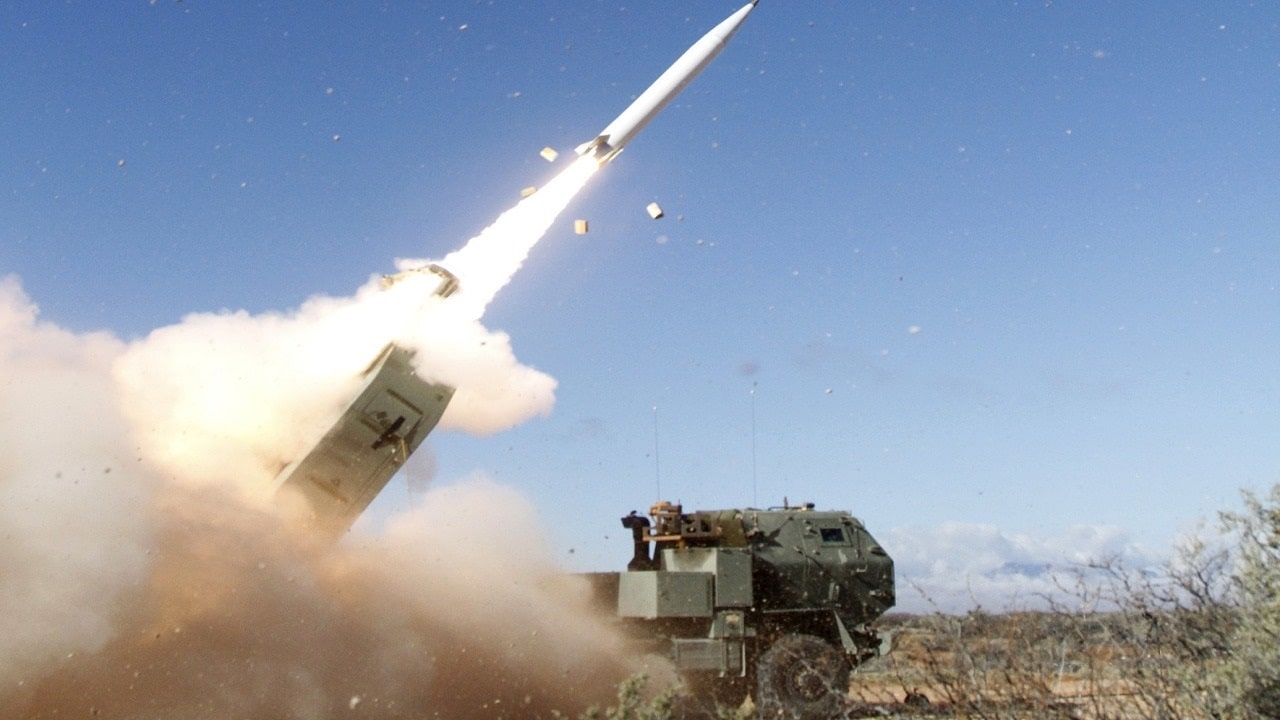
The U.S. Army wants to accelerate the development of a Precision Strike Missile (PrSM) anti-ship variant capable of being fired from the service’s highly mobile rocket launchers and striking maritime targets over a thousand kilometers away, according to a recent notice.
PrSM Increment (Inc) 4 is envisioned to equip the ubiquitous High Mobility Rocket Artillery System (HIMARS) and Multiple Rocket Launch Systems with a next-generation long-range strike ability to target moving maritime and ground targets, a mission set that the Army has deemed crucial for expedited early operational capability. The fly-off, a term used for a competitive evaluation between competing firms, for this variant of PrSM will be held by the fourth quarter of 2028.
PrSM Inc 4 will provide commanders with an extended range weapon system capable of penetrating Anti-Access/Area Denial environments and accurately striking stationary, moved, and moving targets, independent of GPS, in maritime and land domains.
Previous contract documents noted that the service eyed an initial operating capacity by late 2029. Naval News covered Lockheed Martin’s PrSM Inc 4 proposal, a ramjet-powered ballistic missile, at AUSA 2025. The American defense contractor also noted that its munition did not utilize boosters, which it claimed that other firms were using in their designs.

This increased demand signal comes amid an overall American shift to bring forces geared against China’s naval forces in the Indo-Pacific via littoral and archipelagic areas across the first island chain, which Washington wants to use to deter Beijing. PrSM Inc 4 is among several sophisticated long-range precision munitions pursued by the Army in recent years to capitalize on ground-based fires to combat Chinese maritime forces.
Some of these systems have raised protests from Beijing due to their deployments in the Philippines and Japan, particularly the Multi-Domain Task Force’s (MDTF) Mid-Range Capability. Also known as Typhon, the containerized Mark 41 vertical launching system deploys Tomahawk cruise missiles and Standard Missile-6 in land attack and maritime strike roles. The first deployment of this system to the Western Pacific occurred during Balikatan 2024 on Luzon, and was quickly followed by further regional appearances in 2025. A live-fire of an SM-6 from the system was held in Australia for Exercise Talisman Sabre, which the Army used to demonstrate their ground-based maritime strike capability.
Another notable system is the Dark Eagle Long-Range Hypersonic Weapon, a 3,500-kilometer range missile that can rapidly strike targets on the Chinese mainland if deployed to Guam. The Army currently stages one of these hypersonic batteries from the 1st MDTF on the U.S. West Coast.
Increasing U.S. Anti-Ship and Area Denial Potential in the First Island Chain

While U.S. forces arrayed against China are slated to have mid-range and hypersonic capabilities via specialized launchers, PrSM will be able to be fielded on the service’s widespread missile launchers, greatly increasing the deployment schemes of U.S. maritime strike potential across the Indo-Pacific.
HIMARS rapid insertion drills, also known as HIRAIN, have been drilled by American troops, airmen and Marines for years. When paired with the launcher’s ability to be carried by C-130s and small watercraft, PrSM Inc 4 can be rapidly deployed by forces operating in the first island chain. Last summer, the first HIMARS Direct Reload Inside Plane procedure was conducted during drills in Japan, proving a rapid reload capability with Super Hercules aircraft.
With its envisioned 1,000 kilometer range and maritime strike capability, American HIMARS strategically positioned within or near at maritime areas- such as the Luzon and Miyako Straits – can perform anti-ship missions against Chinese forces attempting to transit these first island chain chokepoints. Their extended ranges can also enable potential fire missions into the Taiwan Strait in support of anti-invasion efforts.