On March 23, the Japan Maritime Self-Defense Force (JMSDF) formally disbanded its long-standing “Fleet Escort Force” (護衛艦隊) and established a new “Fleet Surface Force” (水上艦隊), marking its most sweeping organizational overhaul since 1954.
The reform also includes the creation of a new “Information Warfare/Operations Command” (情報作戦集団), reflecting a shift toward integrated, multi-domain operations.
End of a 60-Year Backbone
The Fleet Escort Force, established in 1961, had served as the backbone of Japan’s surface fleet for more than six decades. Its abolition—along with the Mine Warfare Force (掃海隊群)—marks the end of a defining institutional framework.
In its place, the Fleet Surface Force consolidates all surface combatants and mine countermeasure units under a single command.
At the heart of the restructuring is the consolidation of four Escort Flotillas into three Surface Warfare Groups.
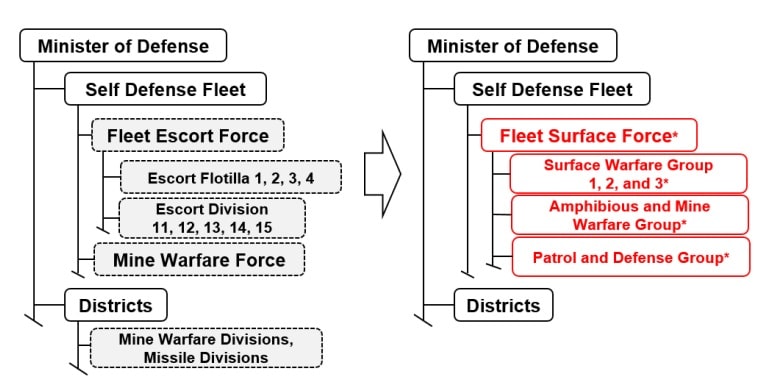
Under the previous system, each flotilla consisted of a helicopter destroyer (DDH), two Aegis destroyers (DDG), and five general-purpose destroyers (DD). The new structure retains roughly the same number of ships and personnel but concentrates them into fewer formations.
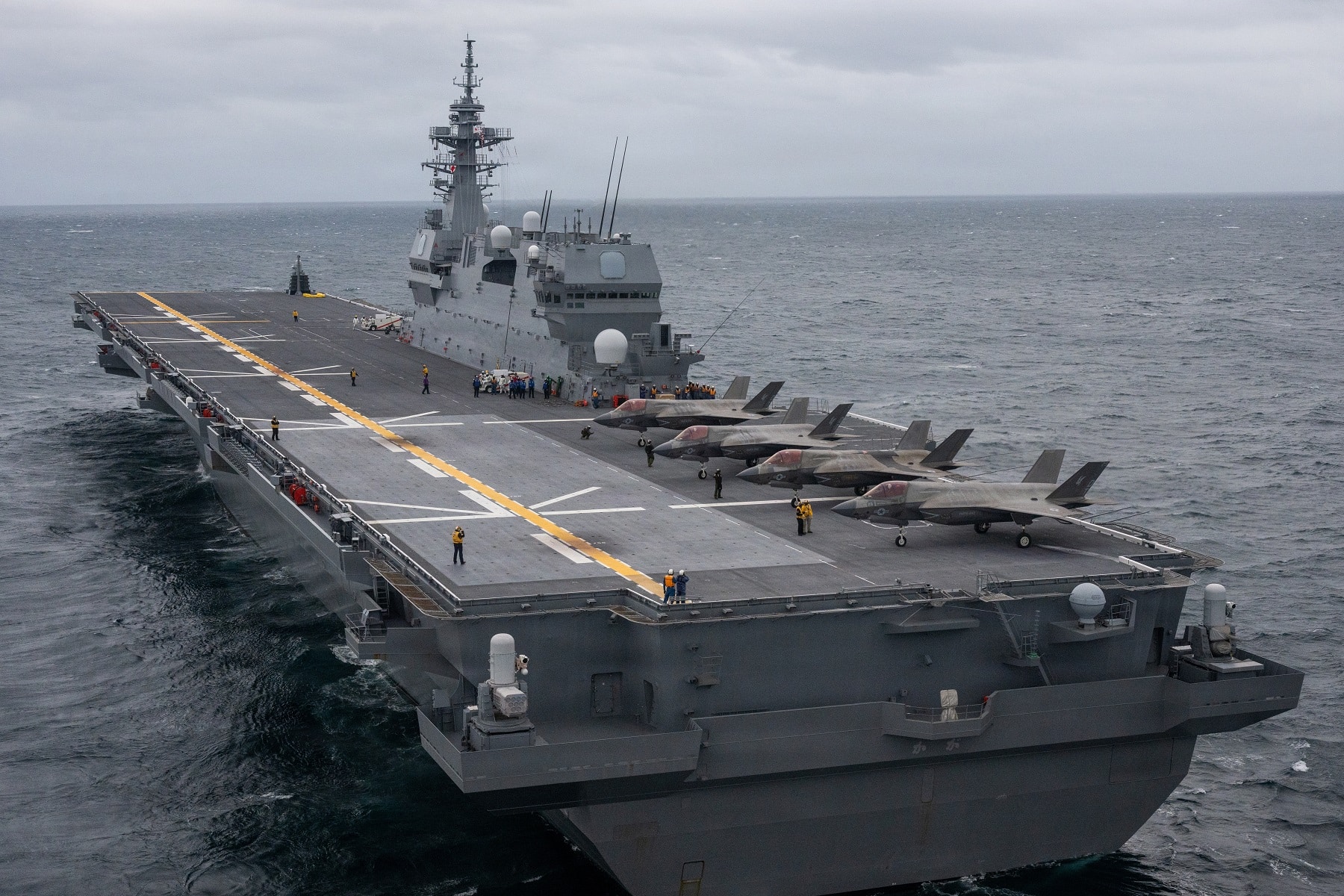
Under the reorganization, Surface Warfare Group 1 is based at Yokosuka and operates with the helicopter carrier JS Izumo (DDH 183) as its flagship. Surface Warfare Group 2 is based at Kure, with JS Kaga (DDH 184) serving as flagship, while Surface Warfare Group 3 is headquartered in Maizuru, led by JS Hyuga (DDH 181).
JMSDF Chief of Staff Adm. Akira Saito emphasized that this is not a downsizing but a redesign.
“The only number decreasing is the number of groups,” Saito said at a press conference on February 17, noting that overall ship numbers and personnel levels will remain largely unchanged.
Concerns Over Redundancy
Despite official assurances, the reform has prompted concerns among retired officers and defense analysts.
Critics argue that reducing the number of maneuver units from four to three could weaken operational redundancy, potentially straining sustainability during prolonged or simultaneous contingencies.
Saito rejected this view, arguing that redundancy should not be assessed solely by the number of command units, and pointed instead to increased “force density.”
Another concern centers on command relationships following the merger of the escort and mine warfare forces.
Under the revised framework, the Fleet Surface Force will act as a “force provider,” responsible for training and readiness, while operational commanders remain “force users.”
“The basic framework does not change,” Saito said, emphasizing continuity in operational command.
New Amphibious and Mine Warfare Group in Sasebo
As part of the restructuring, the JMSDF has established a new “Amphibious and Mine Warfare Group (水陸両用戦機雷戦群)”, headquartered in Sasebo, Nagasaki Prefecture on Kyushu Island.
This group integrates mine countermeasure vessels, transport ships, and amphibious capabilities, and include a Hyuga-class helicopter destroyer JS Ise (DDH 182) as its flagship.
It is designed to operate in close coordination with the Japan Ground Self-Defense Force’s Amphibious Rapid Deployment Brigade, also based in Sasebo.
The move reflects a strategic focus on Japan’s Nansei Islands, where rapid deployment, mine clearance, and limited amphibious operations could be critical in a contingency involving China.
Information Warfare Command
In parallel, the JMSDF established a new Information Warfare/Operations Command, integrating intelligence, cyber, communications, and oceanographic functions.
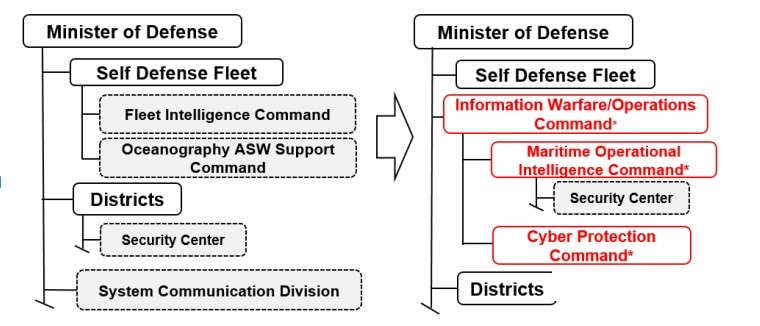
The command will serve as an operational hub for intelligence and C4ISR, but will not control ships or aircraft.
Saito has identified three key drivers behind the move: the establishment of a unified command to ensure coherent and sustained operations and to remedy organizational fragmentation; the growing need for cross-domain integration; and the absence of a senior information commander equivalent in rank to counterparts in allied navies – most notably the U.S. Navy.
The overhaul represents a shift in how the JMSDF generates and employs combat power.
While the number of surface groups has decreased, the JMSDF maintains that the reform will enhance flexibility and readiness without increasing fleet size.
Its effectiveness will ultimately be tested in real-world operations, particularly in scenarios involving simultaneous contingencies.