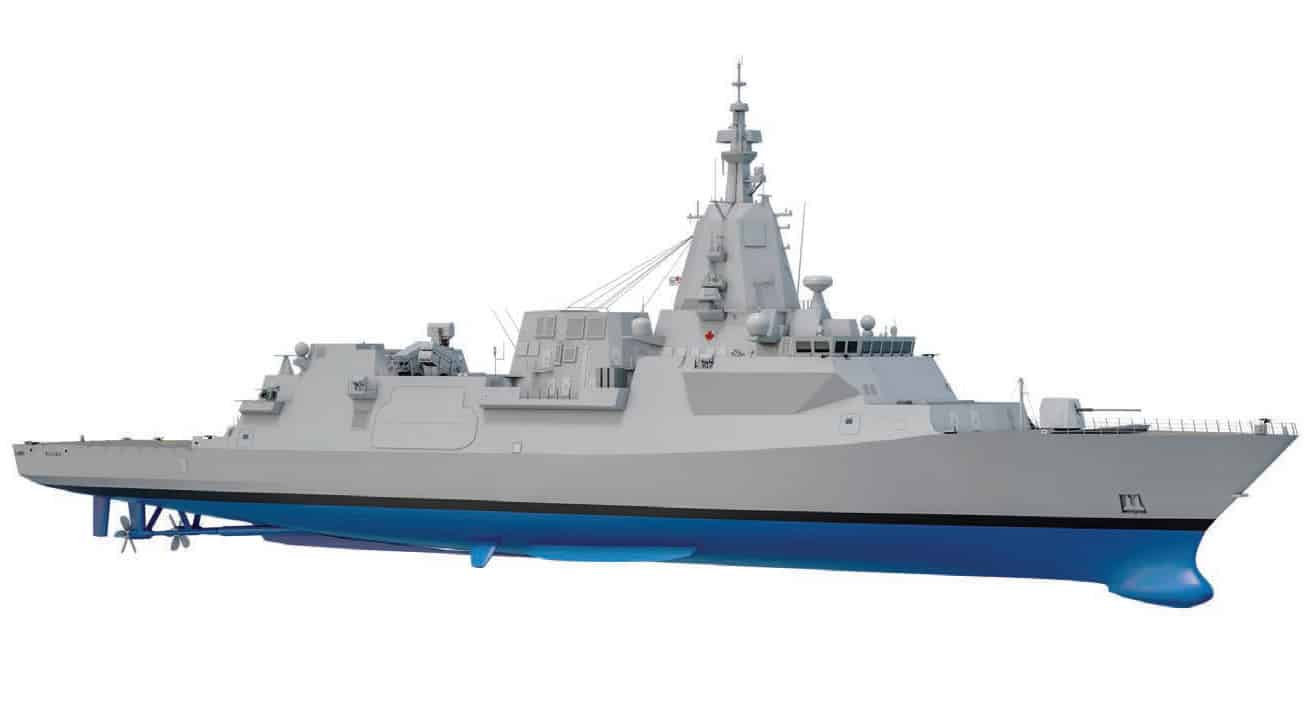
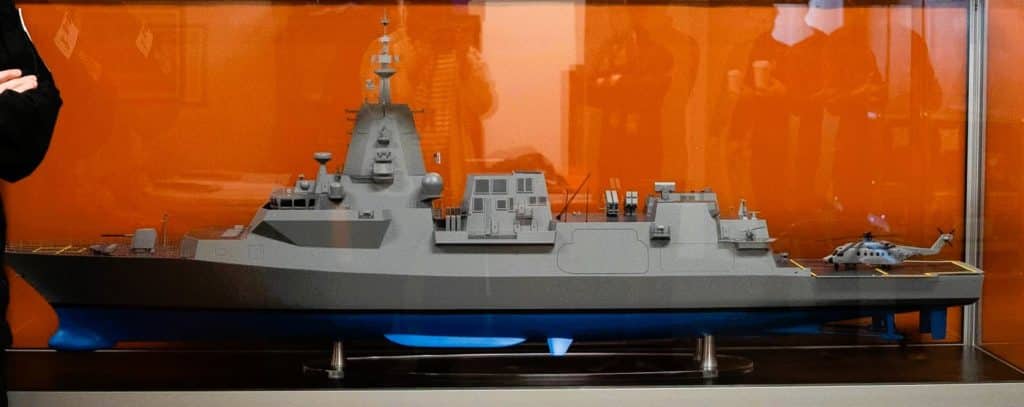
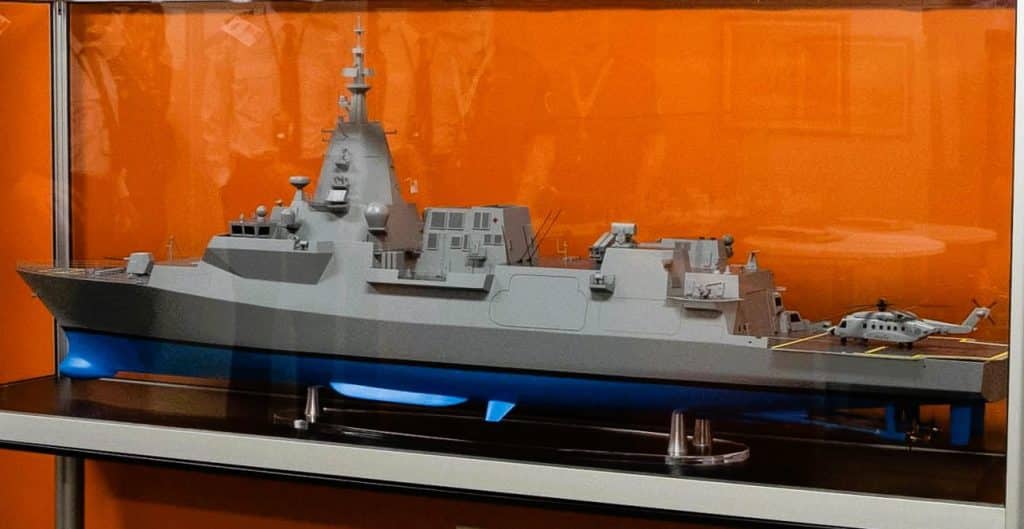
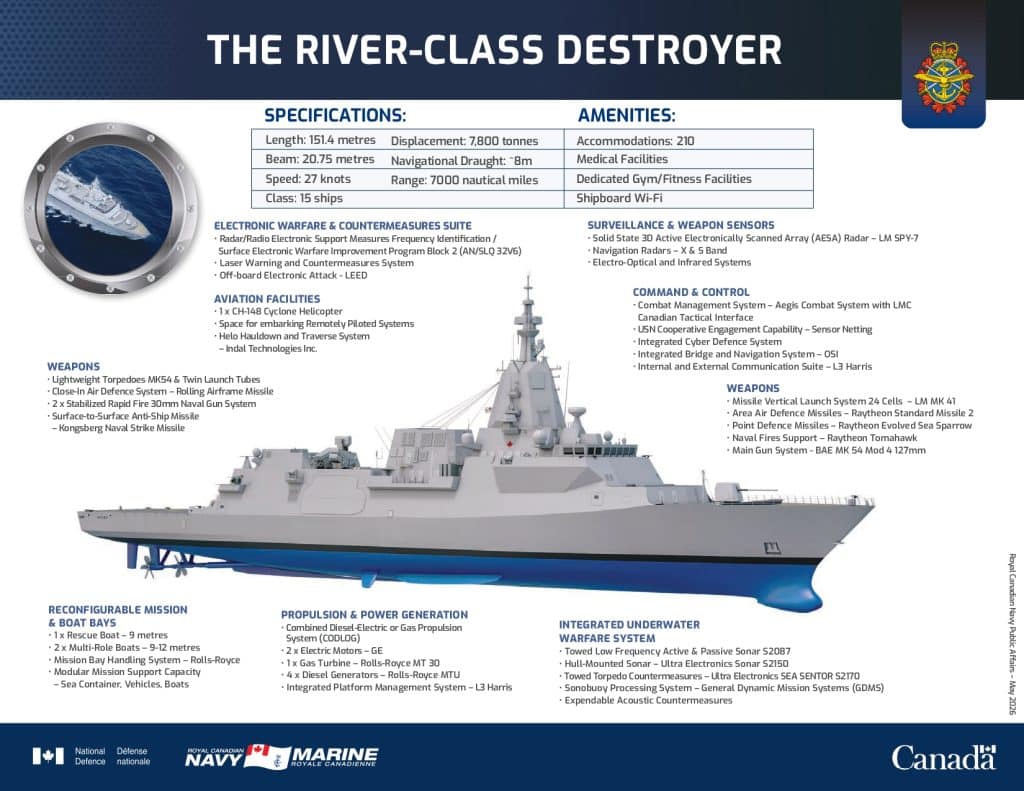
Canada’s new River Class Destroyer (RCD) has continued to evolve its weapon and sensor fit. Updated CGI released in May, corroborated by a physical scale model showcased earlier this year by the Royal Canadian Navy, revealed further changes to the combat system solution embodied in the design.
The latest revisions—including equipment swaps for both the medium-calibre gun system and small-calibre gun system—continue a rescoping process that is migrating RCD to a combat system configuration largely based on military off-the-shelf (MOTS) systems already integrated with the US Navy’s Aegis combat system and/or the Type 26 parent design. The decision to drop a number of previously selected equipment in favour of MOTS alternatives reflects a drive to reduce cost and schedule risk, and engineer greater commonality with allied navies and other Royal Canadian Navy (RCN) platforms.
River-class Destroyer Production Schedule and Milestones
Designed to replace the RCN’s 12 current Halifax-class frigates and four now retired Iroquois-class destroyers, the River-class Destroyer programme involves the build, integration, and delivery of 15 new surface combatants based on the same platform as the Royal Navy’s Type 26 frigate. Irving Shipbuilding Inc. will build the ships at its facility in Halifax, Nova Scotia, as part of the National Shipbuilding Strategy; Lockheed Martin Canada leads the associated industry design team selected to deliver the ship design.
Lockheed Martin Canada—leading a team comprising BAE Systems, CAE, L3Harris, MDA, and Ultra Maritime—was in 2019 contracted to develop and deliver the RCD design (at that time known as the Canadian Surface Combatant or CSC). As nominated design team lead and combat systems integrator, Lockheed Martin Canada has gone on to work with Irving Shipbuilding and government to mature and finalise both the platform design and combat system architecture.
Irving Shipbuilding initially commenced construction on a Production Test Module (PTM) in June 2024 before moving to full-rate production of HMCS Fraser in April 2025. On June 12, 2026, Canada marked the formal start of the warship’s build with Fraser’s ceremonial keel laying. The vessel—the first of three Batch 1 ships ordered in March 2025—is projected for delivery in the early 2030s.
Shift to Aegis MOTS Baseline
The original bid concept design put forward by Lockheed Martin Canada for CSC included a “hybrid” combat system architecture with bespoke delineation of functions between a Lockheed Martin Canada-supplied CMS 330 combat management system (CMS) and the Aegis Fire Control Loop (the latter being acquired through a US Foreign Military Sales [FMS] case to support the anti-air warfare [AAW] mission). The other key element of the proposed core combat system was the Lockheed Martin Rotary and Mission Systems AN/SPY-7(V)3 S-band active electronically scanned array 3D multifunction radar (acquired under the same FMS case).
Capitalising on the proven integration with Aegis, Canada initially baselined the Evolved SeaSparrow Missile (ESSM) Block 1 and ESSM Block 2 missiles for point defence/local area defence, and the Standard Missile-2 (SM-2) Block IIIB for medium-range air defence. It has subsequently pursued an FMS case for the new SM-2 Block IIICU dual-mode missile: ESSM and SM-2 missiles will be fired from three eight-cell MK 41 launchers positioned ahead of the bridge.
As regards offensive anti-surface warfare, the decision was taken to fit the Kongsberg Naval Strike Missile (NSM). The RCN also plans to integrate the Tomahawk cruise missile on the RCD.
Lockheed Martin Canada also selected a number of Canadian and European contractors to deliver key above-water weapon and sensor systems for the CSC programme. These included MDA Space (given responsibility for electronic warfare [EW] system integration, laser warning and countermeasures, and co-development of an electronic attack [EA] subsystem in partnership with Lockheed Martin Canada); Leonardo (127/64 LW Vulcano medium-calibre gun system); MBDA (selected to supply its Sea Ceptor system to meet the CSC close-in air defence system requirement); and Safran (supplying its NGDS trainable decoy launcher system).
As regards underwater warfare, the decision was made to go for a bespoke anti-submarine warfare (ASW) sensor suite featuring Ultra Maritime’s towed low-frequency active sonar (TLFAS), bow-mounted Sonar 2150 medium-frequency sonar, and Sonar 2170/Sea Sentor torpedo defence system. This ASW sensor fit is complemented by a General Dynamics Mission Systems sonobuoy processing system.
However, the project has in recent years seen major revisions to the above-water warfare suite in an effort to reduce cost, schedule, and technical risk. One early outcome of this re-baselining exercise was the decision to reorientate the combat system architecture towards a full Aegis Combat System solution. Initial changes became evident in infographic materials issued in July 2024 to coincide with the RCD programme’s PTM milestone.
The DND told Naval News: “Decisions were previously made within the RCD Project team, jointly between Canada and industry, with support of the US Navy, to adapt the combat system architecture for the RCD in a manner that reduces developmental cost and schedule risk and more appropriately preserves the proven pedigree of the Aegis Weapon System, while retaining elements of the original Lockheed Martin Canada CMS, establishing an essential tactical interface to Aegis.
“Assessed as a vital and very significant risk reduction decision, design of the resulting solution is progressing at pace, in collaboration between the RCD project team (consisting of both government and industry) and the US Navy, to support full system integration initially within Canada’s Land-Based Test Facility at Hartlen Point (Nova Scotia).”
In advance of establishing the Hartlen Point facility, Lockheed Martin has established an Aegis Combat System Integration Centre in Moorestown, New Jersey. This new facility, opened in November 2024, is supporting early test and integration for the RCD programme.
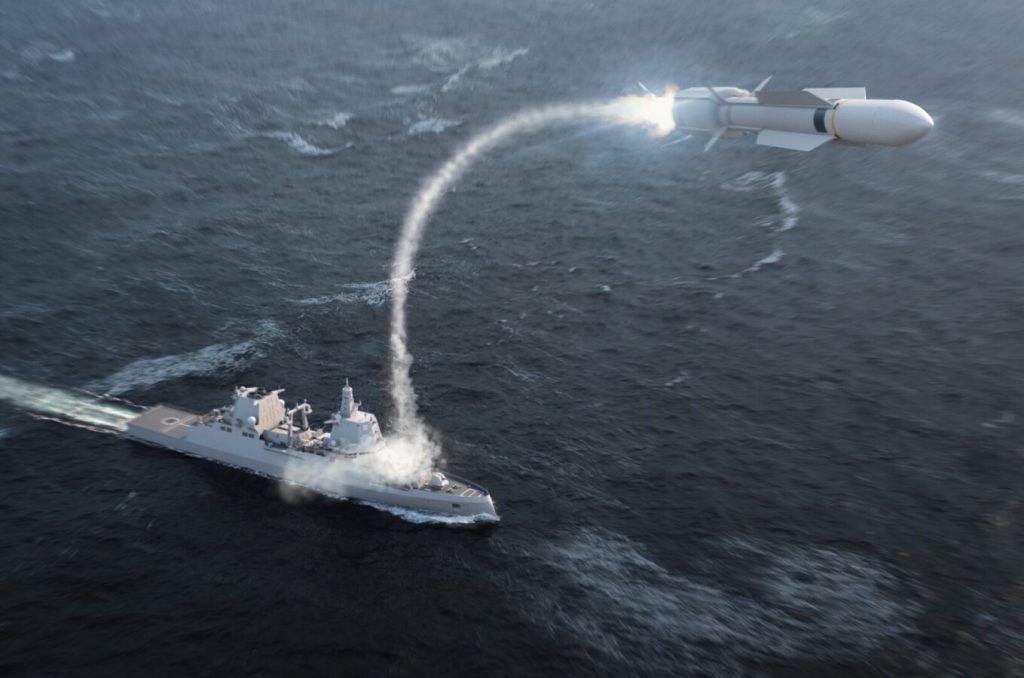
Attendant to the decision to move to a full Aegis fit, the RCD project revisited a number of earlier equipment selections to switch to MOTS alternatives already integrated with Aegis. For example, MBDA’s Sea Ceptor—the original selection to meet the CSC close-in air defence system requirement—was dropped in favour of the Raytheon RIM-116 Rolling Airframe Missile.
Another case in point is the EW/soft-kill suite. The decision has now been taken to integrate a MOTS electronic surveillance solution in the guise of Lockheed Martin’s AN/SLQ-32(V)6 system (already delivered into the US Navy under the Surface Electronic Warfare Improvement Program Block 2). The proposed onboard EA system has been shelved, being replaced by an offboard EA capability (now confirmed as the Long Endurance Electronic Decoy [LEED]), and the Safran NGDS decoy launching system dropped.
Above-Water Warfare & Sensors Updates
The social media debut of the new RCD physical model earlier this year, together with the CGI released in May, confirms further refinements and changes to the design. Naval News’ analysis of the model and CGI suggests the following key revisions, all of which substitute earlier selections with equipment common to the US Navy:
- Introduction of the BAE Systems MK 45 Mod 4 medium-calibre gun system and associated fire control (replacing the 127/64 LW Vulcano gun system).
- Introduction of the MSI Defence Systems MK 38 Mod 4 small-calibre gun system and associated fire control (replacing the Leonardo Lionfish 30/X).
- Introduction of the Ultra Maritime AN/SPS-73(V)18 Next Generation Surface Search Radar system.
- Introduction of the L3Harris MK 20 Mod 1 Electro-Optical Sensor System.
While the DND did not confirm specifics to Naval News, it did state that, as the project progresses through the design phases “it is expected and appropriate that elements of the design continue to be refined”. It continued: “We have continued to refine elements of the original design of the combat systems to manage technical, schedule, and cost risks.
“Any changes in and to equipment or the design for the RCD are carefully evaluated by the Government of Canada and industry experts so that modifications are based on informed decisions and the ship continues to comply with the operational requirements determined by the RCN.”
The latest RCD design baseline also shows revisions to the topside design. This includes refinements to the radar mast; repositioning of the NSM launchers (now mounted athwartships and offset to starboard atop the mission bay); and re-siting of the RAM launcher (now located on a platform offset to port atop the hangar roof). Another change is the addition of LEED launch canisters amidships.
According to the DND, the RCD design team undertook a final Critical Design Review (fCDR) in late March 2026 “confirming that the ship design has met the required level of maturity and completeness, while identifying and addressing any remaining issues”. It added:
“Following this [fCDR], the baseline is expected to remain stable, with any further changes tightly controlled and only introduced where necessary for risk reduction as the project progresses toward Final Design Review forecast for early 2028.”

River-class ASW Suite: Swapping Sonar Systems
Alongside changes to the above-water warfare system, the RCD project has also taken the decision to drop the developmental TLFAS ASW sonar in favour of the Thales Sonar 2087 low-frequency active/passive variable depth sonar system. Lockheed Martin Canada earlier this year awarded Thales Canada a contract for the supply of Sonar 2087 shipsets for the Batch 1 ships.
According to the DND, the move to adopt Sonar 2087 “provides improved interoperability with systems used by other [Type 26] Global Combat Ship nations, and fully meets the Royal Canadian Navy’s operational requirements. As the sonar system falls within the overall combat system package, there is no additional cost…from this change.”
Ultra Maritime says it will continue to support the RCD programme, announcing on 27 May, 2026 that it had received multiple contracts from Lockheed Martin Canada “to support the lifecycle of the newest fleet of surface combatants”. The company added that it would “play a critical role in ensuring system readiness from shore-based installing through sea trials and final acceptance.”