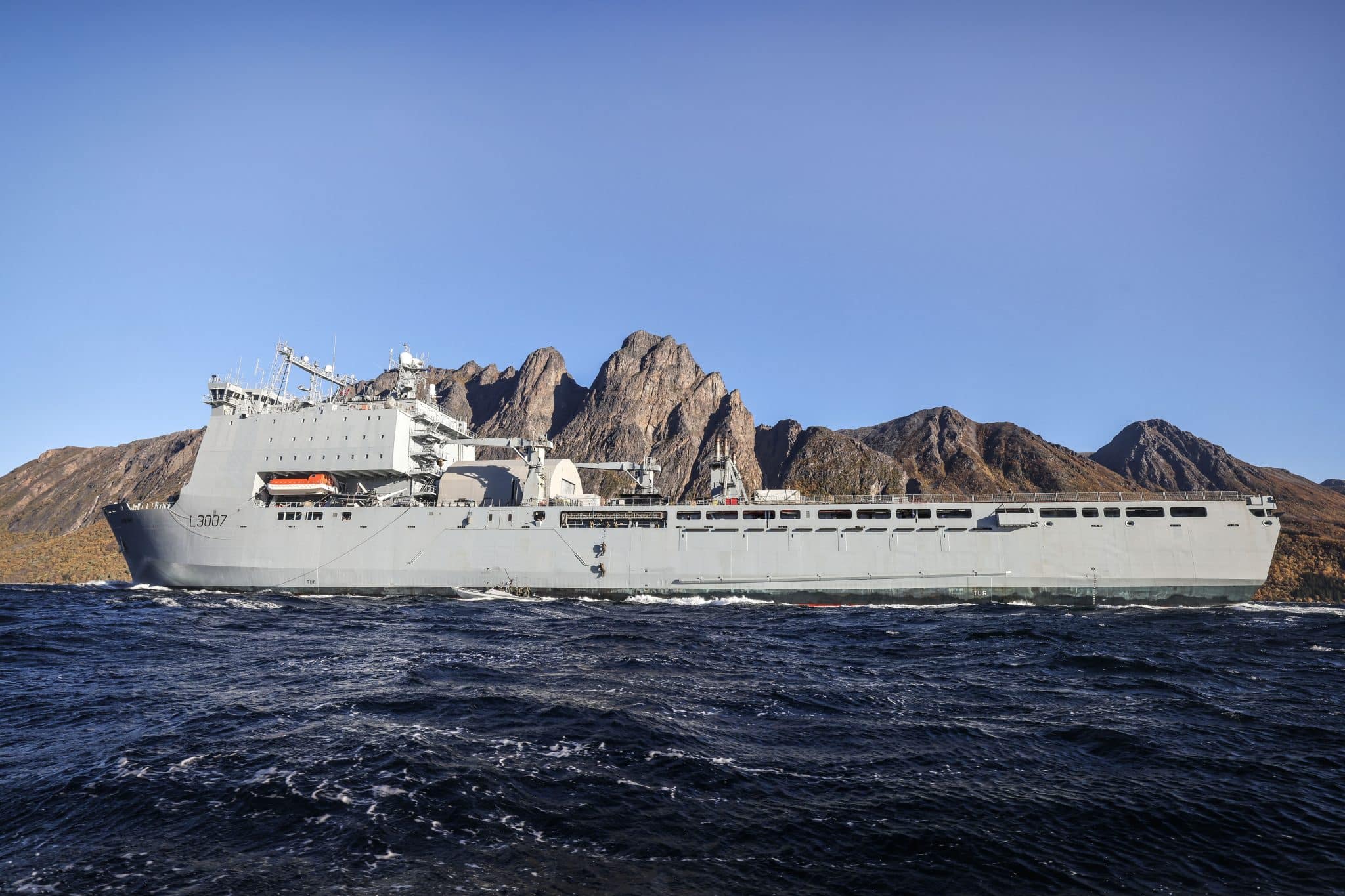
The UK’s outfitting of its Bay-class auxiliary vessel RFA Lyme Bay as a naval mine warfare (NMW) ‘mothership’ carrying uncrewed systems for the mine-hunting role illustrates how the Royal Navy’s (RN’s) ‘hybrid navy’ approach can provide flexibility to respond to events like the current Middle East crisis, the UK’s navy chief told a conference in London.
Speaking at the Royal United Services Institute (RUSI) on 29 April, General Sir Gwyn Jenkins – First Sea Lord and Chief of Naval Staff – said “In response to events in the Middle East, we have spent several weeks turning RFA Lyme Bay, our auxiliary dock landing ship, into a ‘mothership’ for autonomous and uncrewed mine-hunting capabilities.”
NATO navies like the RN have long been using maritime uncrewed systems (MUS) for NMW, to keep platforms and – especially – personnel out of the minefield. More broadly, navies have been turning steadily towards MUS use across platform types for some time. However, escalating insecurity in the Euro-Atlantic theatre, and especially Russia’s war in Ukraine, have prompted navies like the RN to establish ‘hybrid navy’ concepts for teaming crewed and uncrewed platforms to enhance mass, presence, sensing, lethality, and other outputs at sea.
The Russo-Ukraine war has certainly shown to NATO navies the type of conflict they could expect to fight in the future. The current US/Israel versus Iran war in the Gulf, and especially the closure of the Strait of Hormuz to maritime traffic, is also illustrating how MUS capabilities could make a difference in a high-end fight – for example, being used to clear mines in Hormuz.
Gen Jenkins told the RUSI audience that the real test for the RN is putting its hybrid capabilities to sea.
With Lyme Bay, the RN has been building the capacity to do just that.
In late March, the navy announced it was stepping up its NMW capabilities by giving Lyme Bay a MUS-based capability for mine hunting, with the installation work being conducted while the ship was alongside in Gibraltar, having been operating in the Mediterranean Sea. The move followed the ship previously being brought to heightened readiness as the Gulf crisis unfolded. The MUS capabilities being embarked include various systems such as uncrewed underwater vehicles (UUVs) and uncrewed surface vessels (USVs) to provide capacity to detect, identify, and neutralise mine threats, the RN said in a statement.
“Having recently returned to high readiness, we have been put through our paces but I know we are ready to support this autonomous uncrewed kit so as to play an important role in its use,” Captain Mark Colley, Lyme Bay’s commanding officer, said in the navy statement.
In the statement, Gen Jenkins added “Lyme Baypreparing for a possible mine-hunting ‘mothership’ role is a perfect example of how we are building a ‘hybrid navy’.”
The statement noted that, when fitted with ‘plug-and-play’ command-and-control capability for the NMW task, the ship can act as a command centre, demonstrating also capacity to host and showcase innovative technology. Such developments illustrate how the navy is starting to move forward with its ‘hybrid navy’ transformation.
“This is just the start of an ambitious process,” Gen Jenkins told the RUSI audience, “one which gives us rapidly deployable and easily scalable solutions to the current situation in the Middle East, all while minimizing cost to the taxpayer compared to traditional ships, reducing the risk to our sailors and marines in the process, and improving our effectiveness.”
Naval News understands that work to add the new NMW capability to the ship is continuing, alongside in Gibraltar.
Naval News comment
Having a readily deployable NMW capability onboard Lyme Bay will enable the RN to respond to mine threats across NATO’s area of operations, and further afield.
What the mine threat in the Strait of Hormuz – and also in the Black Sea, amid the Russo-Ukraine war – are showing is that the risk is real.
This has certainly registered across NATO. In its most recent Alliance Maritime Strategy, published in October 2025, NATO listed NMW alongside carrier strike, anti-submarine warfare, and seaborne autonomous capabilities as central to “[supporting] NATO’s ability to deter, defend, or decisively strike against an aggressor”.
As demonstrated in Hormuz and the Black Sea, and as a theoretical risk in regions like the Baltic, NMW has become a primary tool for threatening sea lines of communication, which have themselves become contested with the return of state-based competition and conflict at sea.
In the Baltic, in February 2026 NATO ran ‘Steadfast Dart’, a pan-alliance, multi-domain exercise designed to test and demonstrate the ability to deploy the Allied Rapid Reaction Force into a crisis environment, including (according to a NATO statement) to “ensure freedom of manoeuvre across strategic waterways”. A large amphibious task group was inserted into the Baltic Sea through the Skagerrak/Kattegat straits maritime chokepoint to conduct a complex amphibious assault ashore in northern Germany. In a ‘real-world’ scenario, there would be real risk of having to conduct such insertion through the chokepoint and projection across the littorals in the face of a significant mine threat.