The US military test-fired the Typhon mid-range capability system in the Philippines for the first time, as part of the two countries’ largest joint military exercises.
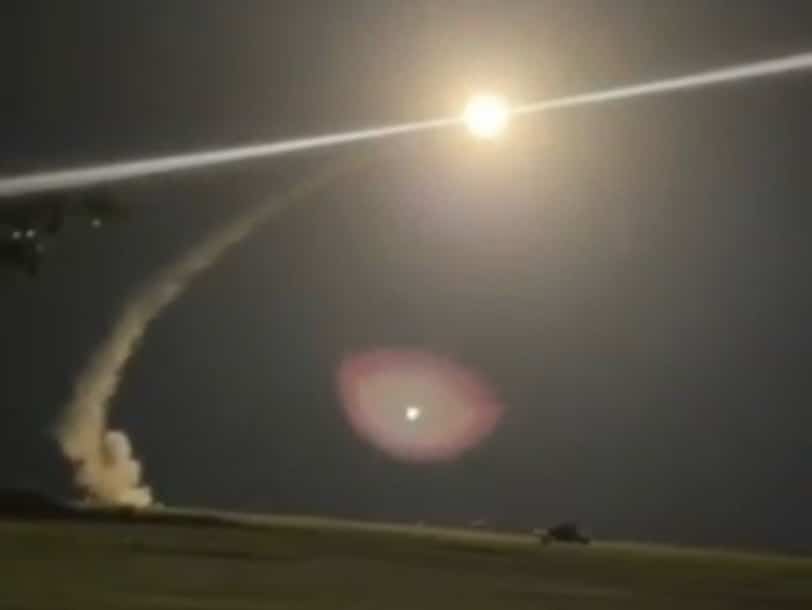
The Typhon system fired a Tomahawk cruise missile shortly after midnight Tuesday from Tacloban City Airport in Leyte, striking its intended target at Fort Magsaysay in Laur, Nueva Ecija, in mainland Luzon—about 600 kilometers away—roughly an hour later, Balikatan spokesperson Col. Dennis Hernandez told reporters.
The Tomahawk is an intermediate-range, subsonic cruise missile capable of striking targets up to 1,000 miles away and can be redirected in mid-flight.
This marked the first test in the Philippines of the land-based Typhon system— which can fire both Tomahawk and SM-6 missiles— since it was deployed in April 2024 for a joint training exercise. The launch formed part of a simulated combat scenario at Fort Magsaysay intended to support ground troops responding to an enemy force during the exercise, Hernandez said.
The missile traveled along the country’s eastern seaboard, passing through the area of Dingalan in Aurora province before reaching the target. It carried no explosive payload and was used to assess accuracy, he said.
Last April 28, the Coast Guard District Eastern Visayas issued a navigational advisory warning mariners of a Tomahawk Land Attack Missile activity in the waters off San Pedro Bay from May 5 to 7 as part of the Balikatan. Weeks before the launch, the Philippine Army conducted information drives for local government units and nearby communities around the airport to prevent public alarm.
China has repeatedly condemned the deployment of the Typhon system to the Philippines, saying it could introduce “risks of geopolitical confrontation and arms race into the region.” From the Philippines, the system has the range to hit the South China Sea, Taiwan Strait and parts of Chinese mainland. Philippine security officials had earlier expressed interest in acquiring the Typhon missile launcher, developed by US defense company Lockheed Martin and introduced into US Army service in 2023.
This year’s Balikatan exercises, running from April 20 to May 8, mark the largest iteration of the annual joint drills between Philippine and US forces that features expansive multilateral training across air, land, sea, space and cyber domains. Australia, Japan, Canada, France, New Zealand and United Kingdom are key participants.
So far, the drills have included live-fire exercises aimed at repelling simulated amphibious assaults, as well as integrated air and missile defense exercises and maritime strike operations in areas facing the South China Sea and Taiwan. Security analyst Dr. Renato de Castro, in his recent column for the local newspaper Philippine Star, described this year’s Balikatan as “a multilateral dress rehearsal in light of China’s irredentist and aggressive agenda against Taiwan in 2027.”
The test-firing of the Typhon launcher comes ahead of maritime strike drills in Laoag, Ilocos Norte on May 6, where the defense ministers of the Philippines and Japan are expected to observe. Tokyo, which has deployed about 1,400 troops for the exercises, is also set to fire its Type 88 missiles and the US’ Navy-Marine Expeditionary Ship Interdiction System (NMESIS).