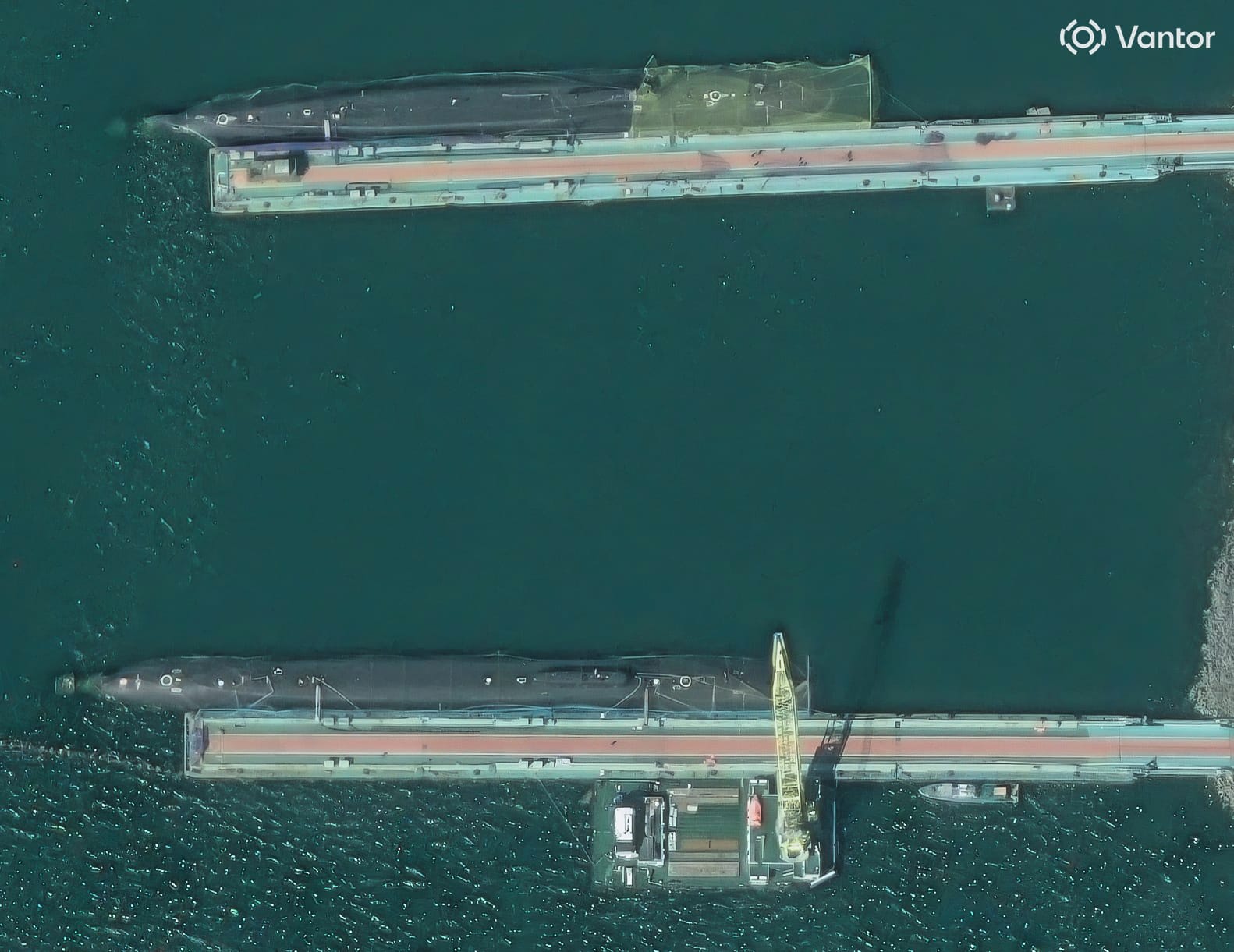
Despite being thousands of miles from the war in Ukraine, Russia’s strategic submarine base at Rybachiy in the Pacific is now showing signs of heightened defenses. New satellite imagery reveals anti-drone protections around nuclear submarines, suggesting Russian commanders fear that Ukrainian surprise attacks threaten even their most remote naval assets.
7,400 km (4,600 miles) east of Ukraine, the Russian submarine base at Rybachiy may appear out of range of Ukrainian battlefield drones. Yet commanders there are taking the threat of a surprise attack seriously. Two nuclear-powered ballistic missile submarines, a vital element of Russia’s nuclear deterrent based there, are now covered in anti-drone netting.
Fresh satellite imagery shared by Vantor show two Borei (NATO reporting name Dolgorukiy-class) submarines with fine netting covering the entire boat.
Rybachiy – A Strategic Base
One of the submarines appears to be the baseline Pr.955 Borei type, and the other the newer and improved Pr.955A Borei-A version. It is likely that, if the nets are deemed practical and necessary, other nuclear submarines will also receive the treatment.
Rybachiy, on the Kamchatka Peninsular, is the main nuclear submarine base for the Russian Navy’s Pacific Fleet. Submarines from there perform long deterrence patrols in the Pacific. Each boat carries 16 RSM-56 Bulava (NATO reporting name SS-N-30) intercontinental submarine launched ballistic missiles (SLBMs). Cruise missile submarines and attack submarines are also based there.
Anti-Drone Nets Can Offer Some Protection
These are not the first Russian Navy vessels to receive anti-drone defenses designed to make them less vulnerable in port or on the surface. In the Black Sea, where the drone threat is real, several warships have been seen sporting various cages and net defenses. These include the Pr.11982 Seliger-class seabed warfare ship Ladoga in Novorossiysk. Pr.1204 Shmel-class river gunboats and Pr. 21980 Grachonok harbor defense boats have also been observed.
These nets provide some measure of protection against the smallest and slowest FPV (first person view) quadcopters seen on the battlefield. But they can be a danger to the crew also. The nets designed to keep drones out might also keep crew in if the boat sinks. Famously this was the case of the Mary Rose, a British sailing ship hundreds of years before the advent of drone warfare. Nets were strung across the deck to stop the enemy boarding, but they also prevent many of the crew escaping when she sunk in battle in 1545.
Anti-Drone Defenses On Russian Submarines
Russian submarines, in the Black Sea but also in the Baltic and Arctic, have also received a basic drone protection. This involves a metal mesh above the surface navigation bridge on the top of the sail which appears similar to a sun awning. It is intended, it seems, to prevent drones dropping small bombs directly down the hatch into the control room deep within the boat. The netting observed at Rybachiy is the first of its type and covers the entire boat.
The netting does not disguise the boat or prevent satellite observation. Russian ships and submarines, particularly in Sevastopol in Crimea, often sport camouflage nets. Generally, this is to hide or disguise the ship during Ukrainian air raids but is also increasingly used to hide battle damage after successful hits. This new net cannot realistically be for these purposes however; it is clearly anti-drone protection.
It seems unlikely that Ukrainian FPV drones will reach the submarine base at Rybachiy. But a surprise attack, launched from much closer to the base like Operation Spiderweb, might be a real threat. Whether covering the entire submarine in netting will be practical remains to be seen. Defense analysts will be waiting to see what happens the next time a storm hits the base.