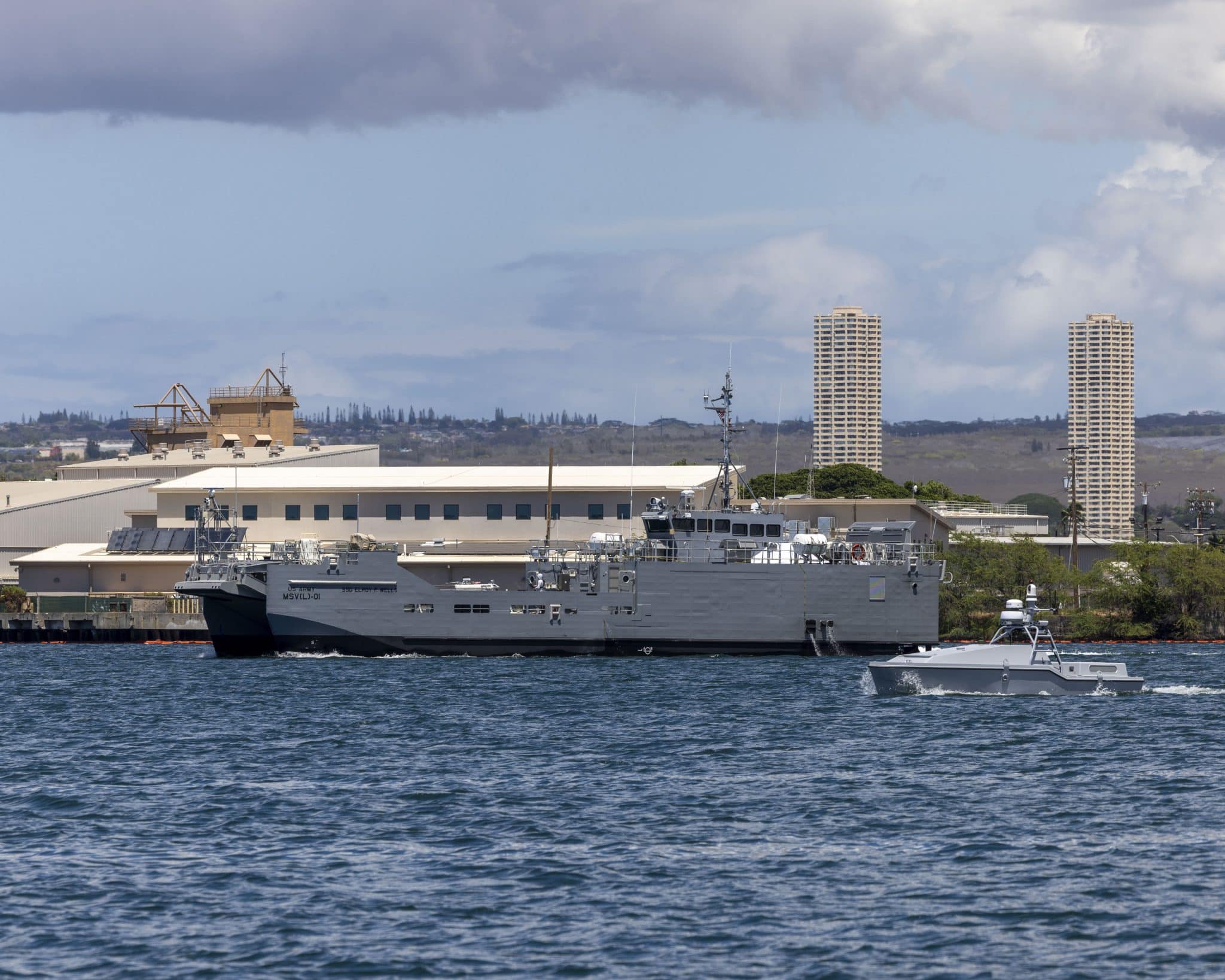
The Pentagon is looking to procure dozens of unmanned surface vessels (USV) to deliver to support U.S. Army logistics operations under contested environments in the Indo-Pacific.
According to a release from the Defense Innovation Unit (DIU) last month, the Defense Department wants to bolster the ground branch’s maritime logistics arm and greatly increase the fleet’s carrying capacity
“For Indo-Pacific Contested Logistics, [USVs] can provide significant operational advantages by eliminating risk to onboard personnel and reducing the need for trained mariners. Additionally, their dispersed and relatively inexpensive nature complicates adversary targeting, enhancing survivability in contested environments,” reads the solicitation.
Dubbed the Autonomous Resupply Vehicle (ARV-S), the USV will be responsible for delivering 20-foot-long containers to forward-deployed units. Requirements for the resupply sea drone include a round trip range of 1,600 nautical miles between sea states 4 to 6, a carrying capacity of at least two containers and the ability to autonomously maneuver.
While the specific amount of ARVs required for Indo-Pacific operations was not specified, the DIU solicitation stated “end strength may require dozens or more ARV-S’s to be produced quickly,” and that any bid “must have a realistic capability to scale production.”
The release highlighted that the Army’s current maritime formations could not move the supplies needed by operational forces.
As American troops in the region prepare for a potential contingency with China, their traditional methods of logistics can come under threat from Beijing’s modernized naval, missile and air forces. The importance of these aging and overstretched Army watercraft formations have been demonstrated in various exercises in recent years.

The potential for these watercraft in a contingency involving the South China Sea and Taiwan was seen as they landed Army and Marine Corps missile launchers at strategic archipelagos across the Philippines annually since 2023. The two services have also collaborated testing new maritime maneuver methods in Hawaii.
Aside from the mobility afforded to combat forces, the nature of an Indo-Pacific fight between the U.S. and China requires American commanders to rely on dispersed logistics to sustain their formations within or near the first island chain. With a set number of bases and friendly facilities that Washington could access, resupplying units in wartime could be a challenge. This is further compounded by the vast distances separating them from the continental U.S.
These concerns are shared by American lawmakers, who added recommendations for the procurement of USVs to escort Army watercraft in the House Armed Services Committee’s chairman’s mark of the Fiscal Year 2027 legislation.
“The committee believes that manned Army watercraft may be aided by dedicated unmanned surface vessels (USV) providing enhanced force protection, early warning, sensing and defensive effects while reducing risk to personnel,” reads the draft bill.