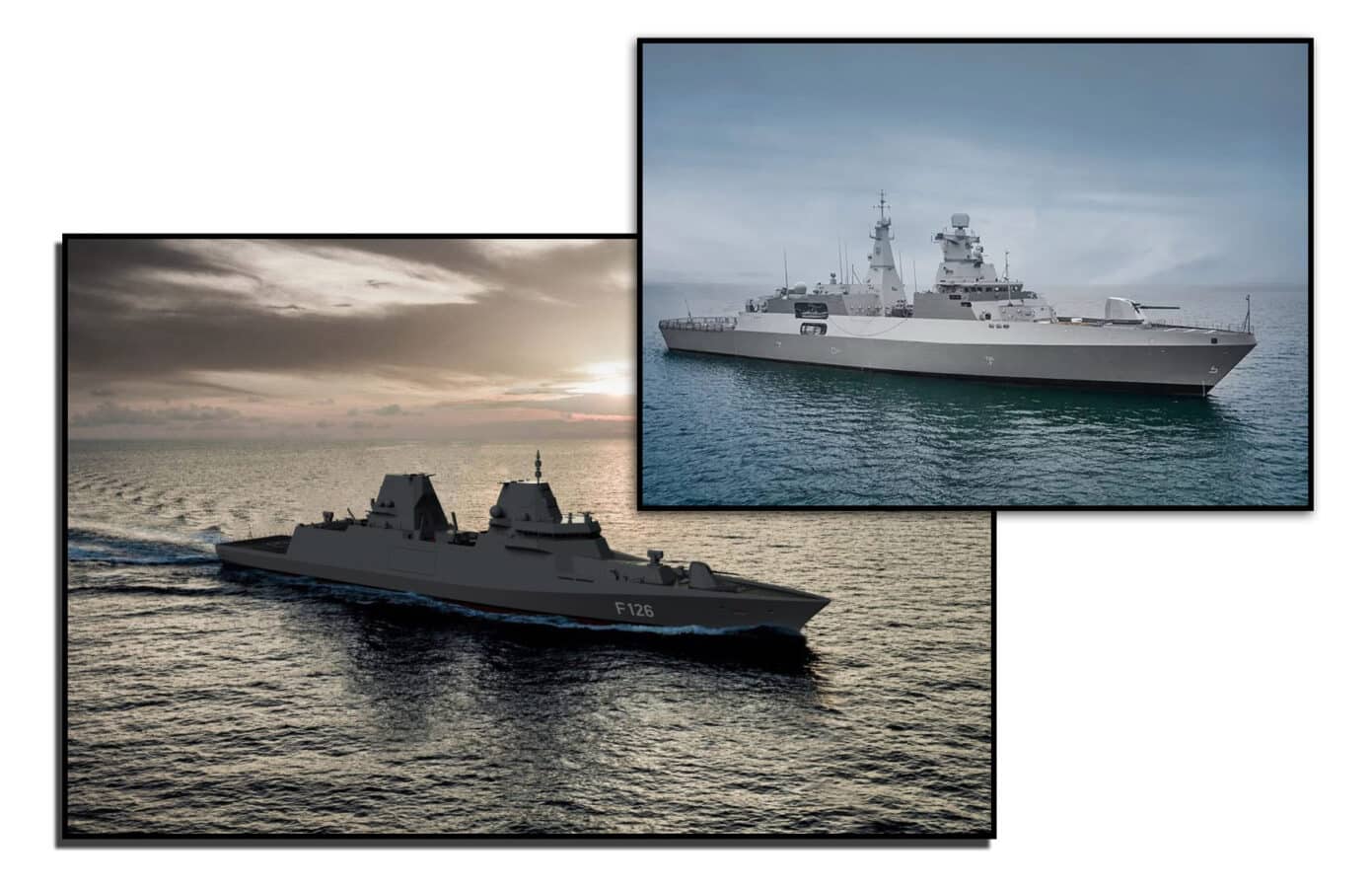
The German Ministry of Defense has decided to discontinue the construction of six F126-class frigates, as the ministry announced in a recent statement. The cancellation is attributed to significant project delays and the foreseeable cost increases and risks associated with changing the general contractor. Hartpunkt had already reported on corresponding rumors on June 23, 2026.
By Lars Hoffman / hartpunkt
Subject to approval by the Budget Committee, the German Federal Ministry of Defense (BMVg) is pursuing the purchase of a total of eight MEKO frigates – primarily for anti-submarine warfare – as an alternative and in close coordination with the Inspector of the Navy (the head of the German Navy). Sea-based anti-submarine warfare is of paramount importance within NATO and therefore also a national priority. The timely and complete fulfillment of NATO obligations is crucial in the procurement of frigates. Reportedly, the MEKO frigates will be equipped with the same towed sonar system from Atlas Elektronik as the F126. This will provide them with an important sensor for anti-submarine warfare.
According to the BMVg, Damen Schelde Naval Shipbuilding (DSNS), the company initially contracted as the prime contractor, was unable to meet the agreed-upon time and budget constraints. The contract stipulated delivery of the first ship, with initial operational capability, by mid-2028 and the construction of a total of six F126-class frigates. The German Navy originally planned to have all six F126-class frigates available by 2033. The project, which began in 2020, was projected to cost approximately €10 billion for the six frigates.
In response to DSNS’s notification that the contract was significantly delayed and that construction of the ships was not possible within the agreed timeframe or within the agreed budget, the Ministry of Defense has been intensively examining the possibility of changing the prime contractor to Naval Vessels Lürssen BV & Co. KG (NVL), starting in 2025, the ministry writes. NVL is now part of the Rheinmetall Group.
The review has now been completed and has revealed that, due to the project’s current situation, significant additional costs would be incurred to continue the project. A contract with the new prime contractor, NVL, for the construction of six F126 frigates was negotiated at a figure of approximately €15.2 billion. In addition, the services already provided under the existing contract with DSNS and necessary contracts for supplies and support services would have to be taken into account. The Ministry stated that the total financial requirement for the F126 would thus increase to over €18 billion.
Furthermore, the federal government would have had to contractually waive any potential claims for damages against the previous contractor in the event of a change of prime contractor, the statement continues. This contradicts the Ministry of Defense’s understanding of the responsible use of public funds. The amount of these claims is currently part of a legal review, the statement adds. This likely means, in a veiled way, that the federal government is examining potential claims for damages against Damen Naval, which failed to fulfill its contractual obligations.
The Head of the German Navy has confirmed, after intensive review, that the MEKO A-200 DEU frigates are capable of fulfilling the German Navy’s core mission of anti-submarine warfare and thus also Germany’s NATO obligations, according to the statement. Furthermore, a standardized ship type offers significant advantages in operation, maintenance, and training. This is also likely to apply to the F123 frigates, which will receive a similar equipment package to the new MEKOs.
The BMVg intends to submit the basis for a decision on the purchase of eight MEKO frigates to the Budget Committee of the German Bundestag as soon as possible. This will allow the force contributions pledged to NATO to be implemented as quickly as possible. Subject to approval by the Budget Committee, the procurement price for the first four MEKO A-200 frigates would amount to approximately €6.3 billion. The option for four further ships could be exercised by the end of 2026 for approximately €5.3 billion.
The cost increases for the MEKO A-200 frigates compared to the originally budgeted amount are based on the conversion of the industry’s cost estimate into a binding contract offer from TKMS. According to the Ministry of Defense, the measures deemed essential to supplement the offer after thorough review by the Navy account for only about five percent of the total costs and are therefore not a significant driver of the price increase.
Reportedly, the three F123 frigates currently being refitted and equipped with anti-submarine warfare capabilities, such as a new towed sonar system, are scheduled for completion in 2029. With the arrival of the lead ship, the MEKO A-200, expected towards the end of 2029, the German Navy would then have four large combat ships specialized for anti-submarine warfare. After that, follow-on MEKO frigates are apparently set to be delivered every nine months.
Due to the desired procurement speed, it is understood that key sensor and effector packages for the MEKO A-200 will be adopted from the TKMS bid to Australia. This means that, among other things, the radars and the combat management system (CMS) will come from Sweden, while German industry will not be involved to the same extent as with the F126. This affects companies like Hensoldt and Thales as radar suppliers. Whether the Swedish equipment package will be used for all eight MEKO ships is likely to be a subject of further discussion. According to information obtained by hartpunkt, the MEKOs will at least be equipped with Naval Strike Missiles, and not the Swedish RBS 15. It also seems conceivable that the Swedish CMS 9LV will be replaced by the Navy’s new standard CMS, the CMS 330 from Lockheed Martin Canada. Furthermore, the next step will likely involve determining how to deal with the subcontractors of the F126 project, who have already made significant contributions.
Regarding the decision to cancel the F126 frigate project, Bastian Ernst, the CDU/CSU parliamentary group’s spokesperson on naval affairs in the Bundestag, stated: “The F126 frigate procurement project began long before the Common Era and is no longer appropriate for today’s security situation. Originally designed as a multi-purpose combat ship, the frigate was intended to be a jack-of-all-trades, adaptable to various mission modules for different purposes. The project was so ambitious that problems and delays arose very early on. Delivery of the first ship was – according to the current schedule – not expected until 2032 instead of 2028. That’s time we don’t have. We have committed ourselves to our NATO allies to make significant contributions to defense against enemy submarines. It is therefore only logical that Defense Minister Pistorius has now pulled the plug. Better an end with horror than a horror without end.”
The contract for the procurement of the MEKO A-200 from TKMS, designated F128, is imminent. The project has already begun thanks to a preliminary agreement. “As the Bundestag, we made this possible by the end of 2025 by allocating €7.8 billion in the budget for the procurement of an alternative to the F126 frigate. Furthermore, we had mandated such a preliminary agreement through a resolution. I am therefore all the more pleased that the Minister of Defense is now pursuing the path outlined by the Bundestag.”
Instead of planning a new ship, the decision was made to use a readily available, off-the-shelf vessel with only minor modifications. “This ensures our navy receives the ships it urgently needs for defense against Russian submarines as quickly as possible. In addition to tkms itself, numerous subcontractors are also involved, thus strengthening Germany’s position as a defense industry hub,” Ernst emphasizes.
This article by Lars Hoffman was originally published in German language at hartpunkt.de. It has been translated and republished with authorization.