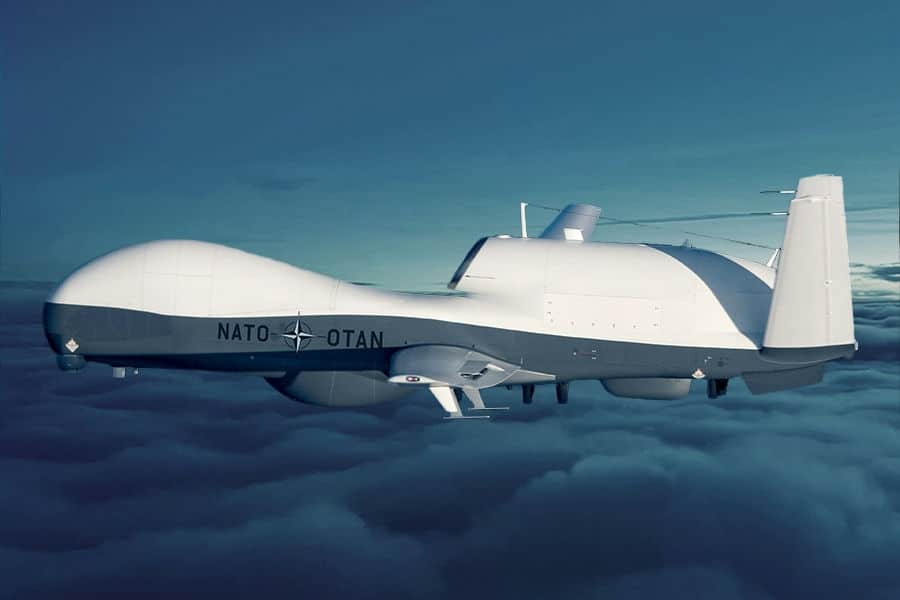
On 7 July 2026, Denmark, Finland, Germany and Norway announced the procurement of up to five Northrop Grumman’s MQ-4C Triton high-end, high-altitude and long-endurance (HALE) unmanned aerial vehicle (UAV) to enhance NATO’s owned Intelligence, Surveillance and Reconnaissance (ISR) Force.
NATO press release
The announcement was made at the NATO Summit Defence Industry Forum in Ankara, Türkiye. The new aircraft will complement NATO’s Alliance Ground Surveillance (AGS) Fleet that operates from Sigonella airbase in Italy.
Triton aircraft offer high-end technological capabilities. Specifically designed for maritime surveillance, the aircraft can sustain 24-hour flights at an altitude of more than 15 km.
Equipped with long-range sensors, Triton aircraft will increase Allies’ ability to detect threats early, protect our sea lines of communication, and support operations in demanding regions, such as the Arctic and the High North.
A transatlantic industrial consortium is being formed to deliver this capability. While Northrop Grumman will build the Triton aircraft, Airbus Defence and Space and other European companies will provide the ground segment, data management services, command and control, infrastructure and mission support. This leverages the work and transatlantic relationships built upon the last decade to enable a modern and capable NATO ISR Force.
-Ends-
Naval News comments:
The Northrop Grumman MQ-4C Triton is a HALE unmanned aircraft system engineered specifically for persistent maritime intelligence, surveillance, reconnaissance, and targeting (ISR&T). Derived from the RQ-4 Global Hawk, the Triton is optimized for the harsh maritime environment with a reinforced airframe, de-icing systems, and lightning protection, allowing it to descend through inclement weather to identify surface targets closer to the water. Operating as a critical node in modern distributed naval warfare, the Triton provides real-time ocean surveillance, intelligence collection, and search-and-rescue support over vast oceanic regions.
Key Capabilities of the MQ-4C Triton
- Persistent Endurance: Operates continuously for over 24 hours per mission, covering up to 4 million square nautical miles in a single flight.
- Operational Ceiling: Flies at altitudes above 50,000 feet (15,240 meters), remaining well clear of commercial air traffic and most localized weather systems.
- Advanced Multi-Sensor Suite: Features the AN/ZPY-3 Multi-Function Active Sensor (MFAS) radar, providing 360-degree maritime surface search and track capabilities alongside electro-optical/infrared (EO/IR) high-definition video.
- SIGINT & Communications Relay: Equipped with robust signals intelligence (SIGINT) tools to intercept and analyze electronic emissions, alongside a secure network relay function to link disparate fleet units across vast distances.
In U.S. Navy service, the Triton augments the capabilities of the P-8 Poseidon maritime patrol aircraft. VUP-19 (Unmanned Patrol Squadron 19) achieved initial operation capability in September 2023 during its deployment to Andersen Air Force Base, Guam. The U.S. Navy deployed a MQ-4C Triton for the First time to Europe (Naval Air Station Sigonella, in Sicily, Italy) on March 30, 2024. Australia is procuring four Tritons.