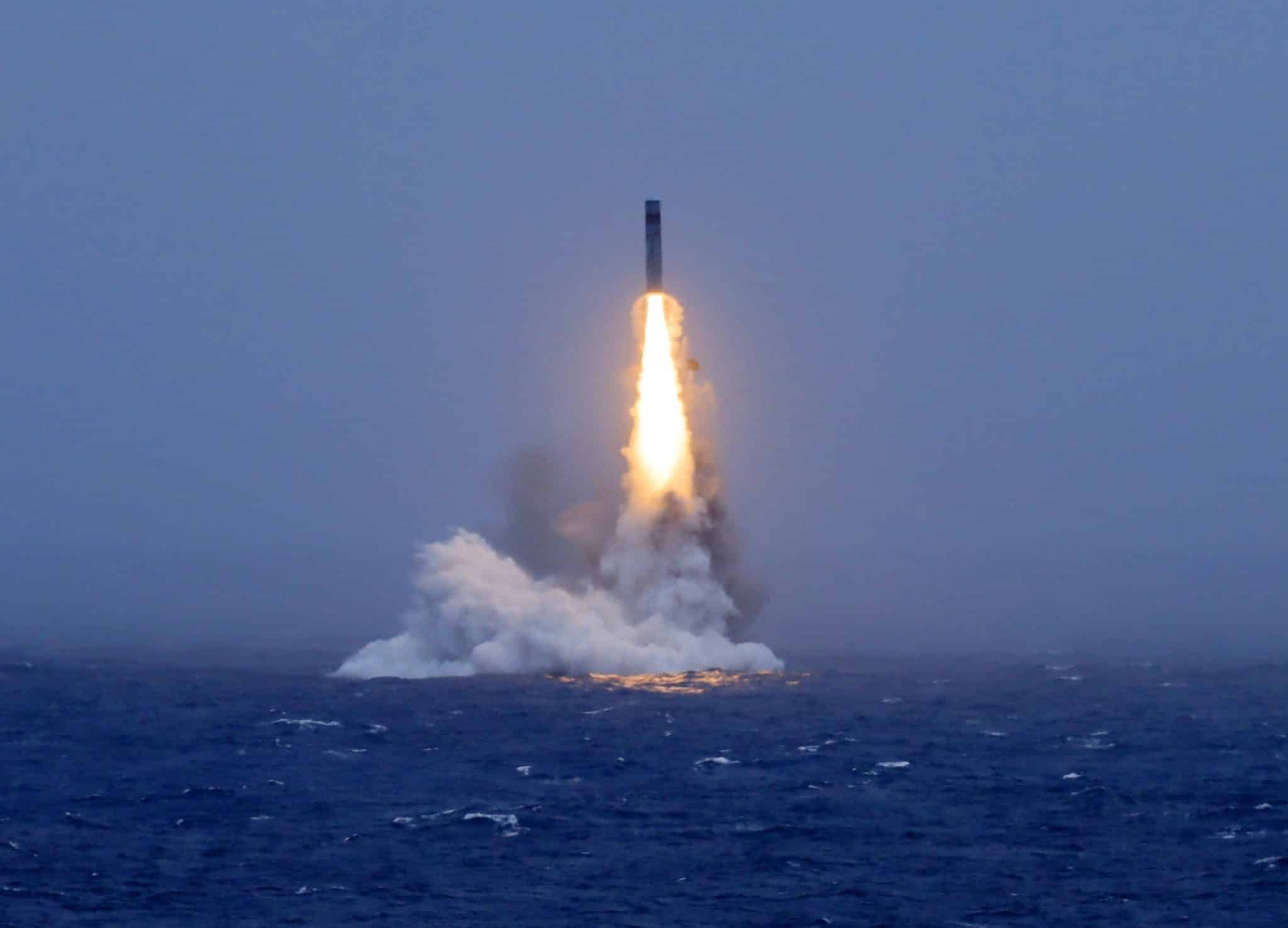
China’s July 6 submarine-launched ballistic missile (SLBM) test into the Pacific has drawn intense scrutiny not only for its political timing, but for what it reveals about the maturing state of Beijing’s sea-based nuclear deterrent.
The People’s Liberation Army Navy (PLAN) said one of its strategic nuclear submarines launched a missile carrying a dummy warhead toward designated waters in the Pacific at 12:01 p.m. Beijing time. The missile reportedly traveled about 7,300 kilometers from the South China Sea, with the warhead believed to have landed in open waters outside Japan’s exclusive economic zone but within the broader South Pacific Nuclear Free Zone established by the Treaty of Rarotonga.
The PLAN described the launch as part of its routine annual training and said relevant countries had been notified in advance. Yet the test immediately drew concern from Japan, Australia, New Zealand, the United States, and several Pacific Island nations. For many governments, the issue was not simply where the dummy warhead landed, but that China had used the South Pacific to demonstrate a nuclear-capable strike capability.
Rather than simply demonstrating another missile system, defense analysts say the launch reflects a broader transition in China’s nuclear posture—from possessing a sea-based deterrent to sustaining a credible Continuous At-Sea Deterrence (CASD) capability.
Why the Test Mattered
According to Étienne Marcuz, a senior analyst on strategic armaments and associate fellow at the Fondation pour la Recherche Stratégique (FRS), the test served at least two distinct purposes.
“The first is purely technical: to test its SLBM on a minimal-energy trajectory, commonly known as a ‘full-range’ trajectory,” Marcuz said.
Because China’s SLBM and ICBM tests are typically conducted over Chinese territory, they rarely allow for genuine intercontinental-range flight profiles. A Pacific overwater shot, by contrast, lets Beijing collect reentry and accuracy data unobtainable from inland launches while also allowing outside observers—chiefly the United States—to monitor the missile’s performance.
“The second objective, and perhaps the most important one, was likely to demonstrate the credibility of China’s nuclear deterrence, both from a technical and an operational standpoint,” Marcuz said.
Operationally, he added, Beijing likely wanted to demonstrate that it can launch a second-strike attack from strategic submarines operating in heavily defended “bastions” in the South China Sea and Bohai Gulf. These zones are intended to shield Chinese ballistic missile submarines (SSBNs) from adversary anti-submarine warfare, compensating for China’s limited access to the open Pacific compared with the United States, the United Kingdom, or France.
The July 6 launch was not simply a missile test; it was a demonstration of an emerging operational concept.
Marcuz also noted that navigational warnings suggested China may originally have planned more than one launch, though only the South China Sea shot appears to have occurred. For a test meant to demonstrate predictable and reliable deterrence, that ambiguity is notable.
JL-2 or JL-3? The Identification Debate Continues
Uncertainty persists over which missile was actually fired. Some Chinese analysts have suggested the newer JL-3, believed to have a range exceeding 10,000 kilometers. But both Marcuz and independent Australian naval analyst Alex Luck point to the JL-2 as the leading hypothesis.
“Most observers agree the missile launched was a JL-2,” Luck said. “However, due to uncertainty over the exact configuration of the JL-3, we are not presently able to clearly distinguish the two types. If the JL-3 really is more of a ‘JL-2A,’ that is, a range-extended variant, it could have been this missile that was used.”
Marcuz noted the reported flight distance broadly matches open-source estimates for the JL-2’s maximum range, though a JL-3 flown on a reduced-range trajectory cannot be entirely ruled out. He said that would be “surprising,” however, given that Beijing test-fired a DF-31 ICBM exceeding 11,000 kilometers in September 2024.
The launch platform also remains unconfirmed, though both analysts reached the same conclusion.
“The most likely launch platform was a Type 094A SSBN,” Luck said, citing Western reporting that China has resumed Type 094A production.
“There is no plausible possibility it was a Type 096, because of the complete absence of indicators that China has launched any of these new boats yet,” he added.
Marcuz likewise assessed that a Type 094 is the more likely platform if the missile fired was indeed a JL-2.

Toward a Chinese CASD
Luck sees the July 6 launch as evidence that China is moving toward a sustainable Continuous At-Sea Deterrence (CASD) posture similar to those maintained by the United States, France, and the United Kingdom.
“China is now taking serious steps to make a CASD-style sea-based deterrence a sustainable reality,” Luck said, adding that as the capability matures, “it will also gain political importance” alongside its military value.
Marcuz reached much the same conclusion from an operational perspective. He said the launch “could mark China’s ambition to achieve a genuine second-strike capability from the sea on a permanent basis,” calling it evidence of “significant operational mastery” as well as growing political confidence in the PLAN.
He anticipates more complex future scenarios, including simultaneous ICBM and SLBM launches from Hainan and the South China Sea, and potentially the integration of the H-6N bomber and its air-launched ballistic missile. Such coordination would require close integration among the PLA Rocket Force, the PLAN, and the PLA Air Force, more closely resembling the annual strategic triad exercises conducted by Russia.
Taken together, their assessments suggest the July launch was less about proving China could fire an SLBM than about demonstrating that it is steadily building the operational foundation for a sustainable CASD posture.
Transparency Remains the Sticking Point
Luck does not expect Beijing to slow the pace of SLBM testing.
“We will likely see a steady increase in SLBM launches, including ‘full-range’ testing,” he said.
How Beijing manages the political fallout, however, will shape regional perceptions. The July 6 test drew concern from Japan, Australia, New Zealand, the United States, and Pacific Island governments. New Zealand Foreign Minister Winston Peters said the launch was inconsistent with the spirit and intent of the Treaty of Rarotonga, while Pacific leaders reportedly considered issuing a strong joint statement.
Luck argues that engagement with Beijing should focus not only on its growing capabilities but also on improving transparency.
“Engagement with China should, in my view, focus on formalising more routine notification processes to avoid political misinterpretation and overreaction by other parties,” he said.
Although China notified selected governments in advance, the process remained ad hoc rather than institutionalized and fell short of the notification standards associated with the Hague Code of Conduct against Ballistic Missile Proliferation, which Beijing has not joined.
The July 6 launch should therefore not be viewed as an isolated event. It points to a PLAN moving beyond the symbolic possession of ballistic missile submarines toward a more operationally credible sea-based deterrent.
For the United States and its allies, the key questions are now how routinely China can deploy its SSBN force and whether open-ocean SLBM testing will become routine.
As Beijing’s undersea deterrent becomes both more credible and more operationally mature, missile identity and submarine class may ultimately matter less than what the launch itself reveals: China is steadily normalizing overwater strategic SLBM launches as part of a permanent sea-based nuclear deterrent. Whether Beijing also institutionalizes predictable and transparent notification procedures may ultimately determine how that deterrent is perceived across the Indo-Pacific. For now, transparency—not capability—remains the unresolved variable.
As Marcuz put it, the overarching political message was clear:
“Observe how we train, and consider what we could do in wartime.”