Keeping fixed-wing naval aviation alive will force Spain to choose between paying the price of continuity, and accepting that the retirement of the Harrier will leave the Spanish Navy without carrier-based fighters for a generation.
By Jorge Estévez-Bujez / Defensa y Seguridad
There are debates that begin with discussions about aircraft and end up debating the entire country. The future of Spanish naval aviation is one such example. On paper, everything seems in place for dialogue: Harrier, F-35B, the aircraft carrier Juan Carlos I, STOVL, CATOBAR, naval FCAS, drones, escorts, budget, industry, and doctrine. In practice, however, the matter is considerably less straightforward, especially since the European 6th generation project (FCAS) has been dealt a fatal blow. Spain must decide whether it wants to preserve a difficult, expensive, and scarce capability, or whether it prefers to bid it a solemn farewell while promising itself that it will one day recover it.
This is not an amateur discussion. It is a dialogue about the future model of the Spanish Navy (Armada), about industrial planning for the next 50 years, and about naval strategy (and foreign policy) for another 50 years.
The Spanish Navy has been operating carrier-based fixed-wing aircraft with AV-8B Harrier IIs for decades. This capability doesn’t make Spain a major naval air power, nor is there any need to exaggerate, but it does give it something very few countries retain: the ability to project combat aircraft from the sea, albeit with limitations. The problem is that the Harrier is ageing, time marches on, and the real alternatives can be summed up in a short, always controversial sentence. If Spain wants to maintain carrier-based fighters for a reasonable timeframe, it will have to look to the F-35B. If it wants something else, it will have to bear the consequences.
Roberto Escámez has been expressing this in DYS when analyzing the CATOBAR issue with a cautious analysis that deserves to be quoted: “ It’s not all about appearances and having the latest technology, but rather seeing if the costs, logistics, and operational capabilities align with our expectations .” That phrase summarizes the debate better than many technical specifications. Comparing aircraft carrier models, aircraft, and carrier-based air wing systems can be fascinating, and indeed it is, but it doesn’t replace the main question: What can Spain truly sustain for decades without dismantling the rest of its Navy in the process?
The CATOBAR has clear advantages. It allows for the operation of aircraft with greater range, larger payloads, more fuel, and a wider variety of platforms. It opens the door to more capable early warning aircraft, heavy drones, conventional naval fighters, and higher-intensity operations. This cannot be seriously denied. France is a prime example on this side of the ocean. The problem lies elsewhere: a CATOBAR aircraft carrier is not just a deck with catapults; it is a complete operational culture, an industrial infrastructure, a sustained budget, a training chain, and an escort and support fleet that must exist before, during, and after launch. In short, a naval architecture of greater scale than what has been available until now, which will require significant resources, even though these are already being considered in an increasingly substantial investment.
The Spanish debate, therefore, should not be framed as a fight between those who dream and those who give up. The issue is perhaps more prosaic. If the Harrier is retired before a carrier-based replacement exists, the Navy will not only lose aircraft. It will lose pilots, mechanics, procedures, training, air traffic controllers, deck culture, and doctrinal continuity. Recovering all of that after 50 years of continuous naval air operations would not be impossible, but it would be far more difficult than preserving it while it still exists.

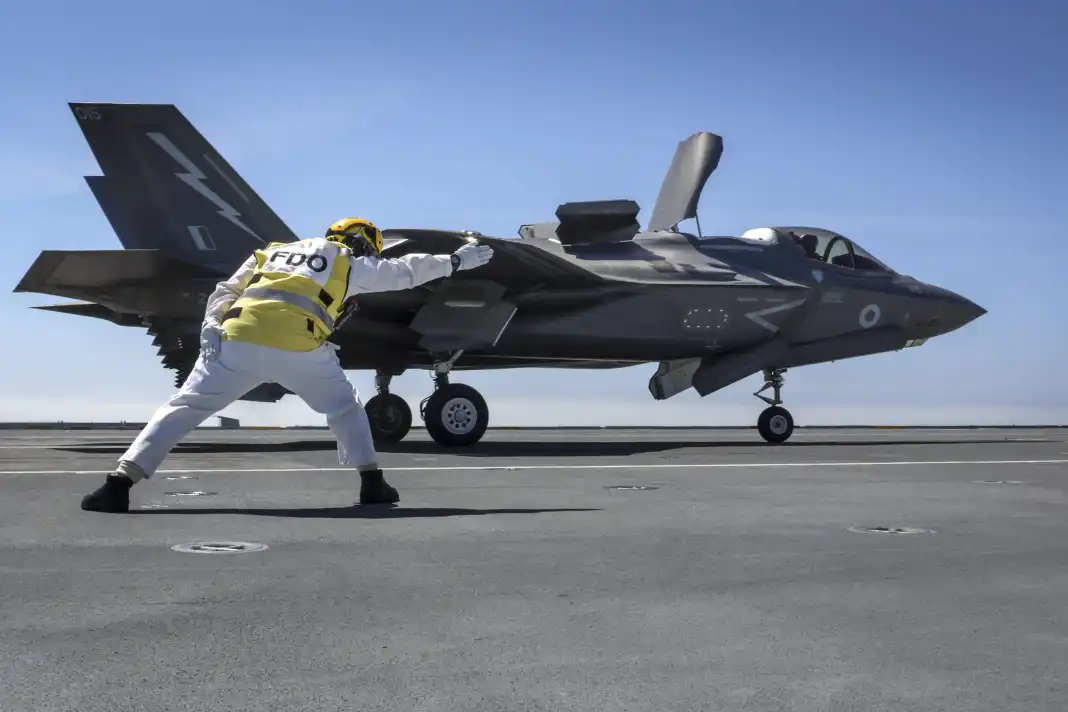
There, of course, appears the F-35B Lightning II, not as a perfect solution, but as the only available option to maintain Spain’s fixed-wing naval aviation without requiring an immediate transition to CATOBAR. For this latter option, there is at least one other possibility: the naval Rafale, an aircraft that shouldn’t be ruled out while the CATOBAR/STOVL options remain on the table. There are quite a few who are considering it. In any case, it’s not the fighter most people consider a viable option. The same is true, with some differences, for the Lockheed Martin aircraft, although for diametrically opposed reasons. While the government has never rejected the Rafale, the current administration has openly expressed its opposition to the F-35.
In any case, and focusing on the aircraft that allows operations from STOVL decks, the one currently available, with short takeoff and vertical landing capabilities, is the F-35B, which fits, at least conceptually, into the continuity of Spanish carrier-based aviation. It doesn’t resolve all the shortcomings. It doesn’t transform the Juan Carlos I into a fleet aircraft carrier. Nor does it eliminate dependence on the United States. It doesn’t match the F-35C in range and payload. But it retains something essential: the ability to continue flying fighters from the sea without a vulnerability.
Escámez aptly described the F-35B as “ a work of engineering art .” Indeed, it is unique in its class, as there is no other aircraft like it. However, he also points out that its STOVL capability necessitates significant compromises compared to the F-35A and F-35C. The lift fan occupies internal space, reduces fuel capacity, limits cargo hold capacity, and dictates the design. Furthermore, vertical landing imposes thermal demands on the aircraft deck, and the integration of the F-35 system entails dependencies on software, maintenance, spare parts, and mission data that should not be overlooked.
The F-35B is not a flagship project. It’s a commitment that aligns with the Navy’s established practices and operational structure. It allows for the maintenance of existing capabilities, but it comes at a price. Anyone who presents it as a clean, inexpensive acquisition without strings attached is mistaken. Those who dismiss it because it’s not a CATOBAR (Catapult Assisted Take-Off But Arrested Recovery) also risk confusing desire with timelines. And here, what we’re talking about is timelines.
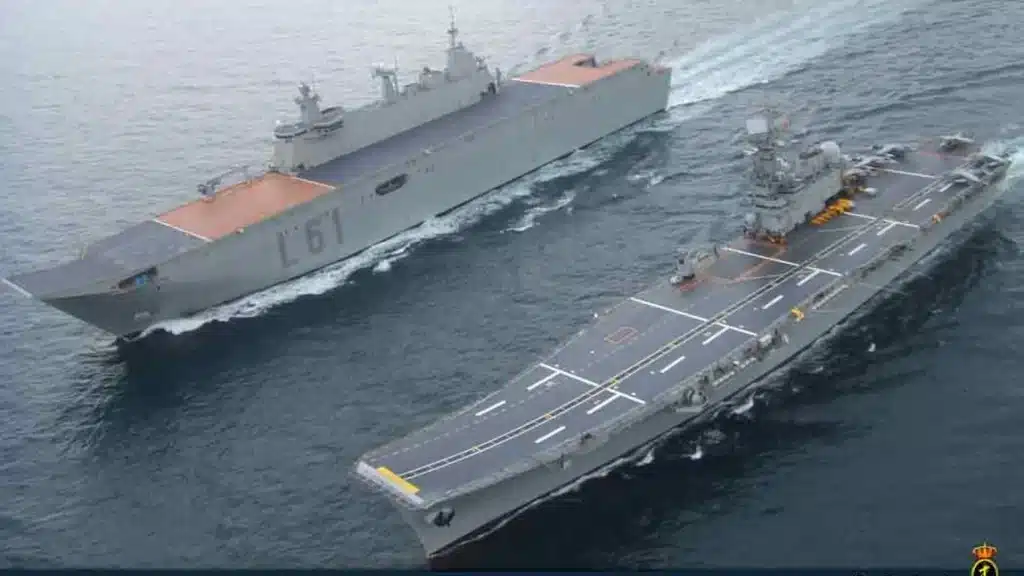
The alternative of waiting for a future Spanish CATOBAR aircraft carrier might make sense as a long-term study, but not as an immediate solution to replacing the Harrier. An aircraft carrier of between 40,000 and 50,000 tons, with EMALS, entering service around 2040 or 2045, is certainly a much more ambitious air capability. It’s a useful exercise because it forces us to consider what kind of navy we want and what that navy would cost. But even accepting the conceptual feasibility, a difficult but necessary question remains: what happens between the Harrier’s retirement and the arrival of that hypothetical ship?
If that interval lasts 10 or 15 years, Spain wouldn’t be making a transition. It would be accepting an interruption. And an interruption, in naval aviation, isn’t an administrative pause. It’s the gradual loss of an operational training ground, with no guarantee of returning to it. Memory, manuals, and some political will can be preserved, but a complex capability cannot be preserved without practice.
Therefore, the F-35B should be analyzed as a tool for continuity, not as the end of all naval discussions. It can be the bridge between the Navy that still operates Harriers and the Navy that, in the future, decides whether it wants a larger STOVL platform, a hybrid solution with drones, or a CATOBAR ambition. But without a bridge, all that remains is a void.
The Plus Ultra concept that we have been developing so far at DYS (it hasn’t been the only one) is interesting precisely because it attempts to present an expanded STOVL option, more ambitious than simply replacing aircraft. But it is not an official program, nor should it be treated as such. It is a conceptual exercise. However, it has value because it shifts the discussion from the isolated aircraft to the naval system that would make it useful.
That is one of the purposes of the debate we wanted to contribute to; it’s not simply about saying ” let’s buy the F-35B ” or ” let’s build an aircraft carrier .” It attempts to describe what should accompany each decision. Because a carrier-based air force doesn’t live on fighter jets alone. It needs early warning, anti-submarine warfare, logistical support, fuel, ammunition, maintenance, escort ships, command systems, and a network that allows each platform to function as part of a cohesive whole.
A few weeks ago, in “The Fleet We Want?” , I raised the other half of the problem: it is not enough to imagine a more capable Navy if there is no will to employ it, maintain it, and bear the consequences. That reflection pointed out that a more ambitious fleet also requires a foreign and naval policy consistent with it. In other words: an aircraft carrier, an LHD, an amphibious force, or carrier-based aviation are not static ornaments on a naval base, nor ships intended only for exercises every few months with allies. They are instruments of presence, deterrence, evacuation, air cover, support for allies, and protection of maritime interests.
The purchase of the F-35B , therefore, should not be understood as an isolated gesture or as a mere replacement for the Harrier . It must be part of a broader decision regarding the Navy that Spain wants to maintain. If the aim is a Navy focused on presence, maritime control, escorts, submarines, and limited amphibious capability, then perhaps fixed-wing carrier-based aircraft might seem dispensable. However, if the goal is to retain its own air-sea intervention capability, even if limited, then the F-35B becomes a difficult asset to avoid.
Therefore, it is essential to distinguish between what is desirable and what is possible. A Rafale M would require CATOBAR . An F-35C would require CATOBAR. A future European naval fighter does not currently exist as an operational program for Spain. A FCAS carrier-based fighter (NGF) belongs to an industrial and political architecture that has not even managed to remain cohesive in its land-based version and has ended up buried under the weight of its partners’ contradictions. The Spanish Navy cannot plan its future based on an aircraft that does not exist, an aircraft carrier that has not been contracted for, and European cooperation that has just demonstrated, once again, its limitations.
That doesn’t mean the F-35B should be purchased without conditions or analysis. On the contrary. The decision would require a complete evaluation of the acquisition cost, maintenance, adaptation of the Juan Carlos I , deck requirements, ground infrastructure, simulators, training, armament, spare parts, availability, minimum number of aircraft, and transition from the Harrier . It would also perhaps require defining the relationship with the Air Force and Space Force , because Spain cannot afford for a decision of this magnitude to become a turf war between services. But that is another issue that will need to be addressed later.
The number of aircraft would be another crucial issue. A symbolic purchase would barely serve to maintain a pose, a brand image, but without any real depth or operational capacity. A sufficient purchase would have to guarantee training, availability, rotations, maintenance, and actual operational capability. And that’s where costs come in. Not just the price of each aircraft, but the total cost of operating a system like the F-35 for decades. In defense, the expensive part is almost never buying. The expensive part is operating for years, keeping what you’ve bought operational, and, above all, ultimately losing it.
The dependence on the United States cannot be treated as a mere footnote, because the F-35 is an ecosystem, not just an aircraft. Its mission data, maintenance, software, logistics chain, and future evolution depend on a multinational framework directed by Washington. This may be acceptable, as other allies have accepted, but we must not ignore it. Absolute sovereignty does not exist in this case. Not by a long shot. The question is whether the operational benefit outweighs this dependence and whether Spain can realistically manage its limitations.
On the other hand, we also won’t turn the word “dependence” into an automatic argument for inaction. Spain already depends on foreign partners for numerous critical systems. The difference lies in knowing this, assessing it, and negotiating with clarity. Rejecting the F-35B for not being fully sovereign might sound coherent; but doing so without a real alternative to maintain the fixed-wing carrier would simply be accepting the loss of capability.
The CATOBAR debate must continue, but in its proper context. It can serve to study a future Navy, to measure what a significant upgrade would require, to assess whether Spain should aspire to operate heavier carrier-based drones, electromagnetic catapults, and a more complete air wing. But it cannot be used as an excuse for not deciding on the Harrier ‘s replacement . A Spanish CATOBAR , even in the most optimistic scenario, would not be ready in time to fill the gap if a solution for continuity is not adopted beforehand.
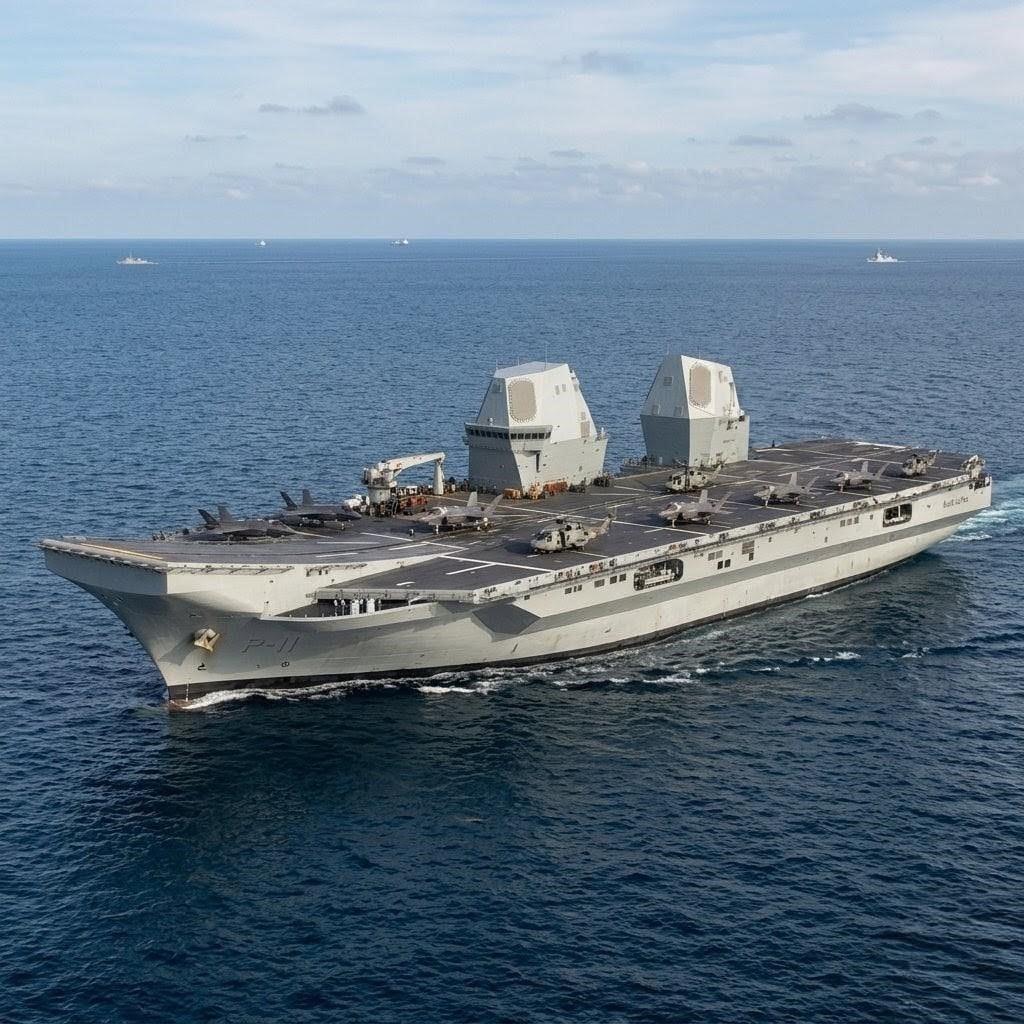
The question is whether Spain wants to maintain demanding professions. Fixed-wing naval aviation is one such profession. It requires money, discipline, planning, perseverance, and a culture that cannot be improvised. For years, the Navy has sustained this capability with limited resources. The Harrier’s replacement will force a decision on whether to continue this effort or accept its demise.
The F-35B cannot be presented as a convenient solution. It isn’t. It’s expensive, demanding, and dependent on other aircraft. But it’s also the only aircraft that allows the current situation to be bridged with a genuine continuity of carrier-based fighters. In that sense, its main argument isn’t fifth-generation technology, stealth, or sensor fusion, although all of those things matter. Its main argument is simpler: it allows the Navy to continue operating from the sea.
Perhaps that’s the crux of the matter. Because Spain can continue studying a future CATOBAR . It can discuss whether it needs a new LHD , a larger STOVL aircraft carrier, carrier-based drones, naval CCAs , or a more ambitious battle group architecture. It must do so, because naval warfare is changing and won’t wait for us to resolve our doubts. But the Harrier ‘s time is limited, and no amount of future planning can replace a transitional decision.
Spain’s F-35B dilemma isn’t about choosing between a perfect option and a bad one. It’s about deciding whether to maintain a capability at a cost or accept losing it in the name of a better solution that won’t arrive in time. It’s not a pleasant conclusion. That’s probably why it’s been avoided for so long.
And yet, with each passing year, the margin narrows. The Navy can continue waiting for a decision. The Harrier cannot.
This article by Jorge Estévez-Bujez was originally published in Spanish language at Defensa y Seguridad. It has been translated and republished with authorization.