The Royal Netherlands Navy (RNLN) has successfully tested and demonstrated a new software system designed to integrate maritime uncrewed systems (MUS) command-and-control (C2) capability. The successful work included using the software to integrate MUS systems with each other and with the combat management system (CMS) onboard the navy’s crewed platforms.
The MUS-focused C2 system is called IDUS (Intelligent Distribution of Unmanned Systems). It is a Dutch-made, bespoke software family consisting of several different elements. During the tests and demonstrations, it integrated with a standalone version of the navy’s CAMS/Force Vision Guardion CMS – another indigenously developed C2 product.
The IDUS test and demonstration activity occurred in June, during a month-long maritime uncrewed sea trials (MUST) series, conducted from the RNLN’s Den Helder base, that was designed to prove the capabilities and integration of the navy’s new maritime uncrewed task force (MUTF) construct.
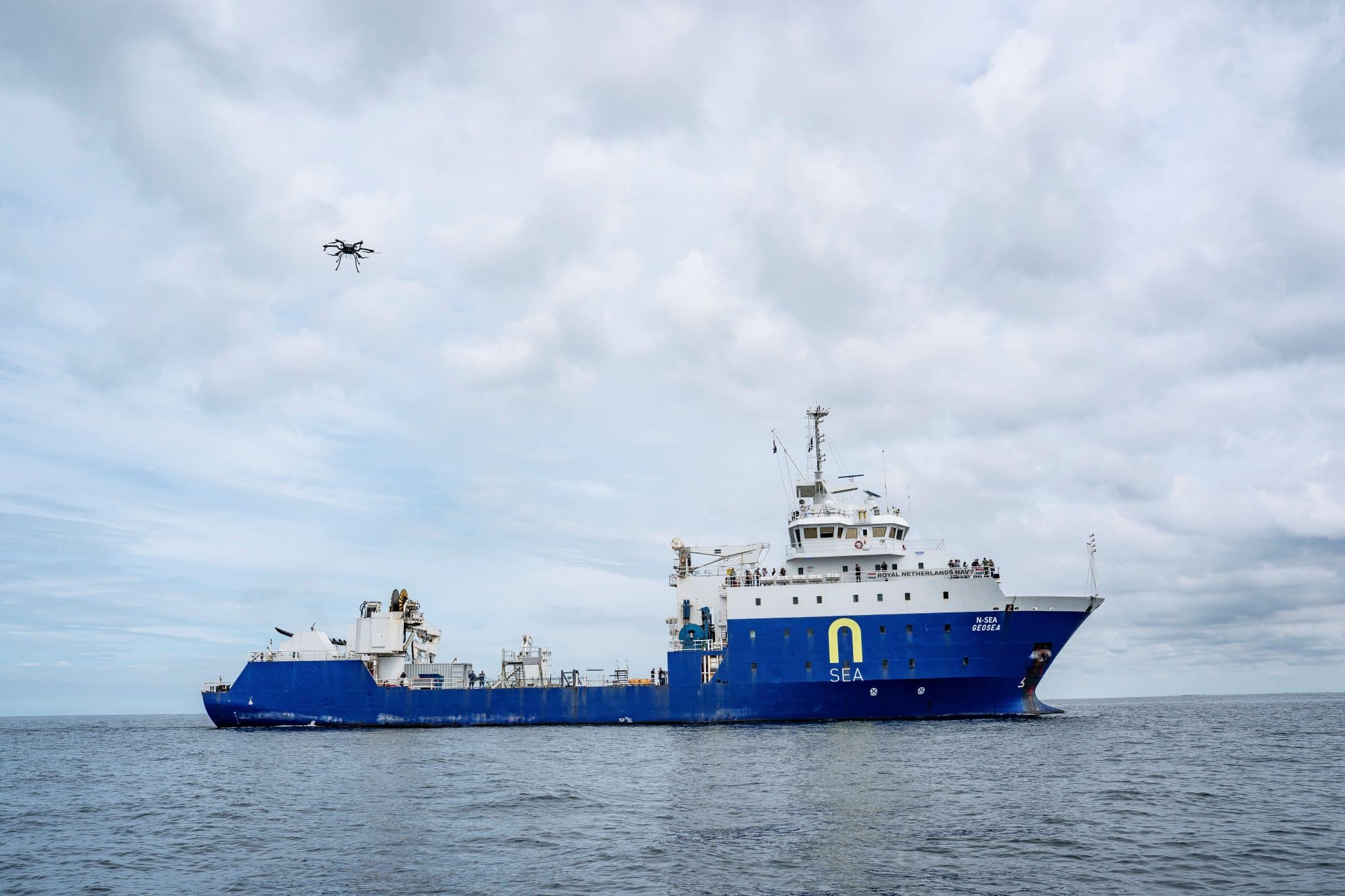
“The main focus for this edition of the MUST series was to prove our software system,” Captain Sjoerd Feenstra, head of the RNLN’s uncrewed systems expertise centre, told Naval News, onboard the Netherlands’ research vessel MV Geosea, during a media day at the conclusion of the MUST activities. The software is designed to manage uncrewed system use, across tasks ranging from autonomous operations to swarming. “The main goal was to prove that everything we have developed is actually working with the assets at sea in all three domains [air, surface, and sub-surface],” said Capt Feenstra.
IDUS has been developed across recent years, and was tested at the Portuguese Navy/NATO co-hosted ‘REPMUS’ exercise, in southern Portugal in September 2025. At ‘REPMUS’, the testing included having two uncrewed aerial vehicles (UAVs) deployed and tasked by another uncrewed system using the software. Following further software development since, for MUST the aim was to test IDUS capability across all three domains; activities included simultaneously ordering and tasking assets from each domain, which were operating in a set area, to work together to complete a mission, Capt Feenstra explained. “Yes, we managed to do it,” he added.
In this activity, IDUS was also integrated into the Guardion CMS, Capt Feenstra continued. With the CMS deployed widely across the RNLN’s fleet, and with the navy seeking to integrate MUS in all domains and tasks across the fleet’s operations, the navy needs IDUS to be a core Guardion application.
These initial integration steps involved the standalone Guardion version used for MUST. This allowed RNLN operations room personnel in the exercise to create and inject missions and assign MUS assets to them, Capt Feenstra explained.
“So, we now know that we can actually connect IDUS to Guardion. That has been proved to work over these past five weeks,” Capt Feenstra said. Achieving this integration was another primary goal in the MUST process, he added, with the speed of software development for such systems, including harnessing artificial intelligence, being so significant that getting ahead in this field of work is a main focus.
MUST requirement
According to the RNLN, the MUST process is designed to help accelerate innovation plus the implementation of new concepts across the fleet, in turn to help prepare the navy for an operational future requiring greater combat power.
The geographical area where MUST took place is also operationally significant for NATO. The North Sea is home to vital maritime infrastructure and access points: the former including critical undersea infrastructure (CUI) on the seabed like oil and gas pipelines, alongside critical national infrastructure on the surface like windfarms; and the latter including chokepoints like the Dover Strait (connecting the English Channel and the North Sea) and the Kattegat/Skagerrak Straits (connecting the North and Baltic seas).
Thus, the RNLN and other NATO navies have a requirement in this area for the sustained presence and surveillance MUS can bring.
Run by the RNLN and the maritime systems department of the Netherlands’ Ministry of Defence’s (MoD’s) Materiel and IT Command (COMMIT),the MUST trials saw a range of MUS involved across the domains, including:
- Acecore Technologies NOA UAVs
- Shield AI V-Bat UAVs
- IMPACD Boats’ Fender uncrewed surface vessels (USVs)
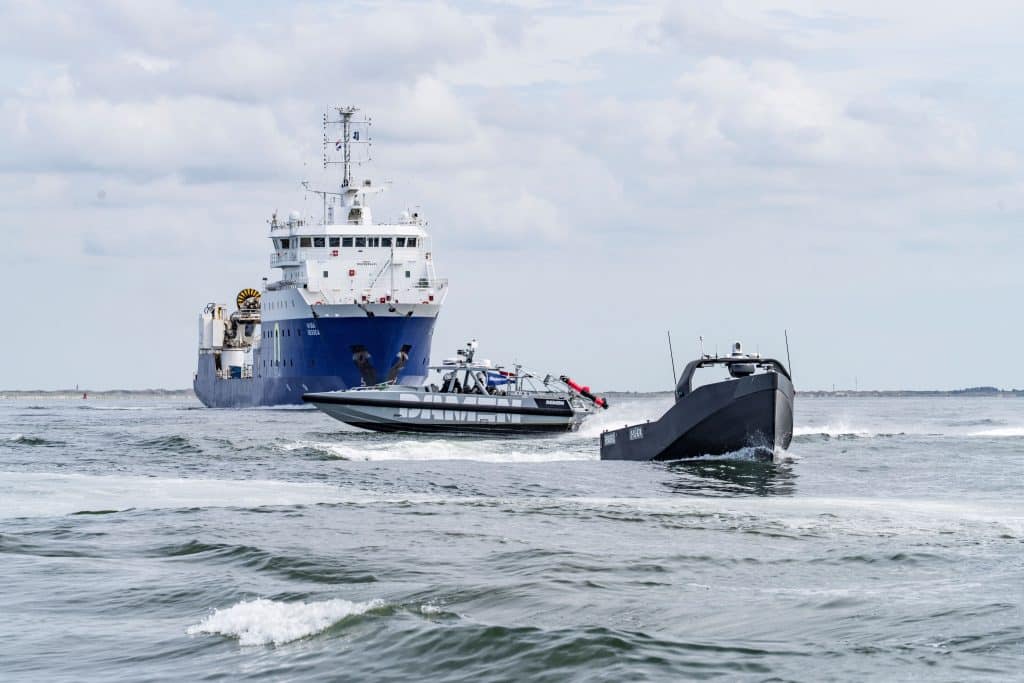
- Damen Interceptor crewed/uncrewed USVs, which are capable of launching uncrewed underwater vehicles (UUVs)
- Lobster Robotics’ Scout UUVs
The Damen patrol vessel DSS Galatea was deployed as an at-sea C2 centre. Illustrating the RNLN’s transition towards developing a ‘hybrid’ force structure integrating crewed and uncrewed platforms, the navy’s amphibious ship HNLMS Johan de Witt supported the trials.
According to the RNLN magazine All Hands, the trials included the requirement to use MUS to locate, monitor, and track a vessel of interest, encompassing intelligence, surveillance, and reconnaissance (ISR) tasking. One feature of the trials was the USVs sailing in autonomous formations.
For the RNLN, its focus in integrating crewed and uncrewed systems is about generating operational effects across seven warfare areas: naval mine warfare; anti-submarine warfare; integrated air and missile defence; littoral/amphibious operations; maritime special operations; maritime strike; and territorial protection (including of the North Sea and the Dutch Caribbean). “For each of these areas, we have described the concept of how to deliver the required effect,” Capt Feenstra told Naval News. In each instance, this includes defining how MUS in all domains combine to deliver that effect. The navy is not describing what type of system it needs, but rather what effects are needed to deliver what task, and thus how relevant systems should contribute to this, he explained.
Pacing ahead
Reflecting the need to stay ahead of the requirement, Capt Feenstra described the next steps in developing the MUS systems and their enabling software.
These new objectives encompass integrating the systems more fully into operational settings and scenarios. “Getting these systems as close as we can to actual operational deployment, that’s what we’re going to identify next,” Capt Feenstra said. “We want to bring the systems forward to actually being implemented and participating in their first sets of operational exercises.” Such exercise opportunities could include ‘REPMUS 26’, plus working with close allies like Norway and the UK at bilateral levels.
Naval News comment
The RNLN’s MUTF concept was launched in late April, including with the publication of the navy’s Future Vision: Maritime Uncrewed document.
The document prescribed the navy’s approach for harnessing MUS capability, which will see the navy transition from fully crewed platforms to a fleet of more lightly crewed platforms paired with uncrewed – remotely operated, and autonomous – systems.
As described in the document, a central aim of the navy’s MUTF requirement is to accelerate MUS development and deployment.
Such acceleration will be enabled by collaboration with partners too, such as the UK.
The recently announced Netherlands/UK plan to build future amphibious transport ships (ATS) together illustrates how collaboration can expand options for deploying MUS capability going forward, and underscores how the ‘crewed/uncrewed’ combination helps operationalise ‘hybrid’ force structures.
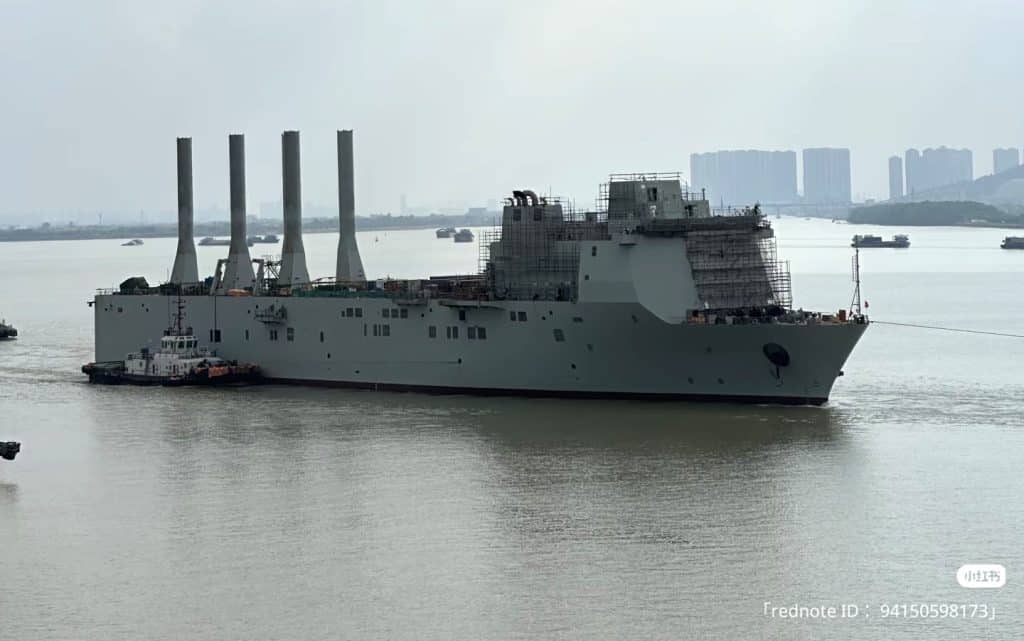
In the margins of the NATO Ankara Summit, the two countries announced plans for a GBP2.4 billion deal for the combined procurement of eight ATS vessels. With four to be built for each country, all eight are reportedly set for construction in UK shipyards, to a Dutch design. While there is no publicly available imagery of the new design, and few details are know, it is understood that the ship will be 160 m long and will displace 15,000 tonnes.
Both countries see the ATS platform as playing a significant role in their future amphibious warfare concepts of operations, providing flexible and scalable capacity to deploy MUS in all domains across the littoral environment.