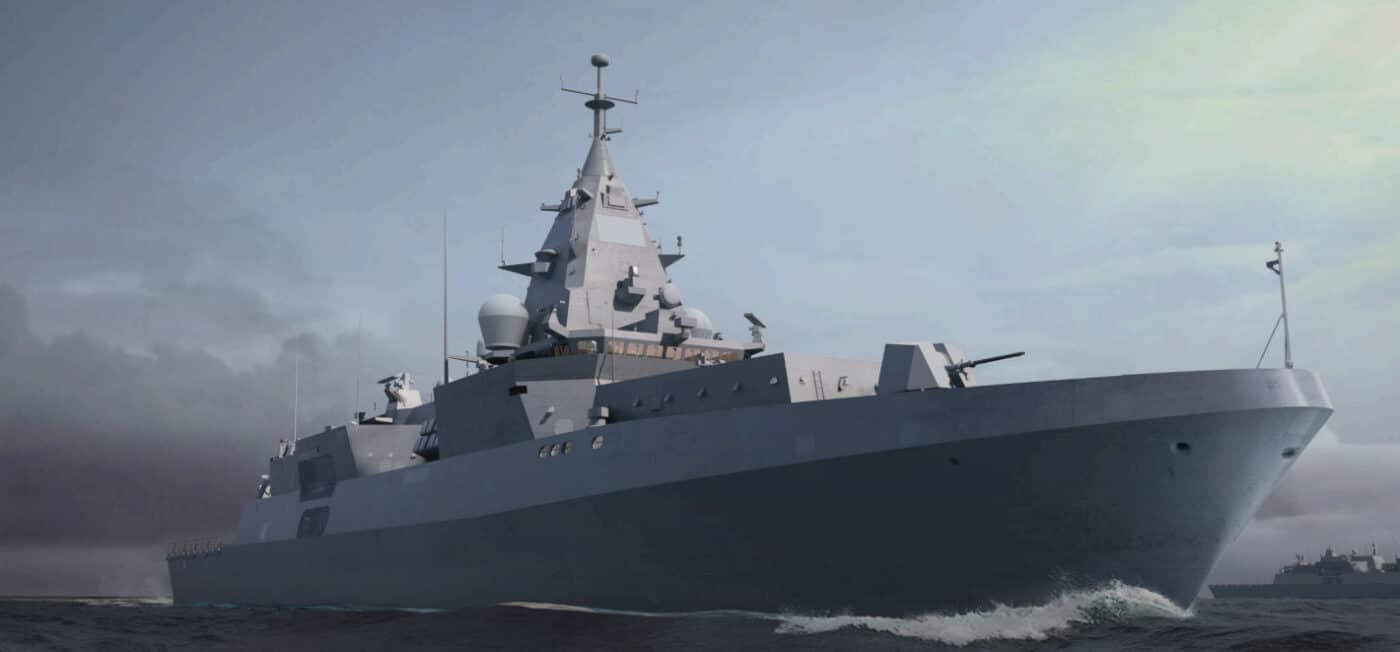
German naval shipbuilder TKMS has indicated that it would, in principle, be open to involving suppliers from the halted F126 frigate program in the construction of a second batch of MEKO A-200-class ships for the German Navy.
By Lars Hoffmann / hartpunkt
TKMS CEO Oliver Burkhard announced that a supplier day will be held to discuss this. As he stated during a telephone conference with journalists presenting the results for the first nine months of the fiscal year, TKMS has also requested a bid from NVL, now Rheinmetall Naval Systems, to provide shipbuilding services for the second batch of MEKO frigates. He did not specify when this bid is expected. The crucial factor for any bid, the TKMS CEO emphasized, is that it does not jeopardize the tight delivery schedule for the warships.
The first ship of the new class for the German Navy is scheduled for delivery in December 2029. There are clear guidelines stipulating that TKMS should involve as many companies as possible that were not selected for the F126 class. “But it’s not mandatory,” Burkhard added. Economic viability must also be ensured.
The first four MEKO frigates are currently being built by the Heinrich Rönner Group in Bremerhaven. This would mean TKMS would also have a potential partner for the second batch. According to well-informed sources, the shipbuilding and steel construction company had previously prevailed against German Naval Yards Kiel (GNYK) and the then-NVL in a frigate order for Egypt and was selected by TKMS as the production shipyard, with cost reportedly playing a significant role in the decision.
While the Bundestag’s Budget Committee has already approved the funds for the first batch of new frigates, the contract has been signed, and production is underway, the €25 million proposal for the second batch of four ships is still pending. Burkhard expects this to happen after the summer recess.
As he explained, the Kiel-based shipyard GNYK will not be involved in the new batch of MEKO A-200s from TKMS. The shipyard was only a subcontractor for NVL in the F126 project as well, Burkhard said. “GNYK plays no direct role for us in the execution of this order because we will not be directly contracting them. If NVL were to do so, that would be their decision.”
TKMS had been in talks with GNYK about a takeover for some time, but withdrew its non-binding offer at the end of last month because it could not agree on terms acceptable to both sides. Rheinmetall had also submitted a non-binding offer to acquire GNYK, which remains valid, as Rheinmetall CEO Armin Papperger stated a few days ago during a conference call. The reason for the takeover was the need for additional production capacity, as Rheinmetall would have been the prime contractor for the F126 project.
During today’s conference call, Burkhard emphasized that a key focus for his company in the coming years will be fulfilling orders. According to him, three submarines were delivered in the first nine months of the current fiscal year. The company currently has an order backlog of €20.1 billion, which is expected to increase significantly once the MEKO A200 order is secured or the submarine contract with Canada is finalized. With 12 units for the Canadian Navy, Burkhard anticipates a potential volume of more than €15 billion for the submarines alone. He stated that a contract could be signed by the end of the year. Next year, negotiations could then begin for an in-service support contract covering a period of 40 years.
The TKMS manager also considers a contract signing by the end of the year for the Indian P-75i submarine project, which involves six plus three submarines, to be quite realistic. The Indian Ministry of Finance has released the necessary funds, Burkhard said.
Besides submarines and surface vessels, he anticipates a long-term demand for mine clearance equipment from Gulf states due to the Iran-Iraq War. This demand didn’t exist before, he says, and a market is emerging that is currently underserved. However, the TKMS CEO declined to specify the magnitude of this demand, stating that it was too early.
Additional potential also appears to exist in the SeaSpider anti-torpedo torpedo, currently being developed by TKMS. According to a recent investor presentation, the weapon is scheduled for qualification by the European arms agency OCCAR next year. Previously, it was stated that the SeaSpider was to be ready for market by 2029.
According to the presentation, a sales campaign for the SeaSpider is planned for the years 2027 to 2030. Germany, the Netherlands, and Canada were previously considered potential customers. The Canadian company Magellan Aerospace Corporation, responsible for the rocket propulsion system, is among those involved in the project. The presentation also includes the US flag. Apparently, TKMS sales managers also see the US Navy as a potential customer.
This article was originally published in German language at hartpunkt.de. It has been translated and republished with authorization.