On August 13, three years after construction began, the frigate Wicher—the prototype vessel of Project 106 Miecznik—was launched. This is a milestone for the Polish Navy, as well as for PGZ Stocznia Wojenna, the prime contractor for the program to build a series of frigates for Polish naval fleet as part of the PGZ-MIECZNIK consortium. Due to the launching technology employed, the preparations and the process itself spanned several days.
Along with the Miecznik program, the modernization of PGZ Stocznia Wojenna (PGZ SW) began, during which existing facilities were renovated and new buildings were erected, including Poland’s tallest production hall, where hulls are integrated, and the value of the investment in production capacity alone exceeded 300 million PLN (approx. 70 million EUR). The new facility is 46 meters high and has an area of approximately 6,000 square meters. The hall’s dimensions—particularly its height—allowed for the assembly of the entire hull, superstructures, and portions of the masts under one roof.
On August 16, 2023, PGZ SW began cutting steel for the production of sections of the prototype. Just four months later, on January 31, 2024, ship’s keel was laid. The frigate was to be named Wicher, a reference to the destroyer built in France (French:Contre-torpilleur) commissioned in 1930, which was the first large Polish combat warship.
Construction of Wicher proceeded on schedule, and the ship’s launch was announced for August 13. This was to be the first operation of this scale ever carried out in Poland. Furthermore, it involved the launch of the largest ship ever built in Poland for the Polish Navy.
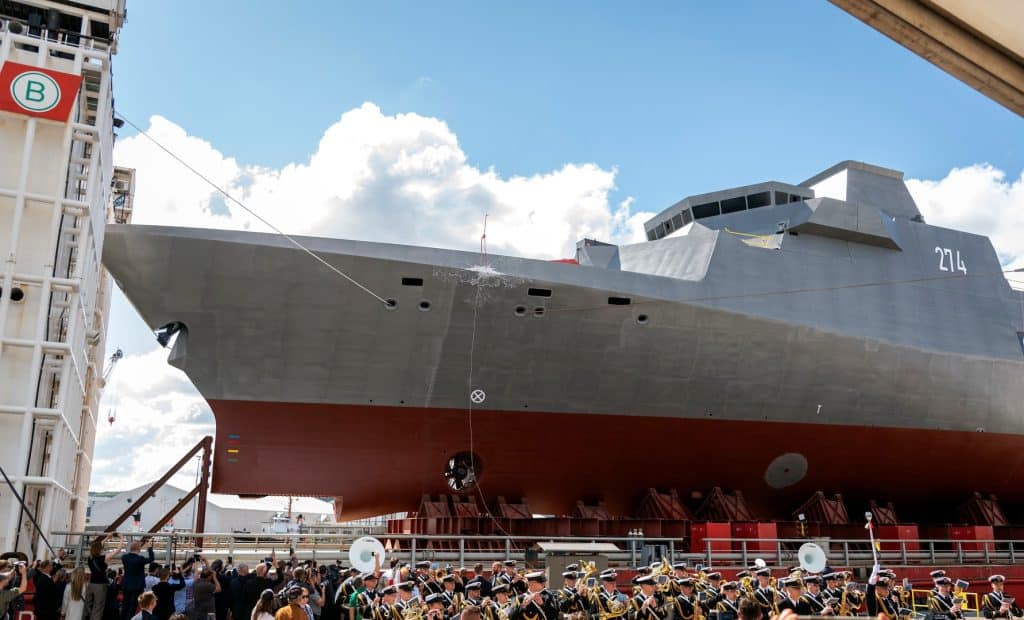
Preparations
Following the modernization, the frigates are being built at the PGZ SW shipyard in a covered hall on a technological foundation. In order to launch the vessel, it must be moved – along with the foundation – from the hall to water of sufficient depth – in this case, to Gdańsk Bay. The Norwegian company BOA Offshore was responsible for the launch operation.
On August 8, as part of the preparations, shipyard workers began setting up SPMT (self-propelled modular transporters) – a total of four columns of carriages, 278 axles, 1,112 wheels in all, with a total weight of 1,250 tons. Then, using hydraulic jacks, the ship weighing 3,707 tons, was lifted a few centimeters and placed onto the SPMTs. The next day, the semi-submersible barge Boabarge 33 (the same one that had transported the wreck of the Norwegian frigate KNM Helge Ingstad to the scrapyard…) moored at the pier in front of the gate to the hall where the frigate had been built. On the evening of August 9, the shipyard organized a spectacular light show featuring the partially rolled-out ship.
The next stage took place on August 10. The Wicher, resting on an SPMT and measuring 138.7 m in length, set off toward Boabarge 33. Once the operation was complete, the trailers were driven off the barge onto land. This marked the first time in Poland that a warship of this size had been transported in one piece.Next, tugboats towed the barge carrying the ship to the pier, where the frigate’s christening ceremony took place.
The ceremony was attended by, among others, Polish President Karol Nawrocki, Prime Minister Donald Tusk, Navy Inspector Vice Admiral Jarosław Ziemiański, PGZ CEO Adam Leszkiewicz, and PGZ SW CEO Marcin Ryngwelski. Agata Ziemiańska, the wife of the Navy Inspector, served as the ship’s godmother.
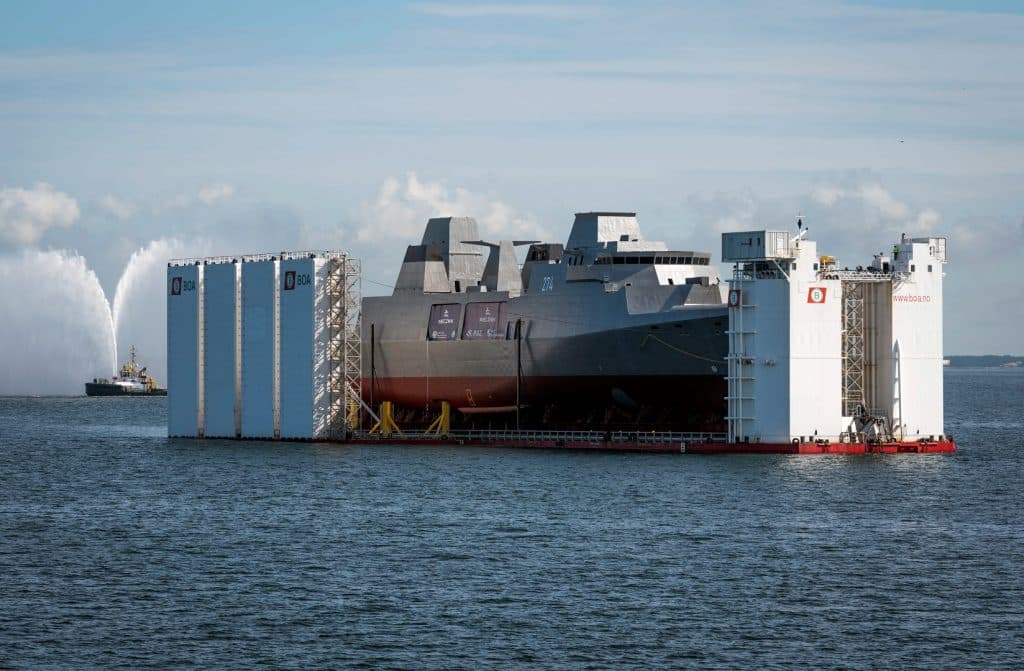
Launching
Before entering Gdańsk Bay, all service outlets below the waterline were sealed. On August 13 at 6:10 a.m., the towing convoy—consisting of a barge with Wicher on board—passed the Gdynia breakwater. The tugboat Multratug 3 towed the barge to its designated position, several nautical miles from the shore. Then the process of filling the barge’s ballast tanks began, and it gradually submerged into the sea.
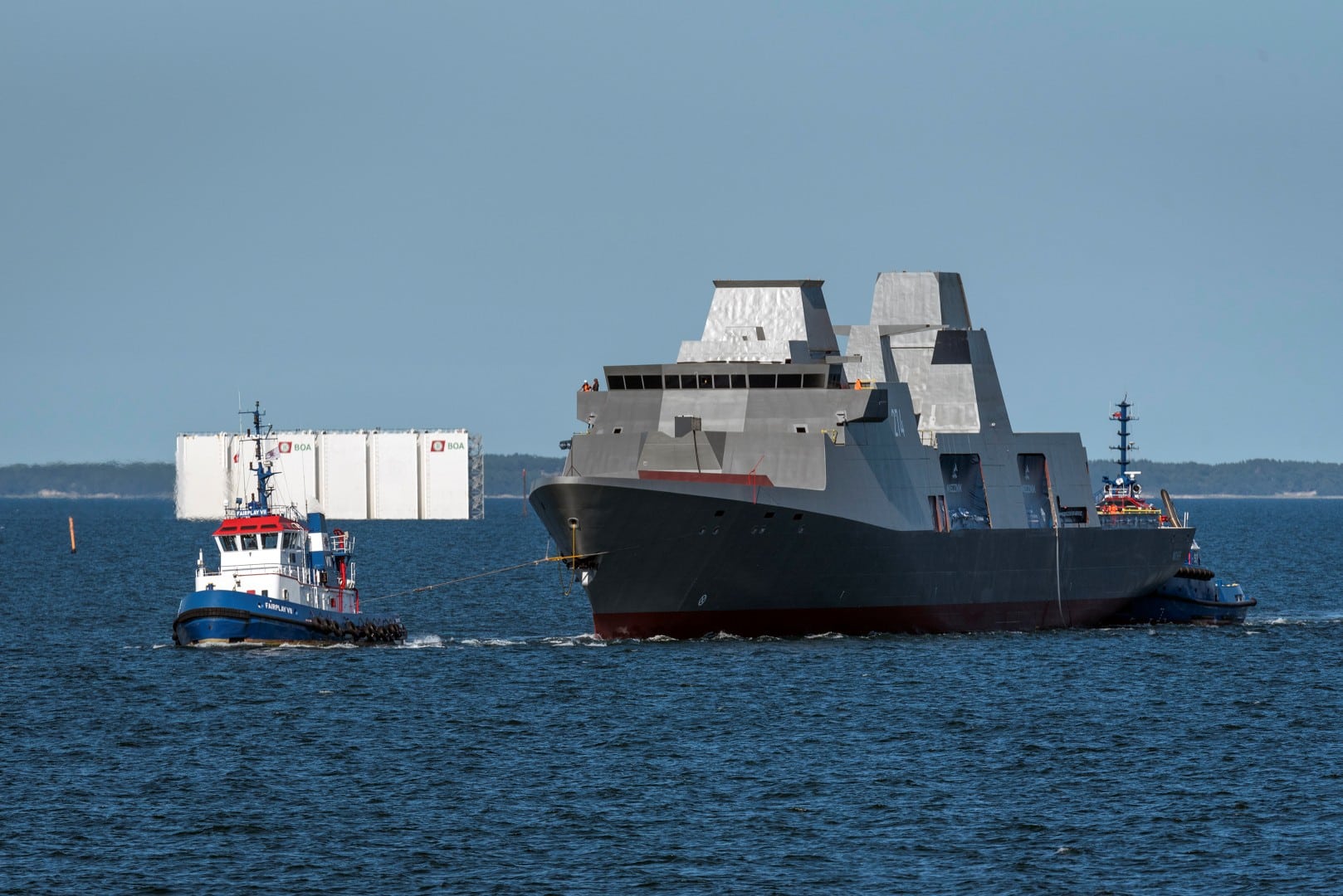
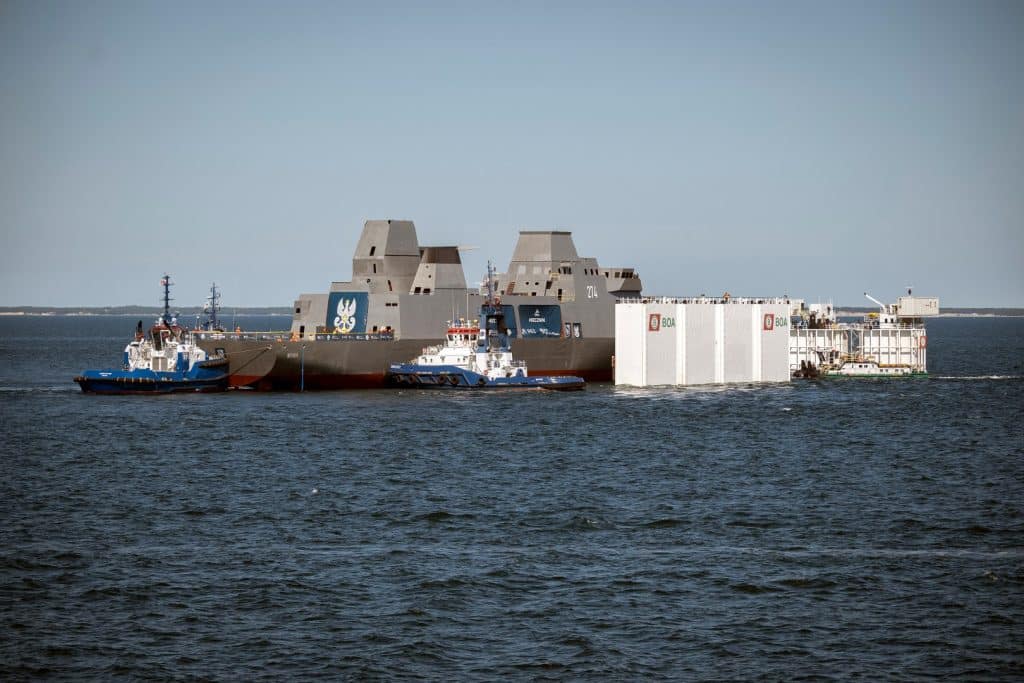
At 11:18 a.m., a historic moment occurred: the frigate’s propellers touched the water. The submersion continued until, at 1:07 p.m., Wicher achieved buoyancy. After the frigate and the barge were separated, the Fairplay VII, accompanied by the remaining pair of tugboats, began its voyage with the Wicher in tow toward Gdynia, where they arrived shortly after 4:00 p.m.
The tugboats moved the frigate into the shipyard basin, where Wicher will remain for the next three years. There, she will undergo outfitting and preparation for harbour trials HAT and sea trials SAT.
That’s not all, folks
All three Miecznik-class frigates are currently under construction. Steel cutting for Burza began on May 5, 2025, and its keel was laid on December 18 of last year. As for Huragan, steel cutting began on April 28 of this year. Its keel is scheduled to be laid in November of this year.
Wicher is now facing the most challenging phase of construction: the installation and integration of electronic systems and weapons, that comprise the Integrated Combat System (ZSW). The displacement of the completed Miecznik will be approximately 7,000 tons; the propulsion system is configured as a CODAD with four Rolls-Royce Solutions MTU 20V8000 M71 diesel engines with a combined power output of 33.6 MW. This will provide a maximum speed of +26 knots, a cruising speed of 12 knots, and a range of 8,000 nautical miles. The power plant consists of four MTU 12V4000 M53B generators, each with a capacity of 1,400 kWe. The control of the propulsion and power plants, as well as damage control, will be managed via the Integrated Platform Management System (IPMS) from L3Harris. The frigates will be equipped with the Integrated Navigation Bridge System (INBS) from OSI Maritime Systems and the IcommS Integrated Communications System manufactured by PGZ SW, featuring Rohde & Schwarz radios.
The air defense system includes a Lockheed Martin Mk 41 VLS Strike Length launcher for – initialy – MBDA UK CAMM missiles of the Sea Ceptor system. Each ship will receive four modules, each with eight cells, along with ExLS modules. They will be equipped with adapters that allow four missiles to be placed in a single cell (for a total of 128 missiles). The ships will also be armed with: eight KDA NSM Block 1A missiles; a 76.2 mm L/62 Leonardo OTO Super Rapid – Strales gun (capable of firing guided ammunition DART – Driven Ammunition Reduced Time-of-flight); two 35-mm PIT-Radwar AM-35 CIWSs, several 12.7-mm machine guns; two twin B515/2V launchers for EuroTorp MU90 torpedoes; and a Terma C-Guard passive countermeasure launch system. The stern will feature a landing pad and a hangar capable of accommodating a 16-ton helicopter. The design also provides for the transport of two 7.5-meter boats and a pair of 11-meter boats in separate compartments, as well as reconfigurable space (capable of holding four TEU containers or 20 pallets and two TEU).
The electronic equipment included in the ZSW consists of: Thales Sea Master SM410 Block 2 multifunctional radar system, Thales NS58 4D radar, Thales IFF system (interrogator TSA 6000 and transponder TSC 4000), Rohde & Schwarz Kora 40 RESM system, Thales Artemis IRST system, two PIT-Radwar ZGS-35K EO system, Thales STIR 1.2 EO Mk2 fire control system, Thales CAPTAS-2 towed sonar, Thales Blue Hunter hull-mounted sonar, Thales TUUM-6 underwater communications system, and Forcys Sentinel IDS dipping sonar for detecting divers and unmanned underwater vehicles. The ZSW will be managed by the Thales TACTICOS CMS. To use it, operators will be provided with 18 multifunction operator consoles in the CIC and two in the staff room.
This set of ZSW equipment will be fully installed on the Wicher. The Burza and Huragan will receive nearly all of its components, though some elements likely remain optional. The Mieczniki-class frigates will have a crew of approximately 120, while the ships will accommodate a total of 187 personnel.
Sea trials for the Wicher are scheduled for the first half of 2029, with its handover planned for the end of the year. The program is set to conclude – with the delivery of the third frigate, ORP Huragan, to the Polish Navy – by the end of 2031. Currently, the cost of the program is estimated at “approximately 15 bln PLN” (approx. 3.5 bln EUR).
On the occasion of the Wicher’s launch, initial information was released regarding discussions between PGZ and the Armaments Agency concerning a potential order for additional Miecznik-class frigates for the Polish Navy.