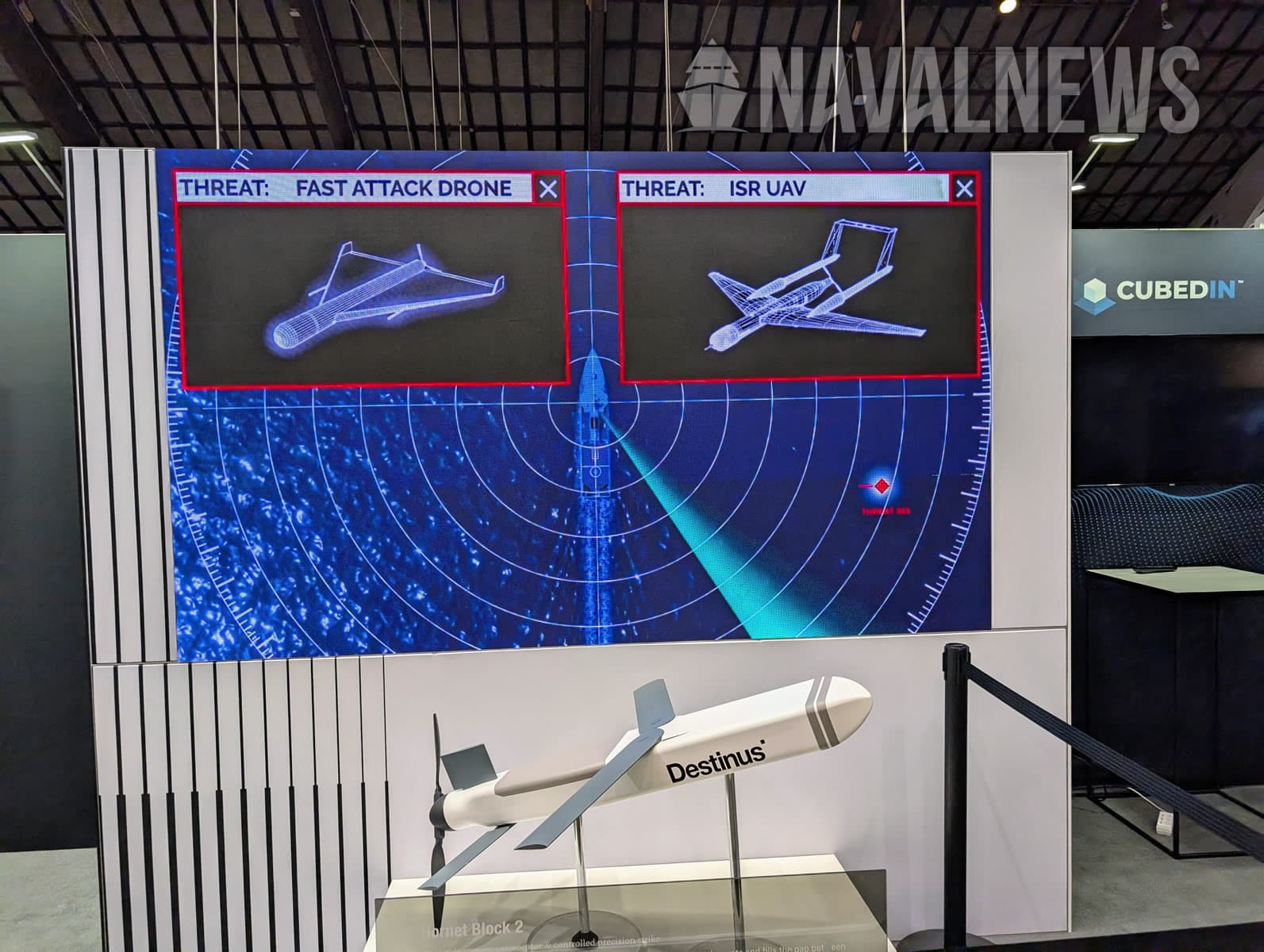
European defense firms Destinus, CUBEDIN, and OMT have signed a Memorandum of Understanding (MoU) to integrate the Hornet counter-drone interceptor into a standardized containerized mission module for surface combatants.
At DALO Industry Days 2026 in Herning, Denmark, Destinus, CUBEDIN, and OMT Group announced a joint effort to develop a modular, containerized naval counter-unmanned aerial system (C-UAS) capability.
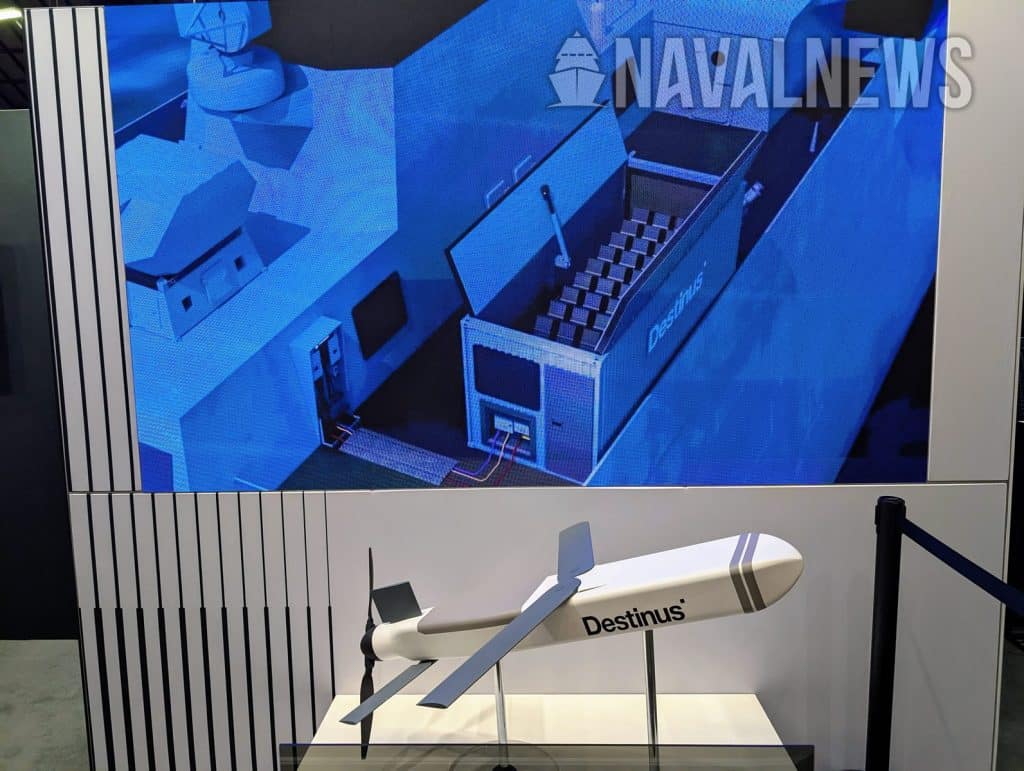
The project aims to package Destinus’ Hornet interceptor family into standard 10-foot or 20-foot mission modules. Designed for rapid integration onto existing warships as well as future ship designs, the system provides navies with a scalable, lower-cost defensive layer against high-volume aerial threats, specifically targeting Class 2 unmanned aerial systems (UAS) and similar air threats.
Industrial Workshare & Modular Concept
Under the terms of the MoU, each partner brings a distinct core competency to the containerized capability:
- Destinus will supply the Hornet interceptor system and the internal launcher/mission payload architecture.
- OMT Group A/S will oversee overall naval platform engineering, structural integration, and ship design adaptations.
- CUBEDIN A/S will provide its standardized mission modularity interfaces and integration software framework, enabling seamless physical, electrical, and data coupling with host platforms.
By leveraging standardized 10-ft and 20-ft ISO container footprints, the partners intend to allow surface combatants to embark or disembark the C-UAS capability based on mission profiles without requiring extensive structural or combat management system (CMS) overhauls.

Addressing the High-Volume Drone Threat
The initiative addresses an increasingly pressing challenge for modern surface fleets: defeating massed, low-cost aerial drones without depleting limited magazines of high-end surface-to-air missiles (SAMs).
“Navies need more defence and deterrence capacity against threats that keep multiplying, without spending a high-end missile on every engagement. A modular mission architecture is a practical way to bring Hornet aboard different vessel classes without redesigning the ship around it.”
— Wouter van Beek, Chief Commercial Officer at Destinus
From a platform perspective, modular integration offers navies flexibility across both retrofits and newbuilds:
“Modularity and adaptability are becoming defining requirements for future naval capabilities. Combining interceptor technology with naval platform engineering and standardised interfaces lets navies add new defensive capabilities without waiting for a new ship class.”
— Kåre Groes Christiansen, CEO of OMT Group A/S
“Advanced effectors do not become operational capability on their own. They have to be integrated safely and efficiently into the platform. Together with Destinus and OMT, we are building a standardised integration approach that shortens the path from concept to capability at sea.”
— Danny Ingemann, CEO of CUBEDIN A/S

The development path for the modular Hornet payload will progress through Preliminary Design Review (PDR), Critical Design Review (CDR), and full naval qualification testing. The consortium plans to pitch the containerized capability to European navies seeking adaptable point-defense options against airborne threats.
The tripartite effort follows a separate milestone for Destinus, which recently secured a contract with the Dutch Ministry of Defence (COMMIT) to run a Concept Development & Evaluation (CD&E) program to integrate the Hornet B2 kinetic C-UAS interceptor directly onto Royal Netherlands Navy warships through Q2 2027.