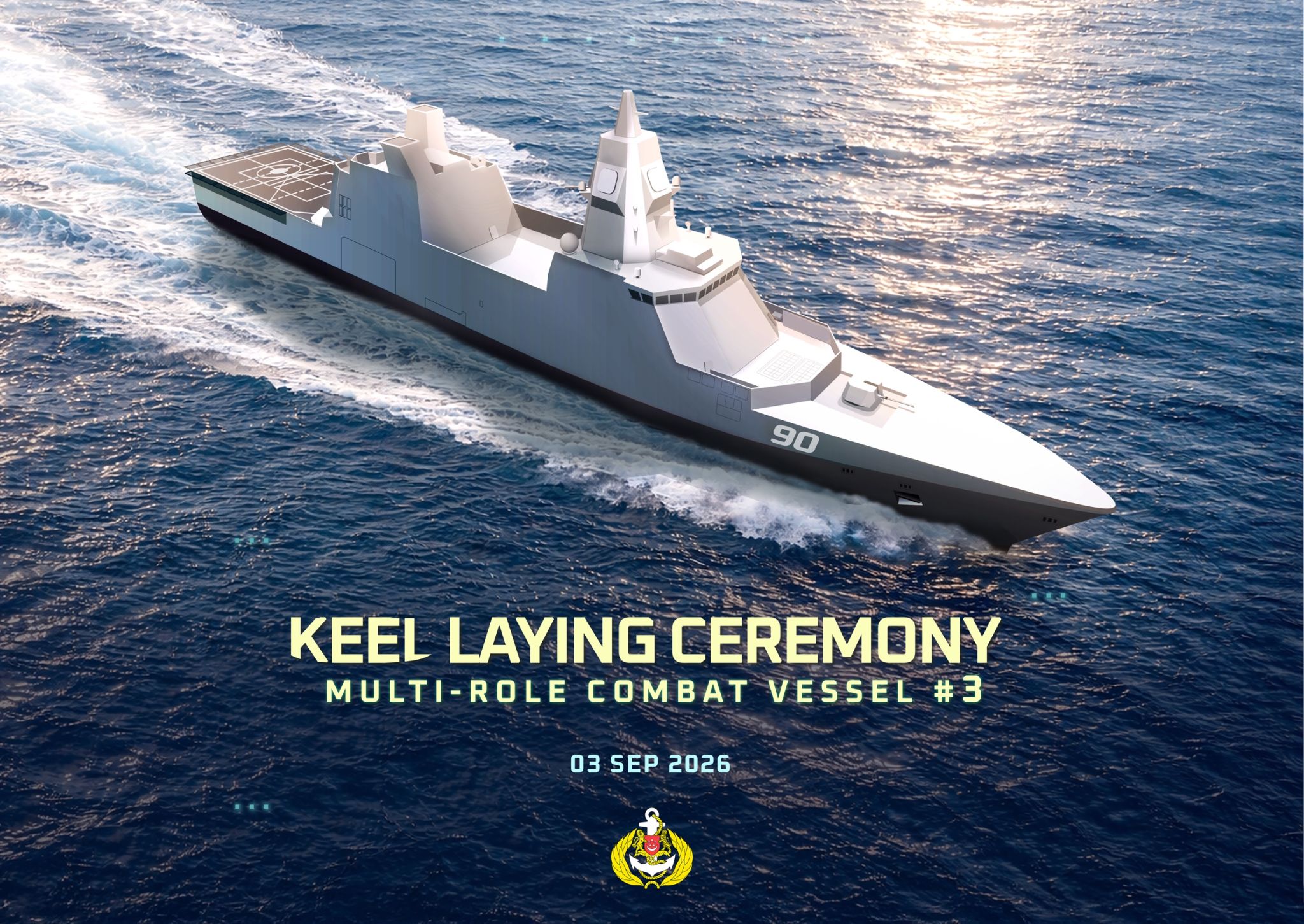
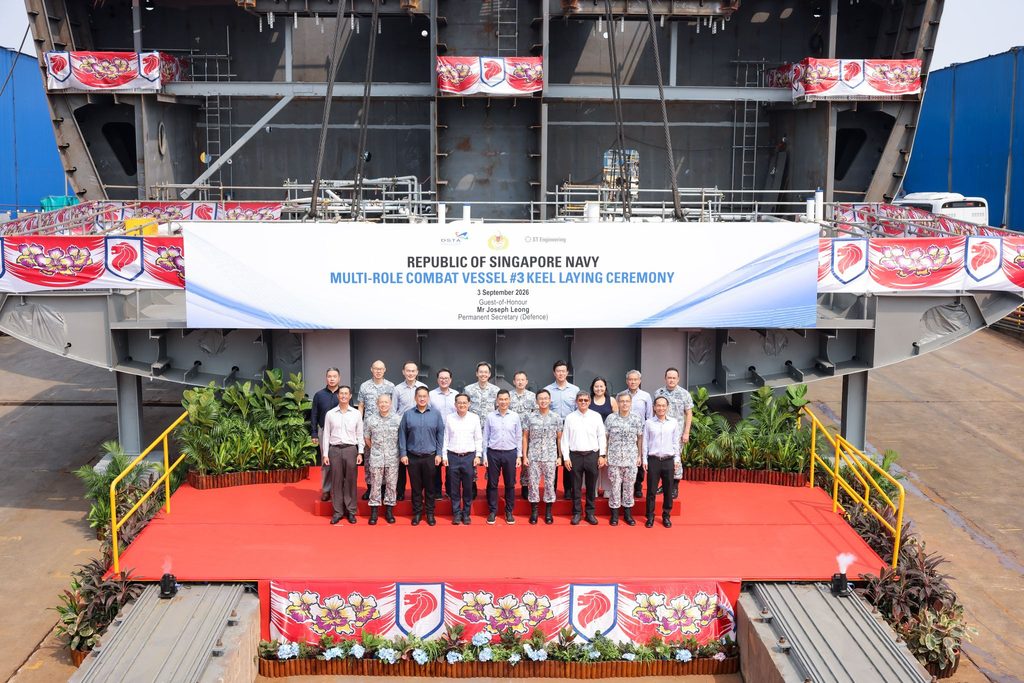
On September 3, 2026, ST Engineering announced the keel-laying ceremony of the third Multi-Role Combat Vessel (MRCV) for the Republic of Singapore Navy
The ceremony took place at ST Engineering Marine and was officiated by Singapore’s Permanent Secretary (Defence), Joseph Leong. Republic of Singapore Navy Chief Rear Admiral Sean Wat attended with representatives from the navy, the Defence Science and Technology Agency and ST Engineering Marine.
The keel laying followed the July 23 launch of Valour, the second MRCV, at ST Engineering’s Benoi shipyard. The first ship of the class will be named Victory. With the third hull now formally under construction, the programme has vessels at different stages of construction.
Singapore plans to receive the vessels progressively from 2028. They will replace the six Victory-class missile corvettes, which entered service from 1989. The MRCVs will retain the names of the outgoing corvettes. Valour is therefore the second ship in the new class to carry a former Victory-class name.
At 150 metres in length, with a beam of 21 metres and a displacement of 8,000 tonnes, the MRCV will be markedly larger than the vessels it replaces. Singapore has described the design as a combatant and a mothership for unmanned systems. It is intended to operate unmanned aerial, surface and underwater vehicles alongside its own sensors and weapons.
The published specifications list a speed above 22 knots, a range exceeding 7,000 nautical miles and endurance of more than 21 days. The baseline crew is stated as fewer than 100 personnel. Singapore attributes this reduced complement to extensive platform automation. The bridge is designed to be operated by two sailors and the engineering control centre by one.
The ships will have an integrated full-electric propulsion system. Their electrical distribution architecture has been designed with capacity for future equipment that may require more power. The superstructure uses composite material, a choice intended to reduce topweight and preserve margins for later additions.

A mission bay will accommodate eight containerised modules. Singapore has identified uses including unmanned systems, logistics and humanitarian assistance and disaster relief. Standard containers could also be used to embark additional medical facilities when required.
For combat systems, the Republic of Singapore Navy has disclosed a Thales multifunction radar and fire-control radar, a Safran electro-optical system and hull-mounted sonar. Listed weapons include a Leonardo STRALES 76 mm gun, 30 mm remotely controlled weapon systems, MICA and Aster surface-to-air missiles. Singapore has said the surface-to-surface missile fit will be confirmed later.
The MRCV is also intended to serve as a command ship for Singapore Armed Forces missions. Its combat management system is being developed domestically by DSTA. The programme brings together DSTA, DSO National Laboratories, ST Engineering and unnamed international partners.
ST Engineering Marine said the MRCV programme had recorded two million man-hours without a lost-time injury. No further details concerning the third ship’s name, launch date or planned delivery date were released during the ceremony or afterwards.
You can watch Naval News coverage of the MRCV at Imdex Asia 2023 from the link below: