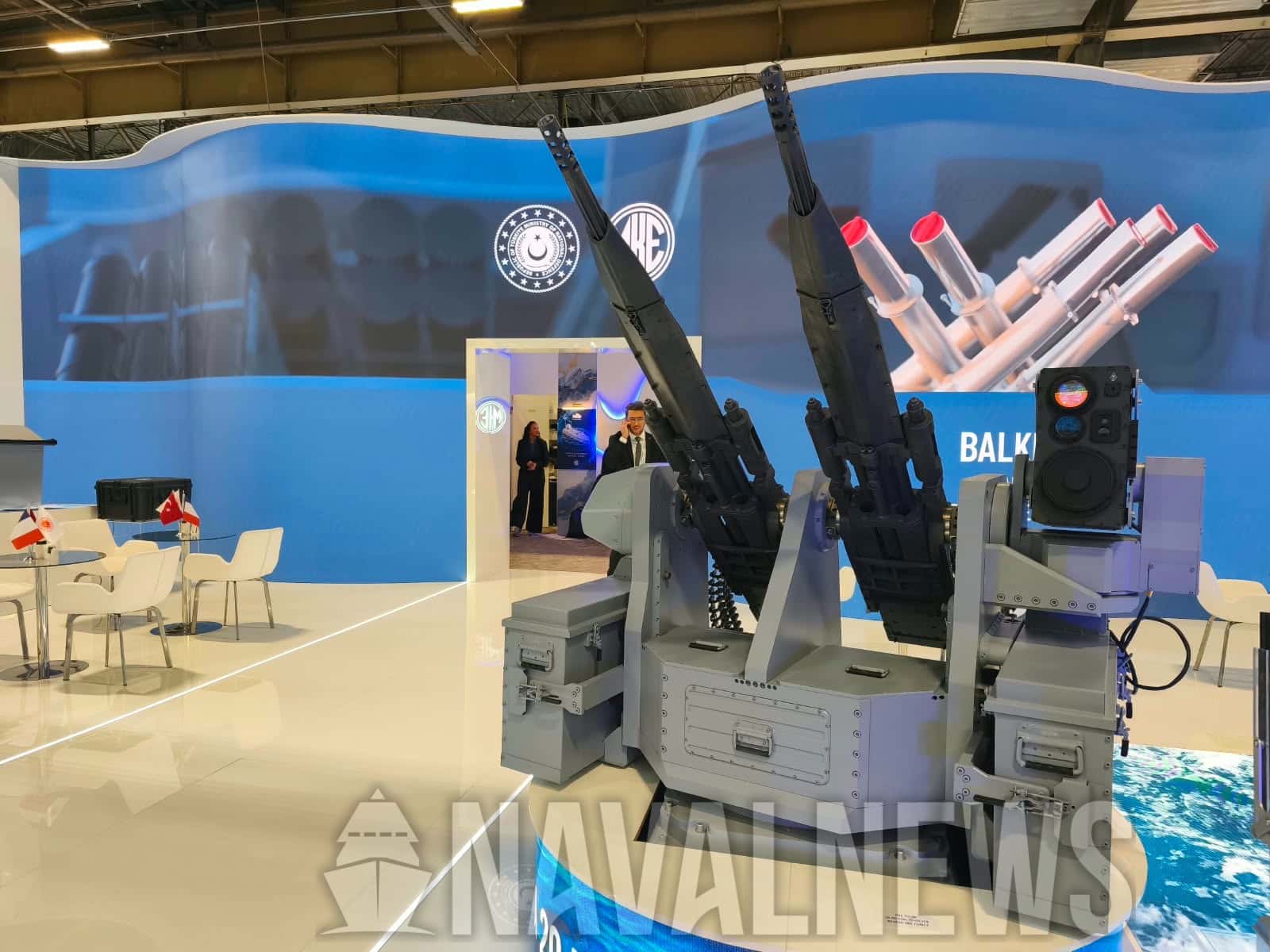
During Euronaval 2026, Turkish defence company MKE showcased the TOLGA 20mm Dual Gun System, a naval remotely operated weapon (RWS) station with high rates of fire designed for close-range defence against surface and aerial threats.
Low-cost FPV drones and loitering munitions are increasingly challenging conventional air defence systems through coordinated swarm attacks. Meanwhile, the low radar cross-section and low-altitude flight profiles of cruise missiles make their detection and interception increasingly difficult for traditional defence systems. According to Türkiye’s Mechanical and Chemical Industry Corporation (MKE), the answer to these evolving threats is the TOLGA 20mm Dual weapon system.
This weapon system is designed to provide close-range protection against a range of threats, including unmanned aerial vehicles (UAVs) and unmanned surface vessels (USVs). Its dual-barrel architecture enables the independent operation of the two guns, providing continuous fire support over a wide engagement area. The system combines two revolver guns, electro-optical sensors and automated fire-control functions, with the ability to integrate external radars, electronic warfare systems and command-and-control networks.
The new weapon system was integrated into a warship for the first time and conducted engagements against air and sea targets from corvette TCG Beykoz during the TURNAS 2026 Exercise in October. The system achieved a 100% success rate across 24 scenarios, without any prior preparation.
Technical Specifications and Firepower
The TOLGA 20mm Dual features two guns with a combined adjustable rate of fire of up to 3,200 rounds per minute. MKE claims this is approximately three times higher than that of comparable systems worldwide. The TOLGA employs two 20mm gas-operated revolver guns firing 20×102mm ammunition. Each weapon has an adjustable rate of fire ranging from 1 to 1,600 rounds per minute, allowing the system to adapt its firing rate to different engagement requirements.
The guns have a stated effective range of 2,000 metres. For fragmented (airburst) ammunition, the effective range is specified at 1,000 metres. Fragmentation is achieved when the explosive charge inside the body is detonated, causing the body to rupture and scatter particles. A minimum of 20 fragments impact the target with high kinetic energy, causing damage.
The system allows each gun to use a different type of ammunition, with one firing conventional HEA ammunition and the other airburst rounds. The system also features a flexible ammunition-feed capability through a flexible chute, providing greater flexibility in weapon installation.
MKE highlights the system’s high accuracy, low dispersion, broad ammunition compatibility and reduced recoil characteristics. The remotely operated turret provides 360-degree azimuth coverage and an elevation range from -30 to +70 degrees. Both azimuth and elevation speeds are rated at 60 degrees per second, allowing rapid repositioning against targets.
The turret has a total weight of approximately 850 kg, including the weapons, and uses servo motors for movement. Its control architecture supports RS422, RS485, Ethernet and fibre-optic communications, using MKE’s proprietary Weapon Interface Control Document (ICD) protocol.
Sensors and Fire-Control System
The TOLGA is equipped with an electro-optical system for automatic target detection and tracking, consisting of three different components (daylight TV camera, thermal camera, laser rangefinder). Its fire-control system includes automatic ballistic calculations, day-and-night operation, a round counter and an end-of-ammunition warning function.
The system can be integrated with the ship’s combat management system (CMS), enabling its inclusion in the vessel’s threat evaluation and weapon assignment (TEWA) process. It can also be integrated with external radars, enabling multi-target tracking of up to 100 targets. Furthermore, MKE lists compatibility with jamming systems, allowing the TOLGA to be incorporated into a broader sensor and electronic warfare architecture.
MKE highlights the TOLGA’s stabilization capability, enabling fire-on-the-move operations and the engagement of moving targets. The system can be equipped with its own inertial navigation system (INS), while integration with a ship’s INS and NMEA network is also available.