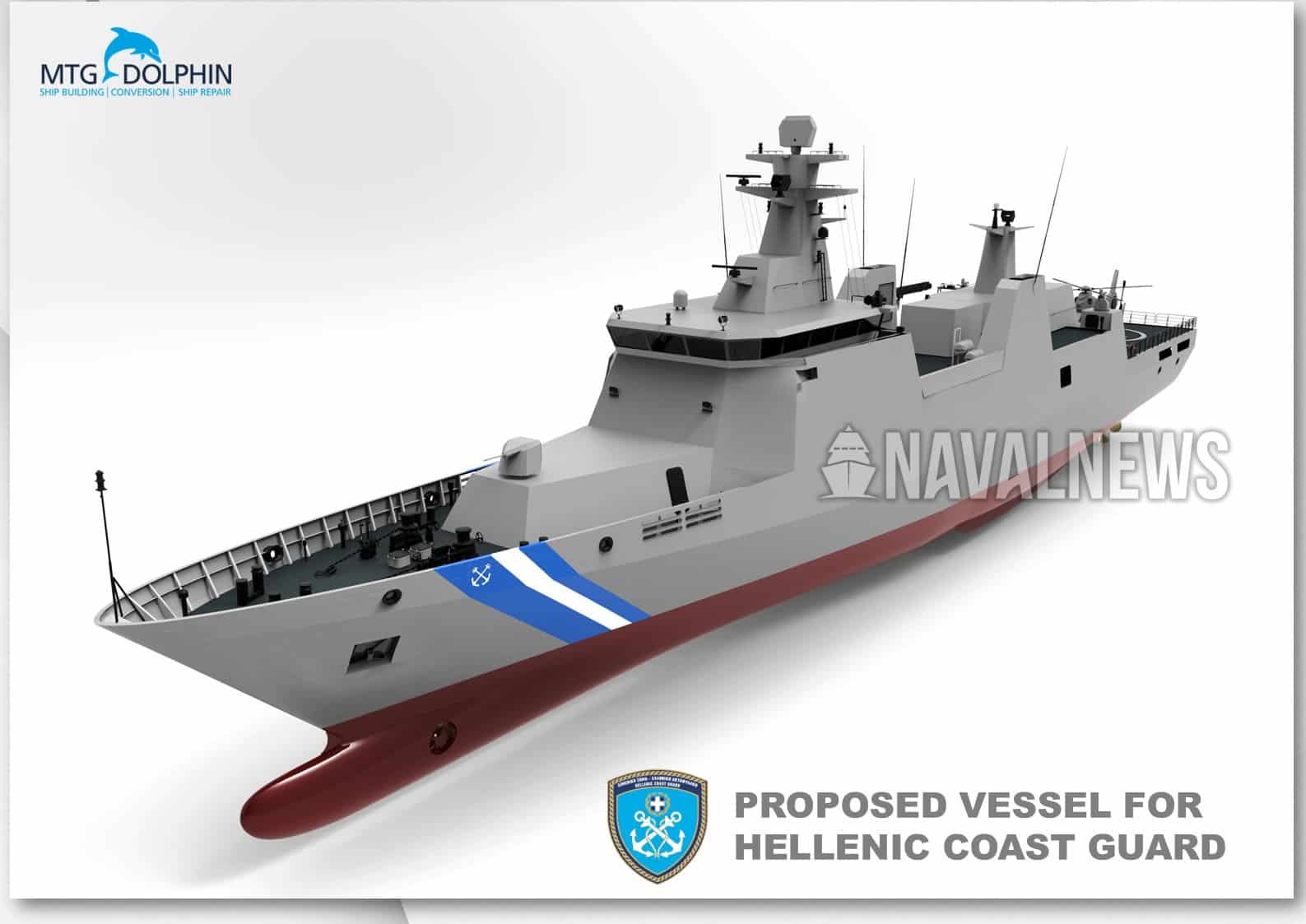
MTG Dolphin has proposed its OPV 90 design for the Hellenic Coast Guard’s upcoming 2+2 armed OPV programme, featuring helicopter and UAV capabilities.
During Euronaval 2026, Bulgarian shipbuilder MTG Dolphin revealed to Naval News that it has submitted the OPV 90, a design based on its K-90 corvette, for the Hellenic Coast Guard’s upcoming competition to acquire two plus two armed Offshore Patrol Vessels (OPVs). The tender is expected to be launched by the end of 2026. Other competitors include Damen, Kership and Fassmer.
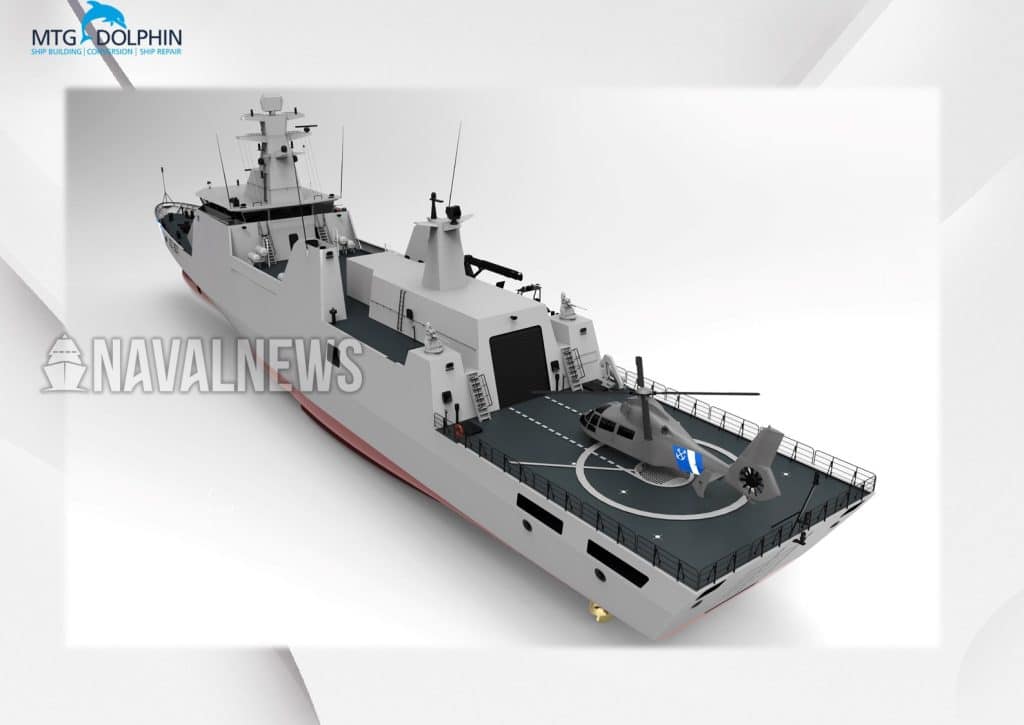
The Hellenic Coast Guard plans to procure two OPVs through a competitive dialogue procedure, with an option for two additional vessels. The ships will be over 80 metres long and feature a flight deck and an enclosed hangar capable of accommodating one helicopter and two Vertical Take-Off and Landing (VTOL) unmanned aerial vehicles (UAVs).
The new OPVs will be by far the largest and most capable vessels in the Hellenic Coast Guard’s fleet, significantly surpassing the existing Sa’ar 4 (OPV 58)-class and Stan Patrol 5509 vessels in terms of size, displacement and overall capabilities. They will provide the service with the ability to maintain a prolonged presence and conduct operations in areas of critical national interest, including under adverse weather conditions.

The initial contract was originally valued at €180 million, corresponding to €90 million per vessel, but its estimated value has increased to €246.4 million in September 2026. Exercising the option for two additional vessels would bring the total programme value to approximately €492.8 million. The programme is financed through European funds, with delivery of the first two vessels scheduled within 36 months of contract signature.
MTG will construct the vessels at its shipyard in Varna, Bulgaria, while the outfitting will take place at shipyards in Greece, in cooperation with several Greek companies. MTG highlights the high quality of its shipbuilding capabilities, pointing to the construction of the advanced MMPV 90 (Hrabri Class) corvettes for the Bulgarian Navy as an example of its ability to deliver sophisticated designs while maintaining very competitive costs.
General Characteristics of the new OPV
The vessels shall be constructed with a steel hull extending up to and including the main deck, including the helicopter deck (helideck). The superstructures shall be made of steel, aluminium alloys, or a combination of these materials.
Each vessel shall provide accommodation for 50 crew members. The vessels shall also feature side rescue areas designed for the immediate recovery of shipwreck survivors, as well as a suitably configured survivor accommodation area equipped with seating and toilet facilities for the temporary accommodation of 50 persons. In addition, the vessels shall be capable of accommodating a further 30 persons in suitable living quarters and shall have an additional transport capacity of at least 150 persons on the external deck areas.
The vessels shall have full operational capability in open-sea conditions up to Douglas Sea State 6, under all wind directions and in both head and beam seas. With regard to helicopter and UAV landing and take-off operations, the required capability shall be maintained up to Douglas Sea State 5, under all wind directions and in both head and beam seas.
The vessels’ survivability shall be ensured in conditions of at least Douglas Sea State 7. Each vessel shall achieve a maximum speed of at least 26 knots at full load, operating at 100% of the maximum continuous rating (MCR) of the main engines, with a clean hull and in calm sea conditions (Douglas Sea State 0–2). Furthermore, each vessel shall have a minimum range of 4,000 nautical miles at a speed of at least 12 knots, at full load, with a clean hull and in calm sea conditions (Douglas Sea State 0–2).
Aviation Facilities and RHIB
The vessels shall be equipped with a flight deck capable of accommodating one helicopter in the 11-tonne class, together with the necessary equipment to support helicopter operations, including refuelling facilities. Each OPV shall also be fitted with an enclosed hangar capable of accommodating one helicopter in the 6-tonne class and two identical VTOL UAVs. The UAV shall have a minimum range of 65 nautical miles and an endurance of six hours and shall be equipped with a maritime surveillance radar, a thermal imaging camera, and anti-jamming and anti-spoofing protection systems.

Each vessel shall further be equipped with at least two auxiliary high-speed boats, each with a minimum length of 9 metres and a maximum speed exceeding 45 knots. At least one of these boats shall be capable of being launched via a stern ramp. Additionally, each vessel shall be equipped with one rescue boat with a suitable launching system.
Electronic Equipment and Armament
The vessels shall be equipped with modern maritime navigation, radio communications and radio navigation systems, including an Electronic Chart Display and Information System (ECDIS), two electro-optical sensor systems mounted on the mast, providing 360° coverage and rotational capability, one X-band marine radar, one S-band marine radar, one 3D surveillance radar and an Automatic Identification System (AIS).

All information, including imagery from the two UAVs, shall be integrated through a single Command and Control (C2) system. The vessels shall also feature a dedicated, separate Command and Control Centre.
Each OPV shall be fitted with a permanent, fully integrated weapons system comprising, at a minimum, one 30mm remote weapon station (RWS), two 12.7mm RWS, and dedicated mounts for machine guns. The vessels shall also be provided with suitable ammunition storage facilities.