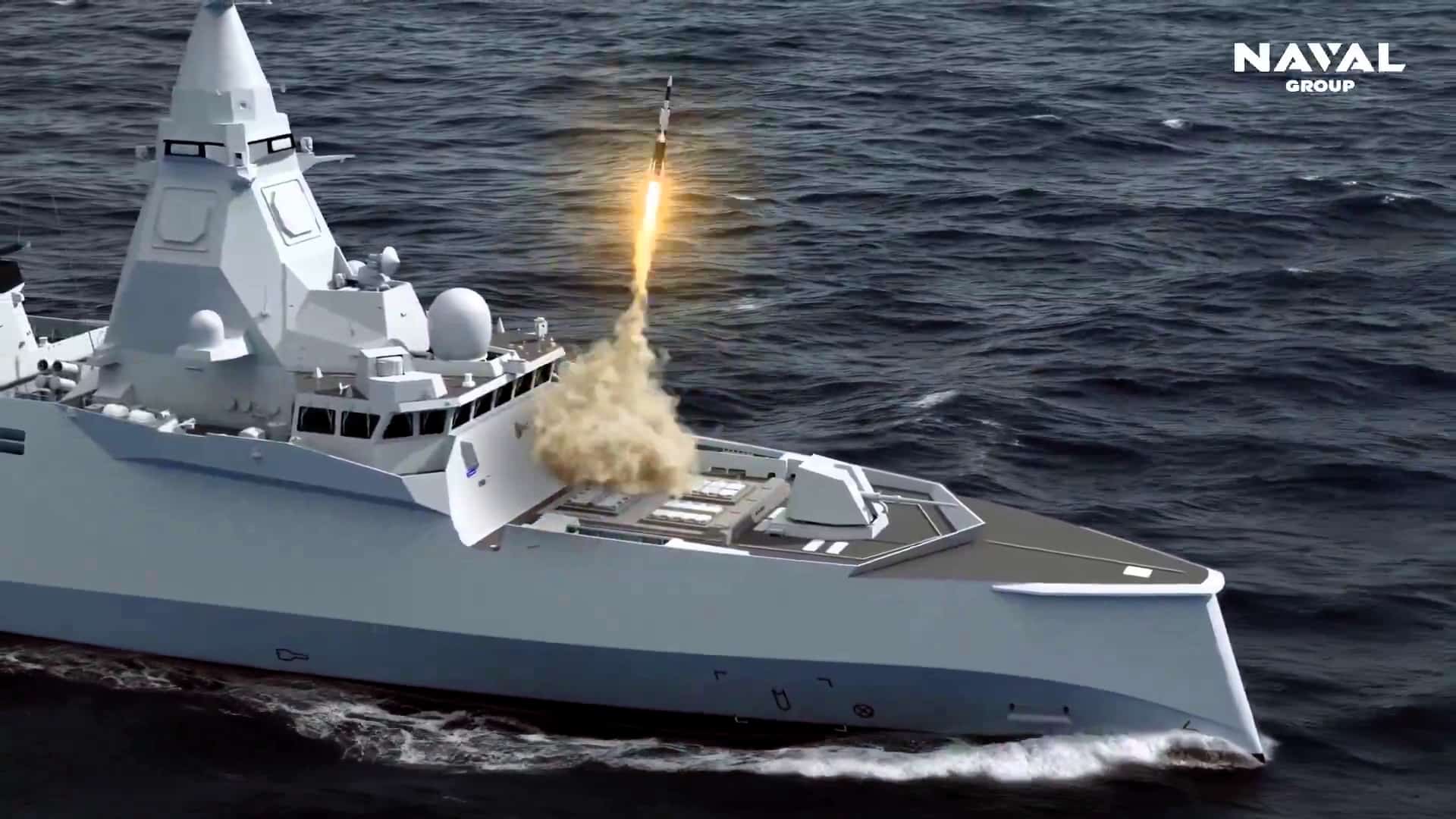
The French Directorate General of Armaments (DGA) has officially finalized an order with Naval Group and MBDA to double the air defense capabilities of the French Navy’s Defense and Intervention Frigates (FDI), increasing their capacity from 16 to 32 Aster missiles.
At the Euronaval 2026 exhibition in Paris, the French Ministry of Armed Forces announced the formalization of a contract that will significantly upgrade the firepower of the Marine Nationale’s newest frigates.
This official contract award locks in the industrial execution of a capability enhancement that was previously debated in parliament. As Naval News reported in November 2025, the French National Assembly’s Defense Commission confirmed during the 2026 budget discussions that the final two FDI frigates would be built with 32 cells and the first three vessels—starting with the lead ship Amiral Ronarc’h—would subsequently undergo retrofits.
According to the French Ministry of Armed Forces, the upgrade aims to bolster the lethality and resilience of the FDI frigates in an increasingly demanding operational environment. The ministry noted that this effort reflects France’s commitment to continuously adapting its naval capabilities to evolving strategic threats, ensuring the frigates are fully equipped for high-intensity maritime conflicts and saturation attacks.
The FDI program, managed by the DGA, is a central pillar of the French Navy’s modernization strategy. These 4,500-ton, data-centric, multi-mission warships are designed to operate in all types of sea states and threat environments. The lead ship of the class, Amiral Ronarc’h, was delivered to the French Navy in October 2025, marking the beginning of a five-ship fleet for the Marine Nationale.
The Aster missile family remains the backbone of European naval air defense, currently equipping the aircraft carrier Charles de Gaulle, Horizon-class air defense destroyers, FREMM multi-mission frigates, and the new FDIs.
- Aster 15: With a range of over 30 kilometers, this variant specializes in intercepting aircraft and sea-skimming anti-ship missiles.
- Aster 30: Extends the fleet’s defensive umbrella beyond 120 kilometers and, in its most advanced variants, integrates some anti-ballistic missile capabilities.
Both missiles feature exceptionally high maneuverability thanks to the unique “PIF-PAF” control system and lateral thrusters fitted in the Aster missile, allowing them to reliably intercept highly agile modern airborne threats.
The move to a 32-cell vertical launch system (VLS) configuration also perfectly aligns the French Navy’s frigates with the platform’s successful export variants. The FDI has already proven to be an export success for Naval Group, most notably with the Hellenic Navy and the Royal Swedish Navy. Greece’s Kimon-class frigates were ordered from the outset with the expanded 32-missile configuration, highlighting the international demand for deep magazines and sustained air defense capabilities. Sweden similarly signed a contract in August 2026 for four FDI frigates to form its future Luleå-class. This export momentum continues, with Naval Group actively running ongoing campaigns to pitch the FDI for future frigate programs in Denmark and Belgium.
During Euronaval 2026, Naval Group unvealed the “FDI family”, which now includes a new, larger and more powerful variant alongside the existing FDI in its various configurations. The larger FDI, sporting a 9-meter-long section added amidships, is mainly intended for export, according to a DGA source who spoke to Naval News.