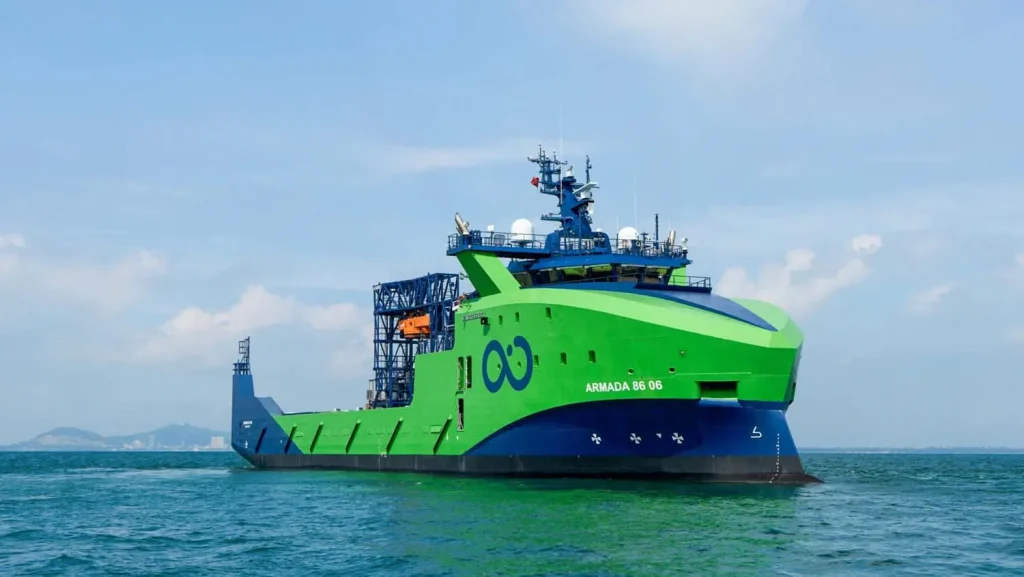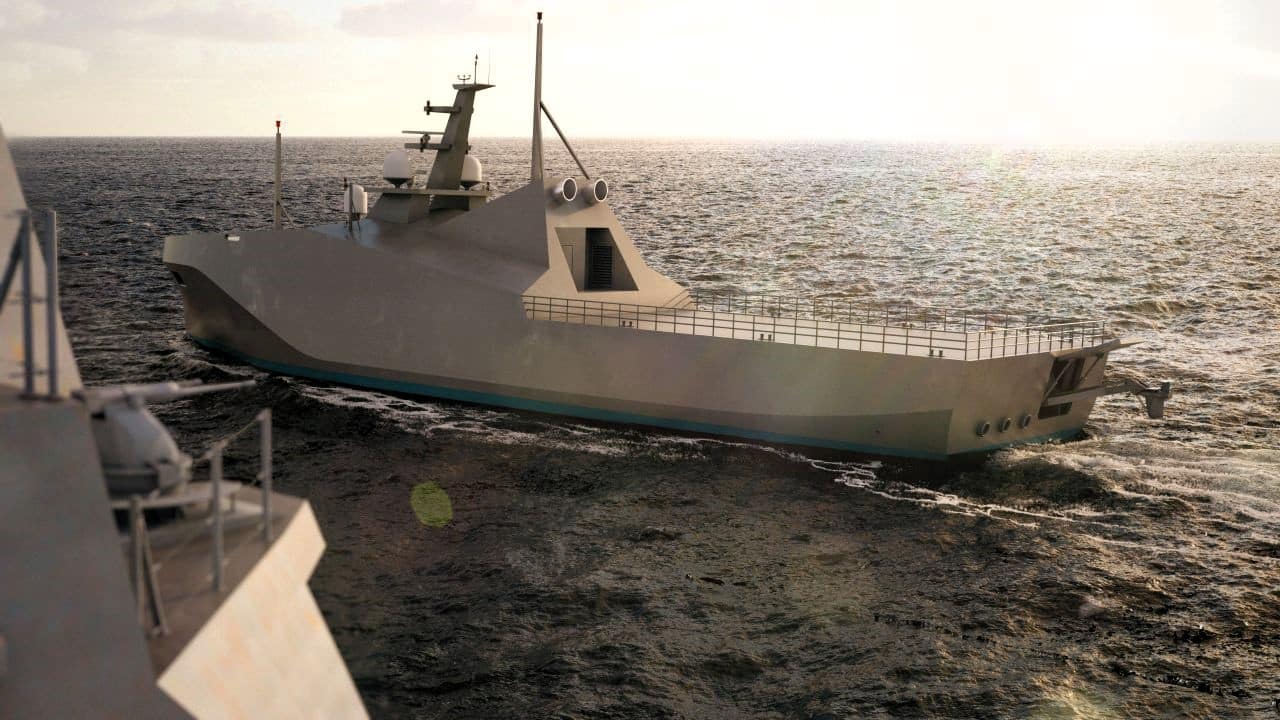
Thales and Kongsberg have announced the signing of a memorandum of understanding (MoU) to develop anti-submarine warfare (ASW) sensing capability designed to meet UK Royal Navy (RN) operational requirements for its future Type 92 uncrewed surface vessel (USV).
Type 92 is designed to deliver capability to support the RN’s emerging ‘Atlantic Bastion’ North Atlantic ASW operational concept. ‘Atlantic Bastion’ is the underwater element of the navy’s wider ‘Atlantic Fleet’ operational construct, through which the service will deliver crewed/uncrewed ‘hybrid navy’ outputs to support national and NATO deterrence and defence requirements across the region.
Under the MoU, the UK business of Anglo-French advanced defence technology company Thales and Norwegian aerospace, defence, and security company Kongsberg will combine to integrate Thales’ proven ASW technologies onboard Kongsberg’s Arctic Hunter USV, overlaying these two elements with advanced autonomous technologies and artificial intelligence (AI)-led enhancements to support underwater sensing, communications, and tactical planning, Thales said in a 10 November statement.
Overall, the statement added, the package is designed to accelerate the creation of “a credible, rapidly deployable ASW solution, aligned with the RN’s ‘hybrid navy’ ambitions and the growing requirement to detect, deter, and defend across the North Atlantic”.
On 9 November, Kongsberg Maritime released its own statement, highlighting Arctic Hunter’s capacity for rapid integration and deployment with ‘hybrid’ fleets, and how it draws on proven commercial vessel designs and Kongsberg’s remote and autonomous technologies to deliver a platform offering significant payload space, alongside capacity for construction at pace.
Particularly, Kongsberg noted, “Operating from a forward support base inside the Arctic circle, the Arctic Hunter USV is designed to provide persistent sensing capability to augment the existing multi-asset ASW infrastructure in the High North.”
Arctic Hunter is not yet in build. However, Kongsberg will work with UK-based Balaena Maritime to build and deliver the USV for the RN from Balaena’s Birkenhead [UK] yard, with vessels “ready for militarisation and operational deployment by the end of this decade”, Kongsberg said.
“We aim to collaborate with Balaena Maritime to establish a production line for the UK requirement,” Bruce Balchin – Senior Consultant, Naval at Kongsberg Maritime – told Naval News. “We are responding to the RN’s demand signal for Type 92 capability, as the priority ‘hybrid navy’ asset.”
Thales’ contribution to the combination will include advanced sonar technology, secure communications, its cortAix AI accelerator, plus modelling and planning tools, its statement said.
In the statement, Thales UK chief executive officer (CEO) Phil Siveter said, “The future ‘hybrid navy’ will be defined by how effectively the platforms are connected, how they share information, and how quickly they can turn that information into operational advantage.”
In its own statement, Kongsberg Maritime CEO Lisa Edvardsen Haugan said: “Atlantic security is an absolute priority, and we believe that Arctic Hunter offers a robust and practical response to the growing need for additional submarine detection capability.”
Threats and advantage
The RN’s ‘Atlantic Fleet’ concept is designed to develop a crewed/uncrewed ‘hybrid navy’ force structure to deliver such operational advantage against the sustained maritime – especially underwater – threat in the North Atlantic, on NATO’s northern flank.
‘Atlantic Bastion’ is the underwater component of this concept, designed to provide in two stages – ‘Atlantic Net’, then ‘Atlantic Bastion’ – integrated crewed/uncrewed sensing capability involving, firstly, uncrewed underwater vehicles (UUVs) around the Greenland-Iceland-UK (GIUK) Gap, and secondly then spreading out across the North Atlantic into other key waters and encompassing other assets like large USVs (LUSVs) and extra-large UUVs (XLUUVs), plus crewed platforms like the RN’s Astute-class nuclear-powered attack submarines (SSNs) and Type 26 ASW frigates, along with the UK Royal Air Force’s P-8A Poseidon maritime patrol aircraft.
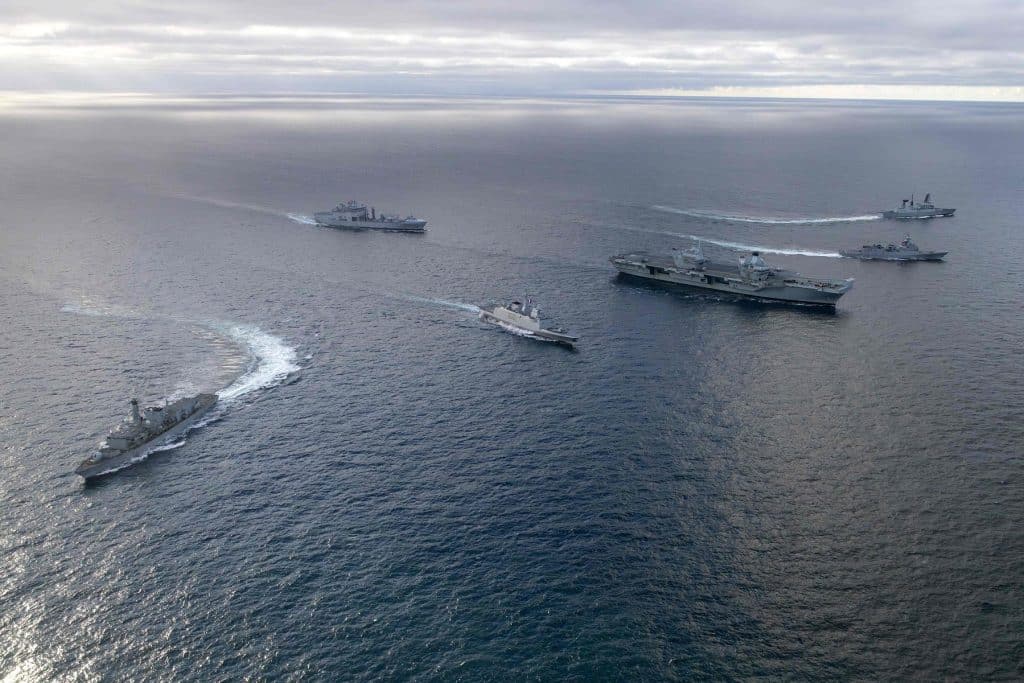
‘Atlantic Shield’ will see LUSVs also employed alongside crewed surface vessels to establish integrated air and missile defence layers around carrier strike, amphibious, and surface action groups.
‘Atlantic Strike’ will bring layers of crewed and uncrewed strike elements to enhance deterrence against threats to such at-sea groups in the first place, through demonstrating capacity and capability to strike back.
As it constructs this concept around developing new crewed and uncrewed capabilities, the UK is working with partners at both national and naval levels. Norway is a key partner, here. The two countries signed the Lunna House strategic partnership accord in December 2025, which brings particular focus on maritime capability co-operation; the RN and the Royal Norwegian Navy (RNoN) are already collaborating in developing ‘Atlantic Bastion’, too. The two navies also work closely together on the UK-led Joint Expeditionary Force (JEF) maritime element, a 10-country, Northern European security-focused construct designed to deter threats at the sub-conflict-threshold, non-NATO level; and on the Maritime Capability Coalition, under which multiple countries co-operate to provide naval capability for Ukraine.
The Thales/Kongsberg announcement coincides with the RN hosting the ‘Atlantic Future Forum’ conference, a major three-day international event, onboard its Queen Elizabeth-class aircraft carrier HMS Prince of Wales in Oslo, Norway.
DIP details
Details on the RN’s Type 92 programme first emerged in the UK’s latest defence investment plan (DIP), published in June 2026.
Over a four-year spend period out to 2030 and adding up to at least GBP1.3 billion, the DIP set out UK plans for several new uncrewed platforms to support ‘Atlantic Fleet’ requirements. These included: the Type 92 and the Type 093 XLUUV, both supporting ‘Atlantic Bastion’; the Type 091 uncrewed missile platform, supporting both ‘Atlantic Shield’ and ‘Strike’; and the Type 094 uncrewed radar platform, supporting ‘Atlantic Shield’.
UK First Sea Lord General Sir Gwyn Jenkins previously has stressed the need to have ‘Atlantic Bastion’ sensing in the water in 2026, LUSVs demonstrating ‘Atlantic Shield’ escort capacity in 2027, and ‘Atlantic Strike’ technology demonstrators launched from aircraft carriers in 2026.
Naval News Comment
The importance of ‘Atlantic Bastion’ and the Type 92 programme is reflected in the fact that the RN and RNoN both bring significant underwater deterrence and defence capability to NATO’s northern flank, and both occupy significant geostrategic positions there.
The UK sits at the eastern end of the GIUK Gap maritime chokepoint, an underwater gateway that needs securing to ensure US Navy ‘heavy metal’ can access the North Atlantic region en masse in the event of crisis or conflict.
Norway’s northern coast sits underneath Northern Cape waters, through which Russian submarines heading west from the Barents Sea must slip; in so doing, these boats must cross the Bear Gap – another maritime chokepoint, this time running from Norway’s Svalbard Island in the north, down past Bear Island, and to the tip of Norway’s northern coast.
In the event of any crisis or conflict, together the two navies – with their collective future Type 26 frigates, the RN with its Astute-class SSNs and the RNoN with its future Type 212CD SSKs (diesel-electric submarines), both with their P-8As in the air, and together with collective uncrewed system capabilities across all domains – will be seeking to push Russian submarines back through the Bear Gap, into their Barents Sea bastions, and out of reach with their Kalibr cruise missiles from a greater number of NATO targets ashore and at sea.
NATO’s collective underwater presence around the Bear Gap is also supported by Norway’s submarine support facility at Grotsund, near Tromsø, northern Norway. Access to such a facility enables NATO submarines to remain on station in that region for longer periods.