The Japan Maritime Self-Defense Force (JMSDF) is shifting towards a ‘software first’ approach in capability development, to build a force structure that can respond to the contemporary naval operating environment and its changing technologies and threats, a senior JMSDF officer has explained.
“The operational domains in maritime security are rapidly expanding from physical to non-physical. We must move towards a capability-centric and a ‘software first’ posture to remain agile and relevant,” Rear Admiral Naoya Hoshi, the JMSDF’s Director General Logistics, told the Combined Naval Event 2025 conference in Farnborough, UK in late May.
“The ‘software first’ approach we are advocating signifies a shift from the traditional platform-centric mindset to a capability-focused approach,” said Rear Adm Hoshi. “In this approach, platforms are viewed as a component within a networked system, with a goal of maximising overall capability rather than focusing solely on the performance of individual vehicles.”
This is regardless of whether the platform is a ship, aircraft, or uncrewed system, the admiral continued. “When we build platforms around adaptable software, we gain speed, flexibility, and sustainability.”
“This [approach] unlocks agility, enables rapid innovation, and allows us to adapt quickly to new threats and operational needs,” he added.
“This shift is not only necessary, but urgent – especially in an era where technology evolves faster than ever before,” Rear Adm Hoshi stressed.“‘Software first’ is no longer an option: it is essential to sustain operational effectiveness.” With the communications and information domains now proving decisive and with platforms alone no longer guaranteeing advantage, “Superiority now hinges on the ability to sense threats, analyse data, and make rapid, informed decisions,” the admiral said. “The human/machine interface, augmented by software, is a new front line of maritime advantage.”
Underlining lessons learned from the commercial world – such as in cars or communications – Rear Adm Hoshi said “Software must be iterated constantly, just like apps on a phone.” “Legacy defence programmes with a 10-year timeline simply cannot keep up,” he continued. “To maintain operational relevance, we must move from long-cycle development to continuous improvement.”
This requirement for operational relevance is set against a strategic background and operational environment in which the JMSDF supports some enduring themes but recognises the need to respond to change.
Noting the world has entered ‘a new era of crisis’, Rear Adm Hoshi said the JMSDF’s core principles remain: to deter threats through continuous peacetime operations; and to retain capacity to respond decisively in the event of crisis. Its focus areas include conducting round-the-clock intelligence, surveillance, and reconnaissance (ISR) and safeguarding maritime trade and traffic, plus the supporting sea lines of communication, in Japan’s waters, surrounding regions, and further afield (including the Gulf of Aden and the JMSDF’s counter-piracy operation there); and to enhance Indo-Pacific security and stability by supporting free trade and economic prosperity, freedom of navigation, the rule of law, and the maintenance of the rules-based order.

Yet the continuing conflict in Ukraine is underscoring the urgency of the JMSDF’s capability and operational transition to a ‘software first’ approach. In Ukraine, the use of uncrewed systems, cyber tools, and artificial intelligence (AI) can shift the balance in the war, said Rear Adm Hoshi, with such technologies evolving in months, weeks, or even days, not years.
Such technologies rely on rapidly evolving software plus high-quality data, the admiral said. In this context, he explained, software and data are foundational, strategic-level enablers.
As regards software, Rear Adm Hoshi said “It enables autonomy, resilience, and adaptability across domains. It serves as the brain behind the complex systems, from integrated missile defence to autonomous vehicles.”
As regards data, the JMSDF sees it as central in transforming its thinking about maritime power, he added. “Data now powers decisions …. It informs readiness, logistics, mission planning, and even training.”
These two strategic enablers are also linked, Rear Adm Hoshi explained. “The ‘software first’ approach depends on operational data. To stay agile, we need real-time feedback loops from the field to development.” “Without this, software becomes disconnected from real-world needs,” he added.
Rear Adm Hoshi explained that a ‘software first’ approach has various implications, including: needing to decouple software from hardware lifecycles; designing platforms as part of an interconnected ‘system of systems’; leveraging open architectures; and developing shared data standards.
Even for platform hardware, the increasing use of non-consumable munitions like directed energy weapons is shaped by the rapid integration of data and software. “To be clear, hardware is still essential – but it is software that defines how effectively a platform performs, how quickly it can be updated, and how adaptable it is across missions,” said Rear Adm Hoshi.
Uncrewed systems are a manifestation of this shift in the hardware/software balance, the admiral explained. “These platforms operate in physical domains on, above, or below the sea, but their real strength lies in software-driven autonomy,” he said. “In increasingly contested environments, the ability to operate with limited human control, or even fully autonomously, is becoming crucial. Success will depend on machine learning, edge computing, and seamless human/machine teaming.”
For example, the JMSDF’s indigenous OYX-1 computer/console display system is designed around an open architecture approach to support modular, scalable software applications for crewed platforms and for management of uncrewed systems. Illustrating the flexibility at the core of the JMSDF’s capability-centric development strategy, OYX-1 can rapidly adapt and evolve operational functions through software rather than hardware upgrades, Rear Adm Hoshi told Naval News.
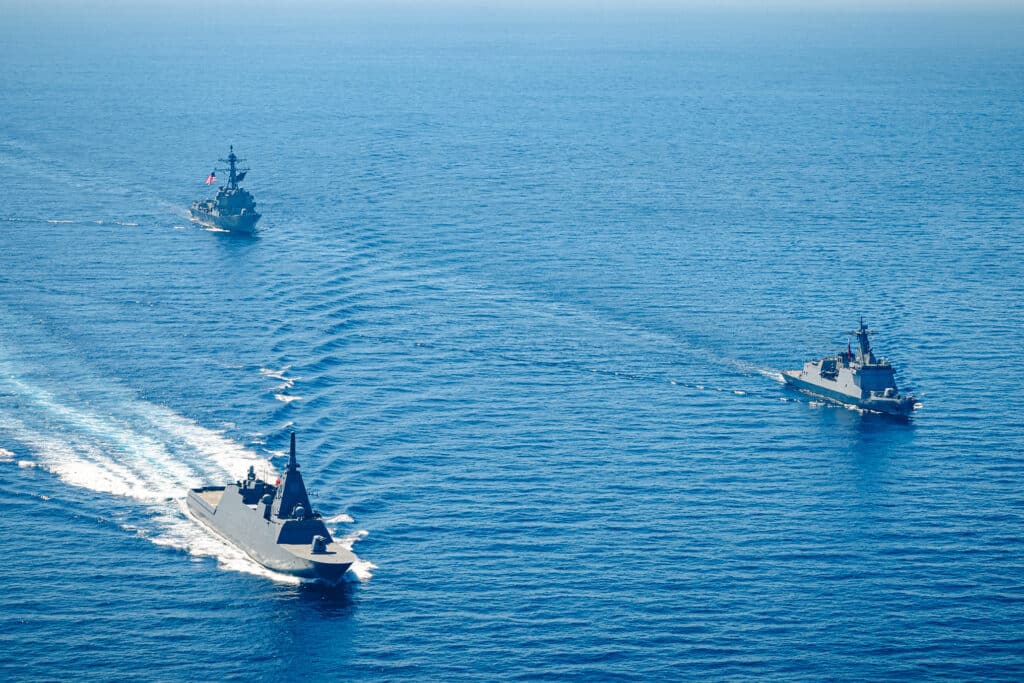
OYX-1 is fitted onboard the JMSDF’s new Mogami-class multirole frigates. The frigates are the newest fleet additions, with eight of the planned 12 ships commissioned (the first entering service in 2022, and the most recent – JS Yūbetsu – arriving in June). The Mogami frigates are adaptable and designed for continuous evolution, Rear Adm Hoshi added. To reduce manpower needs, they use high levels of automation onboard and deploy uncrewed systems offboard.
An upgraded generation of the frigates is scheduled for delivery by 2028.

In concluding his conference remarks, Rear Adm Hoshi said “We must shift from platforms to capabilities, from hardware-centric to ‘software first’, and from fixed cycles to real-time adaptation.” “This shift is not just technical: it is cultural and organisational,” he added.
Naval News Comment
Shifting from a platform focus to a capability-, network-, or data-centric approach is not new amongst navies. However, the JMSDF’s highlighting of the significance of software in this approach is very striking. Navies and industry have already been talking about, and are developing, software-defined systems. Yet, the JMSDF seems to be stepping this up to a higher level, looking to base its entire approach to force structure development – whether crewed or uncrewed systems – around this capability-centric, software-first approach.