The Royal Navy (RN) has no choice but to pivot to an increasingly uncrewed and autonomous hybrid fleet if it is to achieve the lethality, survivability, persistence and mass necessary for warfighting in the North Atlantic and High North, the head of the service has said.
Speaking at the Defence Leaders Combined Naval Event (CNE) 2026 conference and exhibition in Farnborough on 19 May, First Sea Lord and Chief of Naval Staff General Sir Gwyn Jenkins warned that legacy force design could no longer deliver the capabilities required to meet the challenge from Russian surface and subsurface forces. “We are at a fork in the road, and the decisions we take now will have seismic and lasting consequences, not just for the Royal Navy, but our nation’s security and prosperity for our very way of life,” he said. “The capable status quo is not good enough, not anymore.”
The key RN proposition into the 2025 Strategic Defence Review, the Hybrid Navy concept envisages a mix of crewed, uncrewed and increasingly autonomous ships, submarines and aircraft operating as an integrated force. Instead of concentrating capabilities and effects in a small number of high cost platforms, the new model spreads functions – sense, decide, effect, connect, host and enable – across multiple interconnected platforms. Proponents argue that this approach delivers more capability for a given cost, increases mass and firepower, and gives commanders more flexible and resilient options.
The RN intends that Hybrid Navy will underpin its three core ‘Atlantic-series’ activities: ‘Atlantic Bastion’, which will protect the continuous at-sea deterrent and critical national infrastructure through the deployment of new anti-submarine warfare capabilities, autonomous sub-surface systems, and a layered sensor network; ‘Atlantic Shield’, which represents the maritime contribution to integrated air and missile defense; and ‘Atlantic Strike’ as the means to deliver force projection at and from the sea
Giving the CNE 2026 keynote address, General Jenkins said the shift to the Hybrid Navy – which as been both informed and influenced by Ukrainian successes in the Black Sea – marked a decisive move away from a mindset demanding ever bigger and more expensive platforms. “That is an outdated approach that no longer holds,” he told attendees.
“What we need to do is to reduce the cost per unit and time for production to achieve the scale we need, because the reality is that there is no scenario in which we have unlimited resources. There will never be enough resource.”
First Sea Lord and Chief of Naval Staff General Sir Gwyn Jenkins
“Our task is to do the best with that available, and be able to scale it rapidly when needed. The approach is therefore simple: crewed where necessary, uncrewed wherever possible, and integrated always.”
The shift was not only about platforms or payloads, General Jenkins continued, but also embodied a fundamental change in the way the RN would fight at, and from, the sea. “We are moving from a model centered around conventional platforms to one in which capability is distributed across a wider and more survivable mix of assets. Modularity, interoperability, interchangeability, and digital connectivity must become the norm rather than the exception. The core functions of the Royal Navy – sensing, understanding, deciding and acting – must be orchestrated across crewed and uncrewed systems alike. This will restore something the Royal Navy has lacked for decades, rapidly scalable and adaptable mass, and it allows us to increase tempo to complicate an adversary’s targeting picture and to impose cost at a pace they cannot match.”
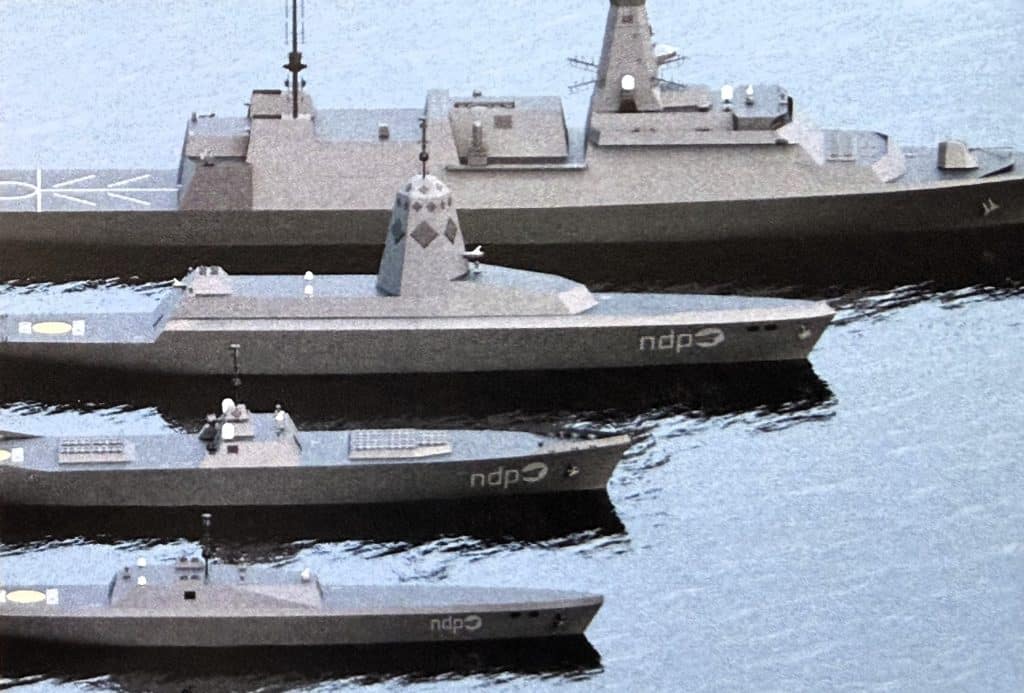
Pushing back hard against critics of his plan, both within and outside the navy, the First Sea Lord acknowledged there were still hybrid skeptics. “But here’s the hard news,” he said. “We have no time to pander to cynicism or traditionalists, because autonomy is already demonstrably changing the nature of warfare, as evidenced in Ukraine and in the Middle East.”
“In fact, I’d go further than that. Drones and autonomy have rapidly become the dominant and decisive factor in the modern battle. We luckily also know our plan will work because we have tested it in our Navy-wide hybrid war games. Compared to our current fleet, the hybrid model delivered a substantial uplift in combat mass, provided additional flexibility and tactical choice for commanders, and increased our missile capacity three-fold to the level necessary to win a contest in the North Atlantic. Across the deterrent, carrier and amphibious strike groups and integrated air and missile defense our readiness to respond also improved markedly.”
General Jenkins added that the force package currently being readied for operations in the Strait of Hormuz – including autonomous mine countermeasures systems and Kraken uncrewed surface vehicles rapidly acquired under Project Beehive – would provide a first glimpse of the Hybrid Navy in action. “[The] Beehive boats…will enable the multinational force to sense, track, and identify potential threats in a way that it has never been able to do before,” he said. “When you’re potentially dealing with fast inshore attack craft, mines and subsurface threats in one of the world’s narrowest congested choke points, the ability to deploy at scale numbers of autonomous and uncrewed sensors and effectors confers a clear operational advantage.”
“This is surely something even our skeptics will recognize. The planning for this has been a huge undertaking, but we are now finally ready to demonstrate to the world what the early stages of our hybrid navy can achieve, however this is just one step on a much bigger journey.”
“We have a plan, and we are implementing it, and we have the willingness to change the Royal Navy, because we must, because there is no choice.”
General Jenkins also emphasized the need for closer partnerships with industry. “I need those of you here today working in the private sector to embrace our plan too, because the technologies underpinning the Hybrid Navy – advanced communications, artificial intelligence, autonomy, modern manufacturing – are overwhelmingly driven by the commercial world at commercial speed, with the race now underway internationally to set the standards for uncrewed and autonomous systems.”
“The UK has a crucial opportunity to lead in this area to build credible capabilities and to become a world leading exporter, but to establish that credibility requires pace, and that requires that we collectively do procurement differently. That means multi-year acquisition models giving way to iterative spiral development. It means creating an environment that allows commercial and classified technologies to develop side-by-side. And it means enabling talent to flow more freely between the navy, industry and academia.”