Norway’s selection of the UK Royal Navy’s (RN’s) Type 26 to meet the Royal Norwegian Navy’s (RNoN’s) future frigate requirement will enable the two NATO navies to enhance their collective capability through operating a common platform, the RNoN’s head told Naval News.
“Operating identical equipment is a very good starting point if you really want to move from co-operation into deep co-operation and integration,” said Chief of Navy Rear Admiral Oliver Berdal, in an 18 September interview during DSEI UK. “Information moves at light speed, modern weapons move at hypersonic speeds, so co-operation is not enough. We need to integrate our most exquisite capabilities even more closely to maximize our future potential.”
NATO’s capability development philosophy for platforms, sensors, and weapons is evolving – increasingly rapidly – from interoperability to integration to interchangeability.
The frigate deal is a core component of a strategic partnership announced between Norway and the UK on 31 August. France, Germany, and the United States – also close partners for Norway – were the other participants in the selection process.
Norway plans to buy at least five Type 26s. The UK is already building eight for the RN. Together, the 13 ships will be delivered in a single, integrated production line at BAE Systems’ Govan and Scotstoun shipyards, where the RN’s build programme is at an advancing stage, with five ships under construction.
“For our government, it was very important to find that strategic partner, where we have that long-term perspective, because the ambition is to move from just buying the same equipment to buying, operating, developing, and co-operating – on maintenance, operations, and especially future innovations and further development of the ships,” said Rear Adm Berdal. “To succeed with that, you need identical ships.”
The two strategic partners share the same strategic perspective.
“We share the same threat, we share the same potential adversary. In addition, we share the same geography, which means the threat direction is the same,”
Rear Adm Berdal
“Being able to operate the same type of frigates in the North Atlantic and Norwegian Sea will enable us to build a more robust barrier towards whatever may come our way in the future.”
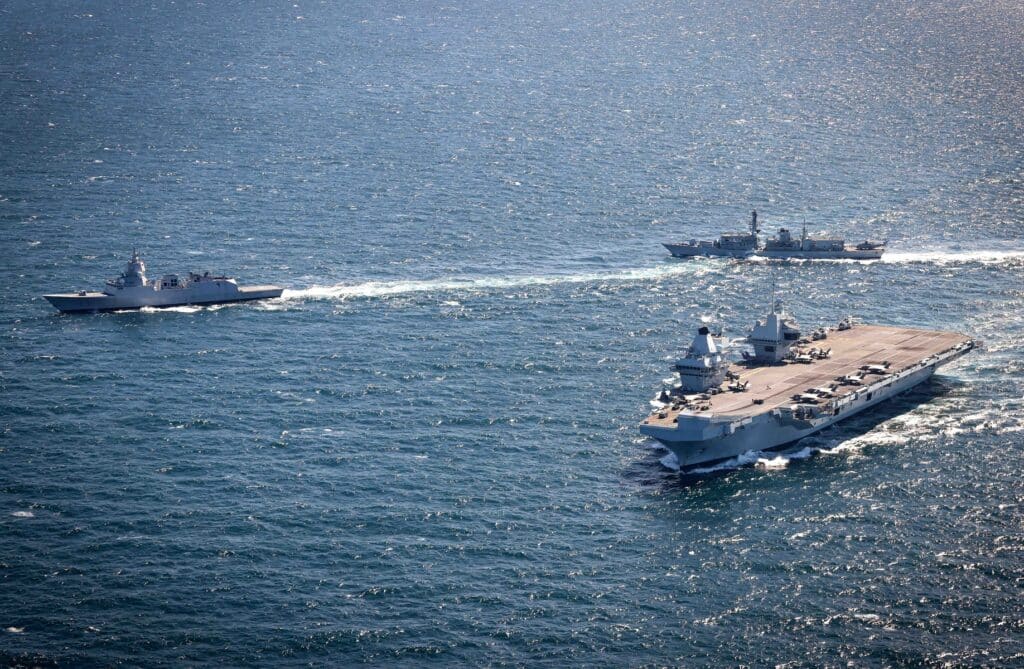
Rear Adm Berdal noted that combining an integrated frigate programme with other integrated programmes like the P-8 Poseidon maritime patrol aircraft – operated in the North Atlantic by the US, the UK, Norway, and (in due course) Germany – will help layer significant multidomain anti-submarine warfare (ASW) and anti-surface warfare capability across the North Atlantic and into the High North. The Type 26s and P-8s are also likely to be operating closely with uncrewed systems in the air, surface, and sub-surface domains.
Using uncrewed systems will present further opportunities for RN/RNoN co-operation. “We have to be shoulder to shoulder when it comes to the innovation cycle, especially for uncrewed technology, and especially if these are systems we’re going to use in the same areas,” said Rear Adm Berdal. “It does not necessarily make sense to end up with a lot of different variants of homegrown systems.”
Broadly, the next steps in the UK/Norway frigate programme and wider strategic partnership are, respectively: to finalise the industrial relationship, including drawing up a build contract; and detailing and signing the partnership itself. The two navies, however, are already taking steps forward together.
“I think we’re off to a good start,” said Rear Adm Berdal. For example, he highlighted the operational co-operation currently underway with the RNoN Fridtjof Nansen-class frigate HNoMS Roald Amundsen deployed in the RN’s HMS Prince of Wales carrier strike group (CSG) for the CSG25 deployment to the Indo-Pacific region. The Fridtjof Nansen frigates, plus other RNoN surface platforms like its logistics support ship HNoMS Maud, also pass through the RN’s Fleet Operational Standards Training (FOST) process as routine.
“The next big step will be for our two staffs to sit down and make a roadmap for how we can be forward leaning on the Type 26s, especially with regards to the uncrewed technology we will look into to augment these ships,” said Rear Adm Berdal. The two navies will also look at options for integrating RNoN personnel into ship’s companies onboard the early RN Type 26s.
Build programme
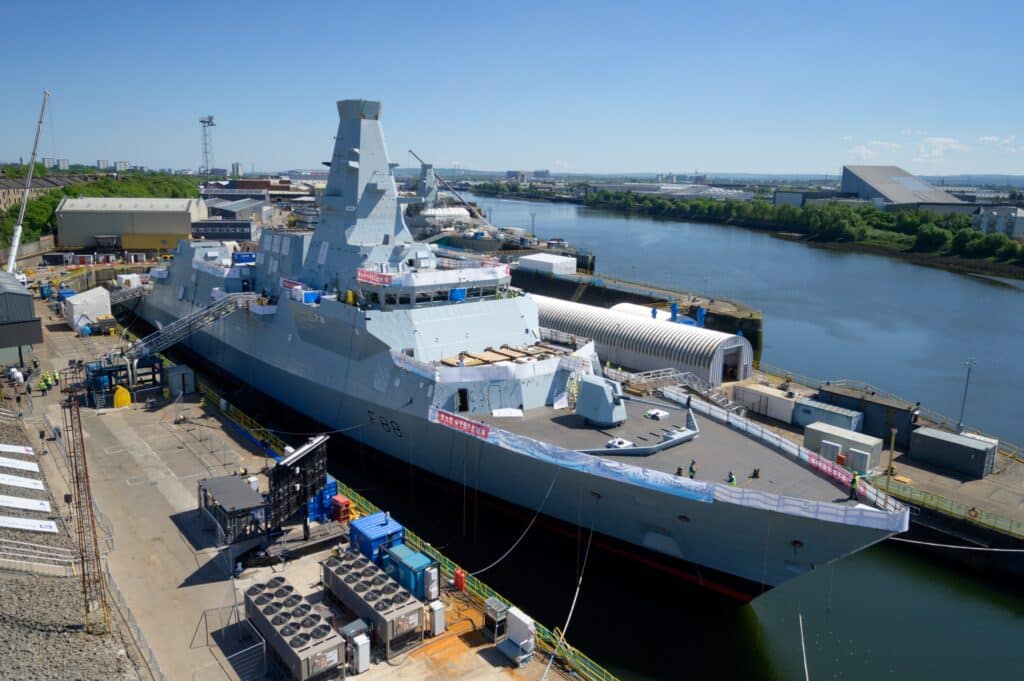
As regards the shipbuilding programme, BAE Systems has already streamlined the RN’s Type 26 delivery – prospectively, from ships four and five onwards – around a 66-month build duration per ship (from steel cutting to delivery) feeding into a 12-month delivery drumbeat. As detailed in Norway’s long-term defence plan, the RNoN’s requirement is for its first frigate to be delivered in the 2029/2030 timeframe. “Exact sequencing with the Norwegian ships will be agreed between the two governments as part of contract negotiations to ensure the programme meets the operational requirements of both navies,” BAE Systems told Naval News, in a statement.
“We are just going to treat it as a continuous, 13-ship build programme,” Geoff Searle, BAE Systems Naval Ships’ Programme Director for Future Business, told Naval News, in a 10 September interview. This approach, he explained, is enabled by significant recent investment in different areas of the shipyard and its capacity, designed to accelerate RN Type 26 production. “We already have been investing a lot in our production facilities and our capability in Glasgow …. We’ve been investing in our plans and our manufacturing capability.”
As regards allocating ships from the production line to either the RN or the RNoN, Searle said “We’ve already got ships very shortly starting to come off the production line, and whatever the UK and Norway agree about which is the first ship to go to Norway, we can accommodate that – but no decision has been made on that.”
Steady drumbeat
The infrastructure investments at Govan and Scotstoun that will enable accelerated build using a single, integrated production line through increasing capacity – as well as ‘future proofing’ the yards – include facilities like a new paint shop and adding a second panel line (with improved automation). However, the most significant development has been the opening, earlier in 2025, of a covered shipbuilding hall. This new facility means build occurs inside, sheltered from what can be challenging weather outside, and provides centralised access to facilities, tooling, and information that support the build work. Most significantly, the hall provides space for two ships to be built simultaneously.
“The investment we’ve made enables us to get to the 66-month build duration/12-month delivery drumbeat,” said Searle. “We’ve got to get into steady state now on that, and then continually look to improve our processes and capacity even further.”
With RN ships Glasgow and Cardiff already in the water, lessons have been learned too from the first few ships’ construction regarding accelerating the build process, for example enhancing the block build approach and increasing outfitting levels onboard each hull before launch.
Overall, Searle explained, the shipyards’ drumbeat pace has picked up through “partly learning, partly process improvement, and partly investment in capacity.”
Integrating both navies’ orders into a single, accelerating production line has been enabled too by the fact that the design requirements for each navy’s ships are identical, Sven Hanssen, BAE Systems’ Head of Shipbuild, added.
“The philosophy remains that the ships should be identical, because what we’re now talking about is interchangeability,” said Hanssen. There is no intent to have anything different on the platforms, although there will be bespoke sovereign aspects like cryptographic and communications equipment.
RNoN personnel have visited the shipyard, so have a good feel for what the ships will be like, said Hanssen.
Reflecting the deepening equipment commonality between the two navies, the RN is already introducing Norway’s Naval Strike Missile (NSM) onboard its in-service Type 23 frigates and Type 45 destroyers. Both the RN and RNoN operating NSM could make it a candidate for Type 26.
Building 13 identical ships also provides longer-term capability benefit. “The deal is done as a partnership. With that comes spiral development as well: so, the two countries will develop these ships together, through their 30–40-year lifespan,” said Hanssen. The aim is to work together on the same capability upgrades through life to keep the ships as identical as possible, Searle added.
Next steps
The next steps in the programme’s progress are a mix of political and practical.
First, at the political level, the two countries will work on the details of the government-to-government memorandum of understanding (MoU), signed in early September, which sets the framework for the partnership and the processes to follow. “Over the coming months, we expect the individual elements of the MoU – of which the frigates are the main part – to be defined,” said Searle. For BAE Systems, these individual elements will encompass aspects like defining the frigate programme and build contract, and preparing and progressing MoUs and collaboration agreements with Norwegian industry. One such agreement is to extend and cover a drydock in Harstad, northern Norway to allow Type 26s to be maintained there if desired.
At a practical level, RN lead ship Glasgow is approaching diesel generator trials. This is a key milestone, being the first time the ship receives electrical power from its own plant.
Naval News Comment
These latter developments illustrate the critical importance of time in the Type 26 programme. The significant underwater threat NATO and its navies face today in the North Atlantic underscores the need to bring the state-of-the-art ASW capability provided by the Type 26 frigate into operational service as soon as possible. Glasgow’s ‘lighting up’ through ‘DG trials’ is a key step in commissioning this capability. The agreement to develop a drydock in Harstad illustrates the importance of sustaining Type 26 forward-deployed time on station, to deter adversary activity underwater in the Norwegian Sea through enhanced forward presence. Together, the 13 UK/Norway Type 26s and those to be contributed by the Royal Canadian Navy (whose Type 26s are arriving under its River-class destroyer programme) will provide a formidable forward-deployed ASW force.