BAE Systems has launched a new family of naval guns, which provide capability to conduct counter-uncrewed aerial system (c-UAS) self-defence activities including onboard smaller naval vessels.
The launch of what is called the Sea Tridon programme was announced at the Euronaval exposition in Paris, France on 3 November.
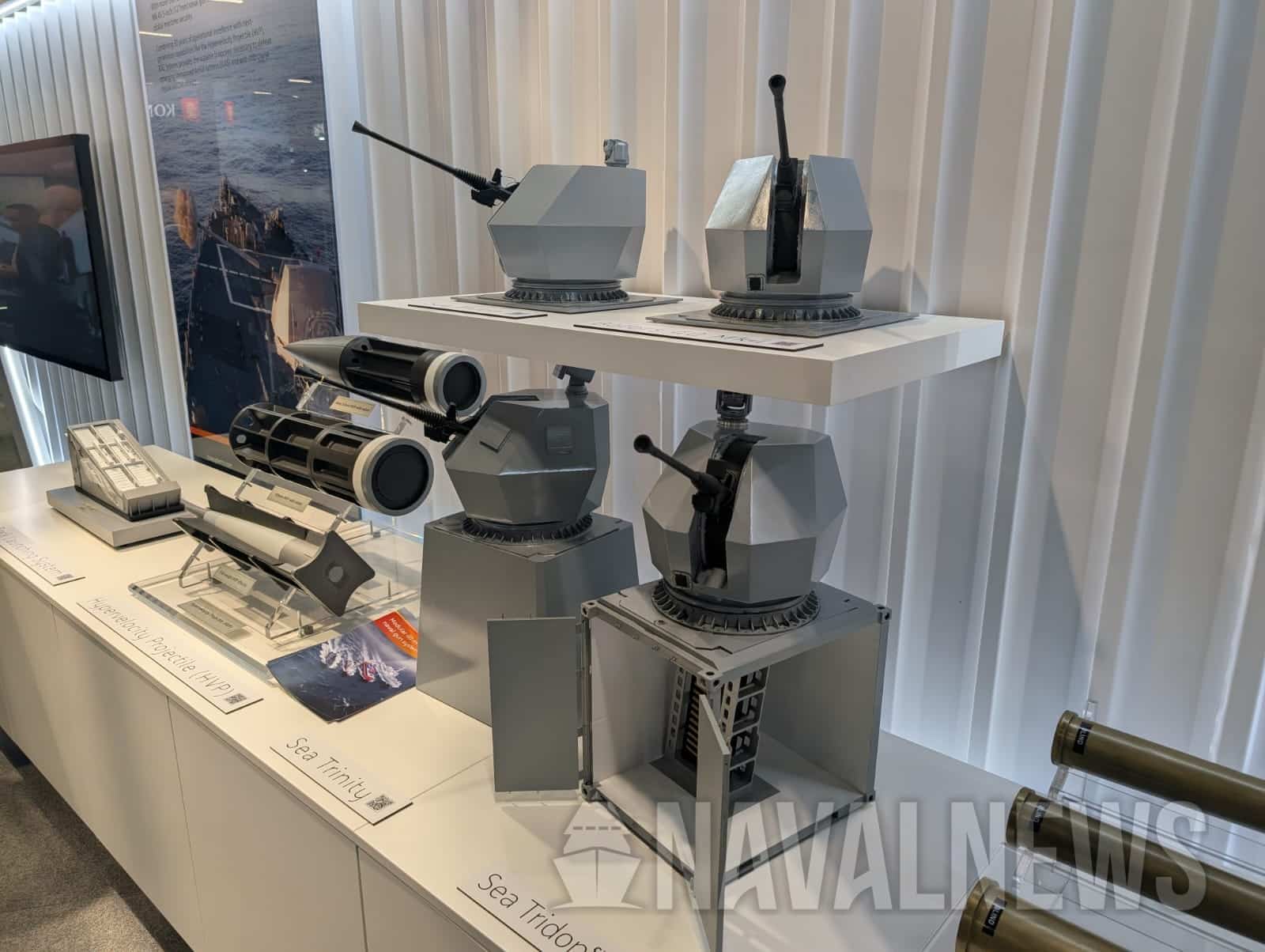
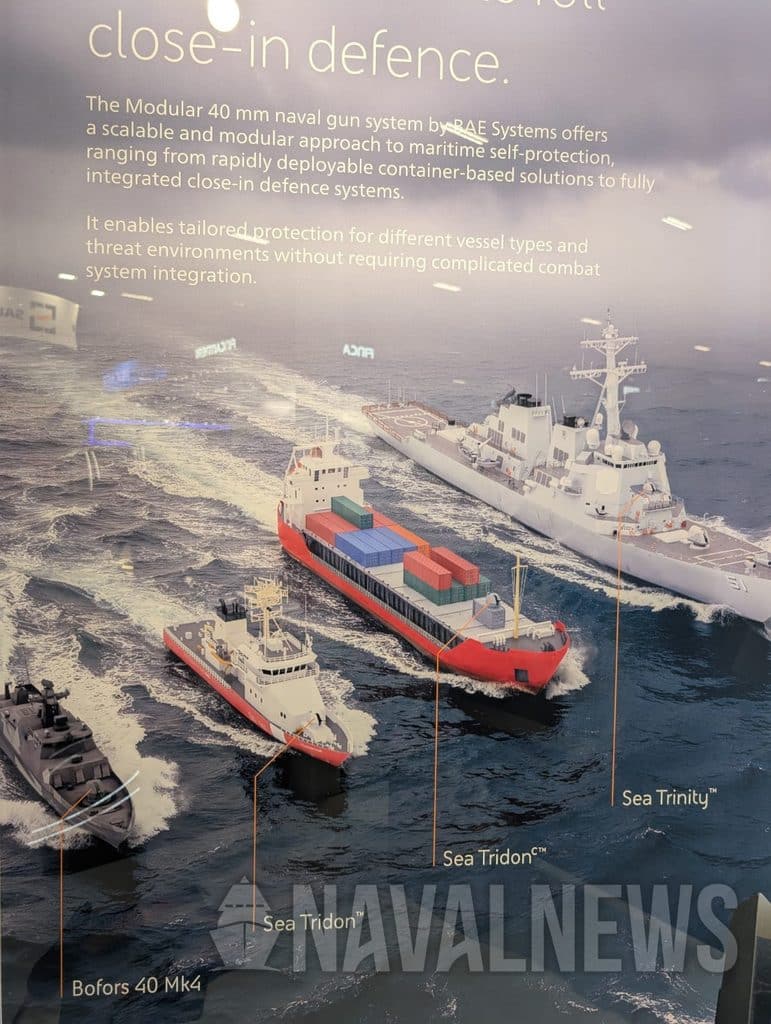
The programme is based around the company’s 40 mm naval gun suite – developed by BAE Systems’ Sweden-based Bofors business, from the baseline of its well-proven Bofors 40 mm/L70 Mk IV naval gun. It encompasses three variants: the Sea Trinity close-in weapons system; and two versions of Sea Tridon, one including just the gun and its standard mount; the other carried within a shipping container, and known as Sea TridonC.
Both Sea Tridon variants can be fitted across naval fleets and force structures, but especially to smaller naval vessels including legacy platforms without an anti-air warfare (AAW) system. Such a fit would provide air-defence capability, including capacity to counter the ‘drone’ threat.
The gun system’s ‘effector’ is BAE Systems’ Bofors‘3P’ Programmable All-Target ammunition, which was developed for both the company’s 40 mm and 57 mm guns.
C-UAS capability
For NATO and many NATO navies, c-UAS is a core capability priority, currently. Conflicts in Ukraine, the Gulf, and the Red Sea are highlighting how UAS systems can threaten both naval and commercial shipping. Alongside the baseline requirement to counter this threat, navies need to do so in a cost-effective manner (rather than using high-end, high-cost air-defence missiles against low-cost one-way attack drones).
“[Sea Tridon] is a way to enable cost-efficient engagement against the drone threat in general – small- and medium-size, or even larger, drones,” Stefan Lofstrom, Business Development Director for BAE Systems Bofors, told Naval News at Euronaval.
The Sea Tridon package provides a prompt option for meeting navies’ c-UAS capability needs, including for existing platforms. “They want to get something quickly and add new capability to a legacy platform,” said Lofstrom. “Those platforms don’t have c-UAS capability: with this, you can get it instantly.”
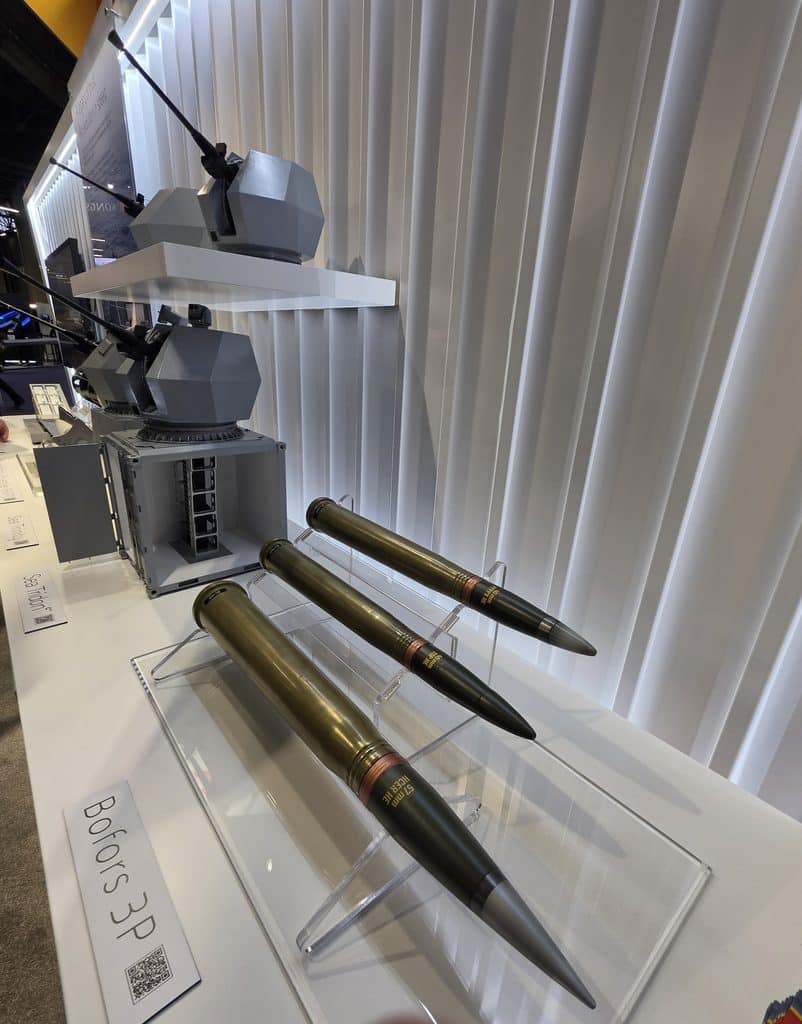
The c-UAS capability is now well-tested, too. “We’ve tried it against drones a lot, especially in the land application. So, we know it works against different sizes and different types [of threat targets]: FPV drones, quadcopters, and the larger, Shahad-like drones,” said Lofstrom.
Capability composition
Developing Sea Tridon from the 40 mm gun’s original naval baseline, in between these two phases BAE Systems has tested the new variant in the land domain (as Tridon). It is now preparing the system for sea-based testing.
Sea Tridon consists of three components – the 40 mm gun; BAE Systems’ own fire-control software system (sensor-agnostic, and able to accommodate other companies’ radars or electro-optical [EO] fire directors); and the ‘3P’ ammunition.
The fourth component is the container.
As regards the fire-control system, “Sea Tridon has an integrated EO fire-control solution, for installation typically on a smaller vessel that doesn’t have a fully-fledged combat management system (CMS),” Lofstrom explained.
Including in the c-UAS role, the system’s core capability – and what Lofstrom referred to as its ‘unique selling point’ – is its effector, the ‘3P’ – programmable, proximity-fused, pre-fragmentation – ammunition.
The gun can fire 300 rounds per min, and each round can be programmed individually. Within six programmable fuse modes, “You can have a mix of time mode, point detection, armour piercing [effect], etcetera,” Lofstrom explained. “It’s a very flexible system, in that sense.”
“[This programmability] gives combat flexibility to the user: you don’t have to change ammunition; you can directly switch from surface to air targets, from incoming missiles to small drones, just by changing the programming,” Lofstrom said. “Also, you can have different programming settings of every round in the same salvo without any delay, as every round is programmed as it’s fired.”
“[‘3P’ is] also very cost efficient, especially in drone scenarios,” Lofstrom added. In the c-UAS and wider AAW roles, “It’s ideal for engaging small and medium-sized drones, but also classic air targets like missiles, fighter aircraft, etcetera,” he said.
Sea Tridon’s containerised version is conceived in large part to provide ammunition capacity, including onboard ships which may not have naval guns and magazines. Here, Lofstrom explained, magazine capacity is provided inside the container, below the gun mount.
Either 10 ft or 20 ft standard ISO containers can be used. With the latter, Lofstrom explained, “You have more flexibility: you can have more ammunition; but you can also have the command-and-control (C2) equipment in the container.”
“Then you can have a truly stand-alone system,” he added. “You just put the container on deck, strap it on, and that’s it.”
“If you have a naval vessel maybe of an older design, where it would be very costly and complex to integrate [new systems] into the legacy CMS, you can have a soft integration where you basically put this on deck and have a self-contained air-defence capability,” Lofstrom continued.
Access to ship’s power may be needed, but Lofstrom explained that the Tridon land-based variant has been developed with its own ‘power pack’, including a generator and batteries. “We could easily do that in the naval domain as well, if you want truly to be ‘stand-alone’,” Lofstrom said. “Usually, you would prefer to get power from the ship, for endurance – but for a shortened mission, [‘a power pack’] is absolutely doable.”
The containerised fit is a key part of Sea Tridon’s capacity to bring scalability in AAW effectors.
Next steps
Currently, BAE Systems is funding Sea Tridon development, while seeking initial customers. Lofstrom noted that the 40 mm Mk IV baseline system is in operation in as many as 10 countries.
While the programme has to date focused on land-based testing, the company intends to step up sea-based variant testing – including the containerised capability – over the next 12 months.
“Over the past year, basically, we’ve done that [testing]. We’ve done very rapid prototyping and development of those different variants, and tested it together with the Swedish Armed Forces,” said Lofstrom. “We’re launching it here this week and then we continue testing back home in Sweden.” Such testing will include the sea-based variant, he added.
“We’re going to progress at pace …. We have a very tight testing programme now,” Lofstrom continued. “The naval gun is proven already … so, we know that [works]; and we have tested everything in the land application, so we know it works.”
“I don’t see any hurdle to get it ready. The hurdle is meeting the demand,” Lofstrom added. “There is huge demand for c-UAS capability, so maybe that’s the main challenge.”
Naval News Comment
NATO navies have been keeping watch on conflicts in Ukraine, the Gulf, and the Baltic Sea – particularly to understand developments in AAW and c-AUS threats. However, they have also been monitoring events in the Baltic. In September 2025, a flurry of UAVs appeared above various NATO Baltic member country civilian and military critical infrastructure sites. Media reports suggested some of these UAVs may have been launched from containers onboard commercial ships.
The security implications of the growing UAV threat for NATO states has seen the c-UAS requirement rise to the top of operational capability requirements lists for alliance naval organisations like the NATO Naval Armaments Group, which is looking for national c-UAS programmes around which to start developing wider alliance capability.
Alongside capability, affordability is crucial – especially against the massed threat that has been demonstrated. A deployable system like Sea TridonC shows that there are more cost-effective options that ‘shooting a sparrow with a cannon’ (to use Cold War phraseology).
Here is Naval News’ interview with BAE Systems on this new system at Euronaval 2026