The French Navy is continuing to reinforce its core operational concepts and capabilities as it responds to continuing evolutions in threats at sea, according to senior officials speaking at the Euronaval exposition’s opening conference, in Paris on 2 November.
These operational concepts and capabilities are projected in its primary operational missions.
According to Alexandre Lahousse, Deputy Delegate for the Armed Forces, at the French Ministry of Defence’s Delegation General de l’Armaments (DGA), the French Navy has four such missions. Moreover, he explained, each mission is being underpinned by the development and delivery of new capability.
First is generating the navy’s contribution to France’s strategic-level nuclear deterrent. This includes delivering its next-generation nuclear-powered ballistic missile submarine (SSBN), the four-boat SNLE-3G (Sous-marins Nucléaires Lanceurs d’Engins-Troisieme Génération) Invincible class, plus developing and deploying both the M51.3 and M51.4 versions of the M51 submarine-launched ballistic missile (SLBM).
The navy’s second mission is to deploy into areas of potential crisis in order to deter any crises there. Naval capacity is central to this mission, Lahousse explained. Here, he underlined the contribution of France’s new aircraft carrier, France Libre, which will be delivered in 2038 under the PaNG (Porte-avirons Nouvelle Génération) programme.
There is ongoing discussion in France regarding the possibility of building a second carrier.
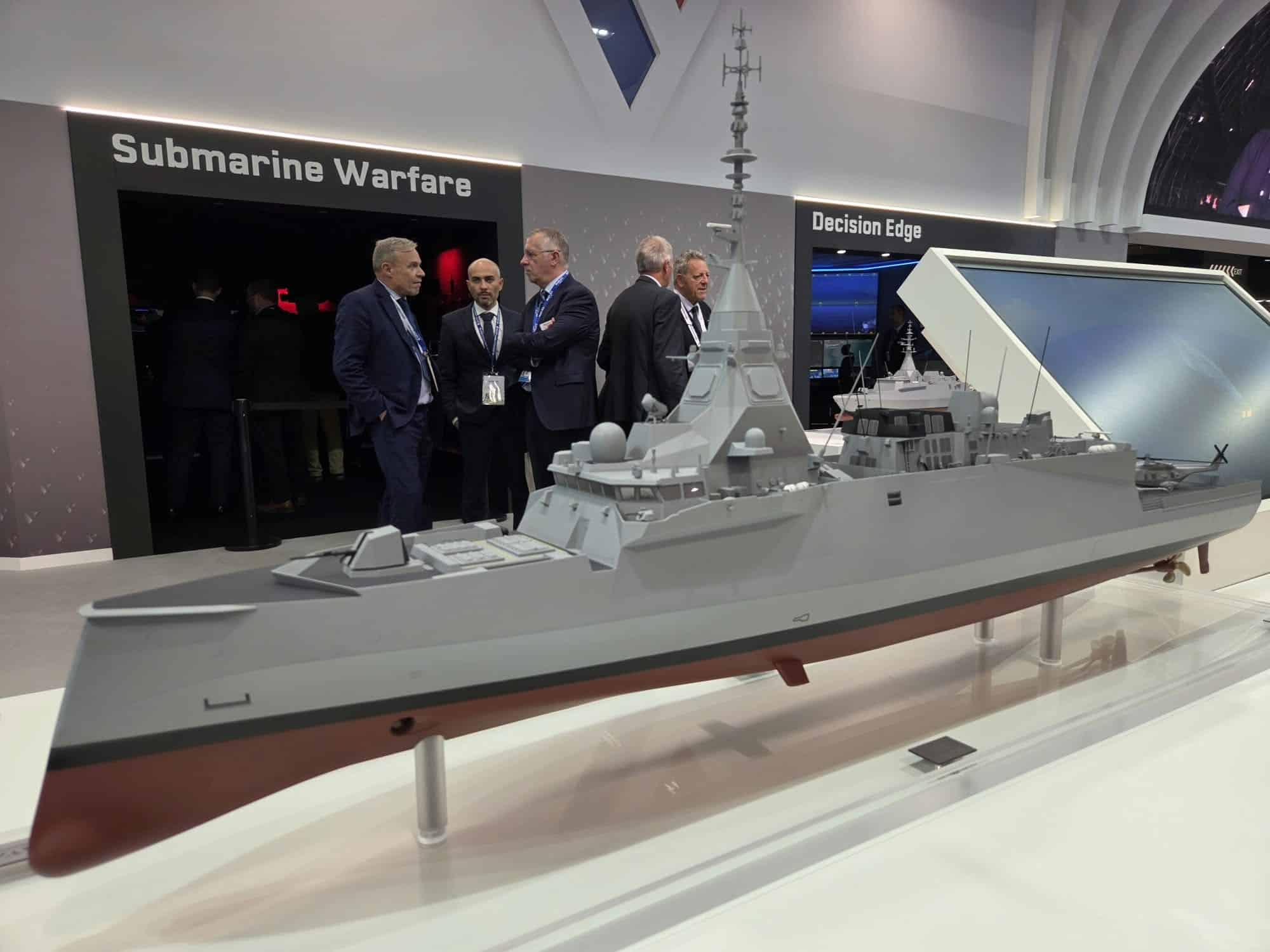
For this second mission, Lahousse noted too the contribution of the navy’s new FDI (Frégate de Défense et d’Intervention) frigates. This new class – led by lead ship FS Amiral Ronarc’h – is showing how the navy is using the latest technology to counter the latest threats, and is representing “a turning point in capability” for the navy, Lahousse said.

Also important in maintaining this mission is France’s support ship capability, he added. Here, the navy has received two of the planned four Jacques Chevalier-class BRF (Batiments Ravitailleurs de Force) fleet tankers; ship three is in the water, too.
The third mission is protecting France’s maritime spaces, in both naval and civilian/commercial senses, through deploying patrol capacity in key waters. Here, France is again delivering new capability: for example, in February 2026, it launched the first of a planned seven offshore patrol vessels in the Patrouillier hauturier class.
The fourth mission is maintaining information dominance. This mission is underpinned by surveillance capacity, itself based around generating precise knowledge of the maritime domain and the ability to share such knowledge through effective command and control (C2), to help generate data-based decision-making, Lahousse explained. Given that integrated C2 relies increasingly on digital architecture, Lahousse added that DGA will increase developments in both areas to accelerate the navy’s development of knowledge and decision-making capacity.
From the DGA’s perspective, overlaying these mission requirements is the need for rapid capability delivery. As an example, and illustrating the need to expand and enhance capacity – especially surveillance – to tackle maritime uncrewed capability threats including uncrewed air systems (UASs), Lahousse noted that the DGA had developed a counter-UAS programme within two months.
Strategic missions
These operational missions reflect the navy’s wider strategic impact requirements. According to Rear Admiral Hugues Laine, the navy’s Deputy Chief of Staff for Air and Naval Operations, these core, strategic-level outputs are defined as safeguarding sea lanes, projecting power, and securing national interests.
With technology improvements in surveillance and strike capacity, the navy is continuing to enhance its ability to observe maritime activity, and to build capability to detect, identify, and track threats, Rear Adm Laine said.

Yet, the admiral explained, delivering outputs and effects at sea remains challenging, due to the continuing ‘fog’ in the nature of maritime activities.
There are three primary drivers generating this ‘fog, he continued.
First is the scale of the maritime domain, and the mobility of actors therein. “Even with military and commercial satellite constellations, continuous wide-area surveillance is almost impossible,” Rear Adm Laine said. “The maritime domain also offers considerable freedom of manoeuvre for any type of asset.”
Here, the admiral explained, a vessel moving at 15 kt can cover 700 n miles per day, and thus can affect matters over 1,000s of nautical square miles in the small window of just a few hours between satellite passes. “This creates a dilution of actors and assets,” he added.
Second is what Rear Adm Laine referred to as ‘The illusion of transparency at sea’ and efforts by state and non-state actors to exploit sensor issues therein. Here, he explained, while ships may carry AIS (automatic identification system) trackers, AIS was developed as a tracking/identification tool designed to support collision avoidance, not to support intelligence gathering and other national security matters. So, AIS only transmits what the vessel chooses, and can be switched off. Vessels also manipulate their identification and ‘spoof’ their position to help avoid detection.
In addition, the significant increase in commercial shipping traffic over recent decades provides an effective screen behind which rogue assets can hide, and rogue actors can use hydrographic and oceanographic vessels to for example conduct clandestine surveillance activities, the admiral said.
Third is the underwater environment. Above the water, navies can draw on a broad range of sensor and other surveillance systems to provide the data required to locate a target. Underwater, the laws of physics make the search task much harder, Rear Adm Laine explained. Those sensing and wider surveillance technologies used above water do not work below it. So, acoustic systems like sonar must be used – although these too can be impacted, for example with water temperature, salinity, and pressure creating complex sound velocity profiles. “That can create a ‘dead zone’ where a submarine or an unmanned underwater vehicle can hide very easily,” Rear Adm Laine said. Moreover, in littoral waters, acoustic sensors must deal with ambient noise from marine life and commercial shipping activity. In sum, Rear Adm Laine concluded, “This physical opacity of the sea and especially the underwater domain provides a favourable space for every threat, and the opportunity to conduct aggressive action below the threshold of conflict.”