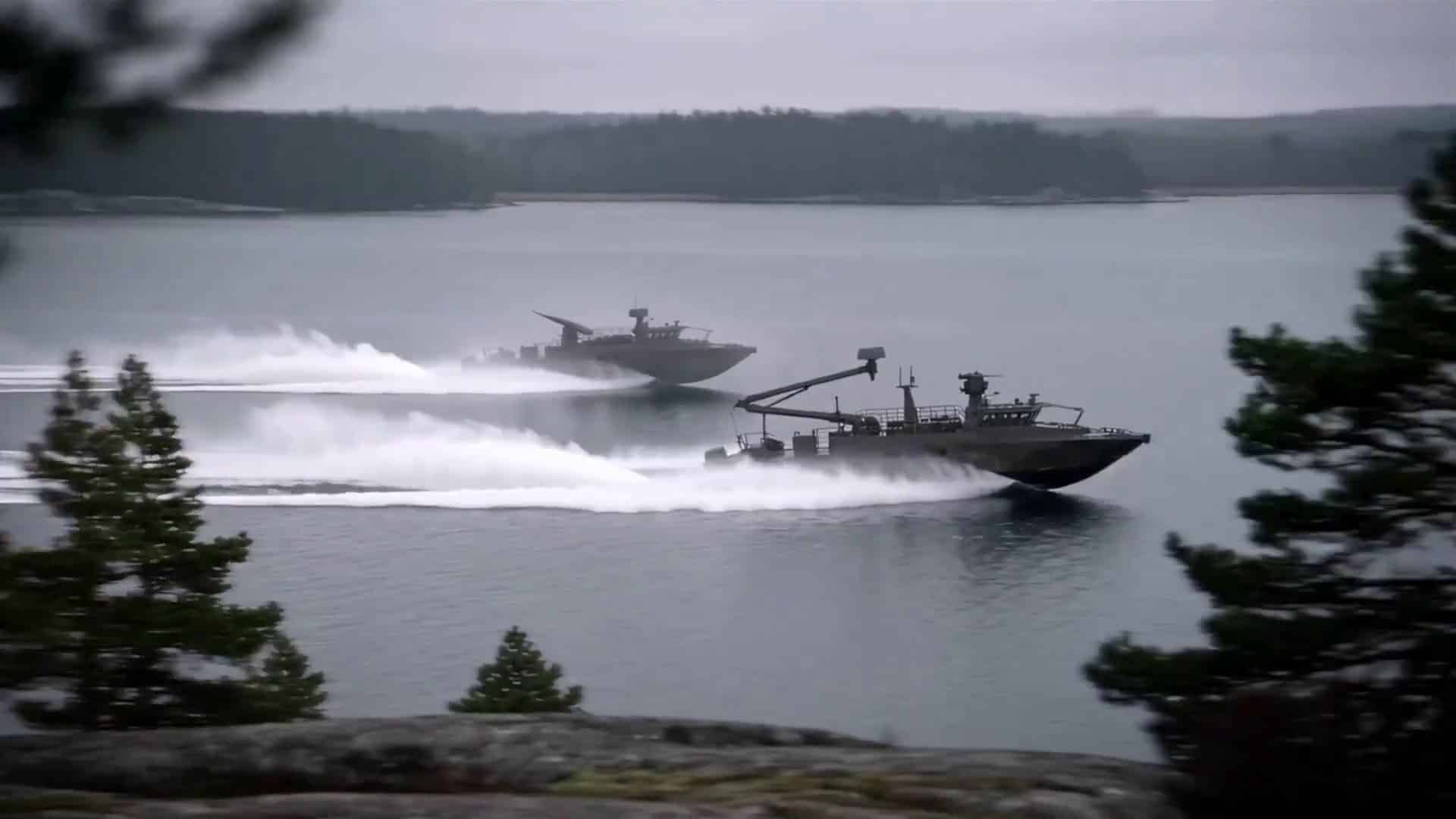
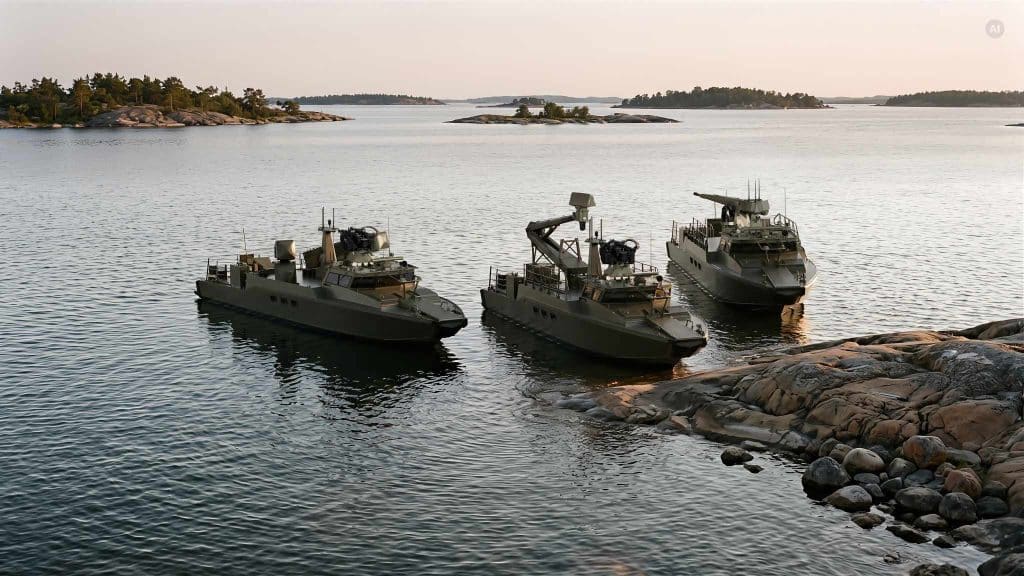
Saab has unveiled a larger, optionally crewed variant of its Combat Boat 90 (CB90) fast assault craft designed to expand the role of the combat boat beyond troop transport to a multimission combat platform.
The new variant, known as CB90 Capability X (CB90 CX), will initially be offered in three configurations: intelligence, surveillance, and reconnaissance (ISR), anti-ship warfare, and short-range air-defence (SHORAD).
Sweden is the launch customer, and the first boat is undergoing final acceptance trials ahead of delivery.
Briefing media online on 30 October, Anders Hellman, head of Saab’s business unit Docksta, said CB90 CX was the company’s response to a rapidly changing maritime security environment, where naval forces need to detect threats earlier, distribute capability across more platforms, and operate with greater flexibility.
He pointed to incidents involving critical infrastructure in the Baltic Sea, the use of small distributed systems against conventional naval forces in the Black Sea, and attacks on commercial shipping in the Red Sea.
“These are of course different environments, but I think the lesson is similar,” he said. “Naval forces need to see more, they have to move faster, and most importantly, they need to distribute their capabilities across more platforms. So, the idea is quite simple: we have taken a proven combat boat and turned it into a distributed capability.”

Platform design
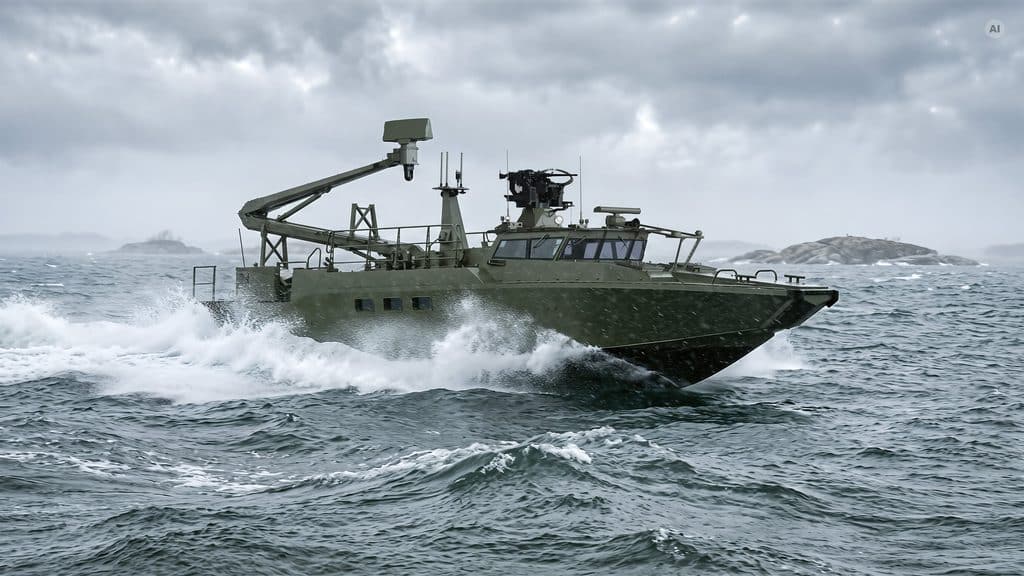
With an overall length of 18 m, a beam of 4 m, and a draught of 1.1 m, CB90 CX is 1.4 m longer and 0.3 m wider than the CB90 Next Generation (NG) variant. Powered by two 1,100 hp engines driving waterjets, the boat has a top speed of more than 40 kt fully loaded and a range of more than 300 n miles at around 40 kt. It can carry a crew complement of up to 10 personnel.
According to Hellman, the larger hull has increased payload capacity by more than 50% compared with CB90 NG, on a like-for-like basis, from around 3 tonnes to “well beyond” 5 tonnes. It has also significantly improved seakeeping, he said. The boat is built to the DNV HSLC R2 class notation, which enables it to operate up to 100 n miles from a safe haven in summer and 50 n miles in winter. “From a Baltic perspective, this gives us free manoeuvrability within the entire Baltic,” he said.
Asked by Naval News whether the larger hull had required any trade-offs, Hellman said the company had been able “to keep the same user experience and feel” of the baseline vessel, which is centred around simplicity of design, and ease of use and operation. He added that the profile of the vessel has been kept low, both to limit its signature and to ensure it remains transportable by road and air.
More significant than the hull changes, according to Hellman, is the vessel’s new common system architecture, known as Combat Core. This integrates ship automation, platform monitoring, fire control, and a new steer-by-wire system into a single digital backbone, enabling capabilities to be added and upgraded throughout the boat’s lifecycle. The Combat Core is based on an open architecture, allowing customers to integrate their own sensors and weapons.
Saab’s Autonomous Ocean Core software is integrated with the Combat Core to provide the basis for uncrewed operations. According to Hellman, all CB90 CX boats are prepared for uncrewed operations from the outset, enabling the boat to be controlled from a remote station or through AI functionality. “This doesn’t take people out of the decision-making process, but it gives the operators much better flexibility in how they use people and platforms,” he noted.
Three configurations
Saab is initially producing the CB90 CX in three customer-driven configurations, although Hellman stressed these are only a starting point.
The ISR configuration is equipped with a Saab Sea Giraffe 1X X-band 3D surveillance radar, which rotates at 60 rpm to provide 360-degree coverage of air and surface targets and has an air detection range of more than 100 km. The radar sits on a newly designed mast that extends to 11 m, enabling the boat to see over islands in the archipelago. In its lowest 4 m position the mast allows unrestricted operations at speed. A Saab Trackfire remote weapon station armed with a 12.7 mm or 30 mm gun provides counter-uncrewed aerial system protection.
The anti-ship version was shown during the briefing armed with MBDA’s Marte ER sea-skimming fire-and-forget missile, which has a range or more than 100 km with external targeting data. Amphibious forces have traditionally carried missile teams ashore to set up and engage naval targets. With the missile system onboard, “the combat boat can do more than transport the capability. It becomes part of the strike capability itself,” Hellman said, adding that it also enables forces to regroup much faster and with greater manoeuvrability. He noted that Sweden’s amphibious battalion is acquiring a different missile, and that the Marte ER fit is intended to demonstrate the platform’s flexibility.
The SHORAD variant is armed with Rheinmetall’s Seasnake 30 naval gun, which fires KCE-30 30 x 173 mm ammunition. Its primary targets are helicopters, drones, and loitering munitions, with ground targets, small landing craft, and small patrol boats as secondary targets. In February 2026 FMV, Sweden’s defence procurement agency, ordered an initial eight Seasnake 30 systems to arm its CB90s under the Amphibious Battalion 2030 modernisation programme. “The big change is that short-range air defence becomes mobile; it can move and appear when it is needed,” Hellman said.
He said the three configurations are intended to work together, operating in different locations but connected as one force, taking the combat boat “from carrying the fighting force to becoming part of it”.
Saab is also developing additional capabilities for CB90 CX, including the option to launch drones – with both tube-launched systems and quadcopters under consideration – and torpedoes. Hellman said the company has a parallel development track for further configurations.
Orders and production
Sweden has a total of 36 CB90s on order, including 10 ordered in June 2024, 22 in 2025, and a further four added in the first half of 2026.
The CB90 CX will be offered alongside the CB90 NG, which Saab will keep in production. To meet anticipated demand, the company is building a new site at Docksta that will double its production capacity. Hellman said its focus markets are NATO and allied nations, particularly in the Baltic and Mediterranean regions. More than 300 CB90s are in service with nine navies.