South Korean shipbuilder Hanwha Ocean showcased new destroyers and export frigates designs at MADEX 2025.
By Eunhyuk Cha and Xavier Vavasseur
At MADEX 2025, Hanwha Ocean showcased its latest surface ship concept designs to highlight Hanwha Group’s strength as a total maritime security solutions provider, built on integrated capabilities in shipbuilding, sensors, and propulsion systems. By combining Hanwha Ocean’s proven shipbuilding expertise with advanced sensor systems from Hanwha Systems and propulsion and energy systems from Hanwha Aerospace, the new surface ships exemplify the Group’s ability to deliver optimized, interoperable platforms tailored for the demands of global clients.
Future destroyer

Unveiled for the first time at MADEX 2025, Hanwha Ocean’s “Future Destroyer” is a concept ship “optimized for maximum stealth features and unmanned systems operations”. The vessel is 180 meters in length for full load displacement of 8,200 tons. it features a 5″ railgun, an impressive 88 VLS, laser CIWS, conformal sensors (flush with the superstructure)…

This destroyer concept is very much a mothership vessel for unmanned systems as it can deploy UAVs, UUVs, USVs, as well as loitering munition. The MUM-T capabilities of the design are very advanced and leverage Hanwha Systems know-how in the field.
OCEAN 8000 destroyer

This time, Hanwha Ocean unveiled three concept models alongside one futuristic design. Leading the showcase was the OCEAN 8000, an 8,200-ton class destroyer measuring 156.3 meters in length, with a beam of 18.8 meters and a draft of 9.9 meters. It reaches speeds of up to 29 knots and adopts an Integrated Full Electric Propulsion (IFEP) system, offering enhanced stealth through low acoustic signatures.
The ship features an inverted bow and a fully enclosed superstructure designed to reduce radar cross-section (RCS), including retractable SSM launchers and other integrated systems. It is equipped with Hanwha Systems’ Integrated Mast, originally developed for the KDDX program, and a low-earth orbit (LEO) satellite communication antenna, allowing for wideband, high-efficiency command and control.
Designed with future operations in mind, it includes a mission bay capable of deploying UAVs and USVs. Armament consists of a 5-inch naval gun, CIWS-II at the stern, and the potential integration of directed energy weapons, enabled by the efficiency of IFEP system. Vertical launch capabilities include a KVLS-I (32-cell), and a KVLS-II (16-cell).
While developed for the domestic market, the OCEAN 8000 integrates key technologies from Hanwha Group’s three major defense affiliates, positioning it as a strong candidate for future international exports.
4500-ton frigate for export
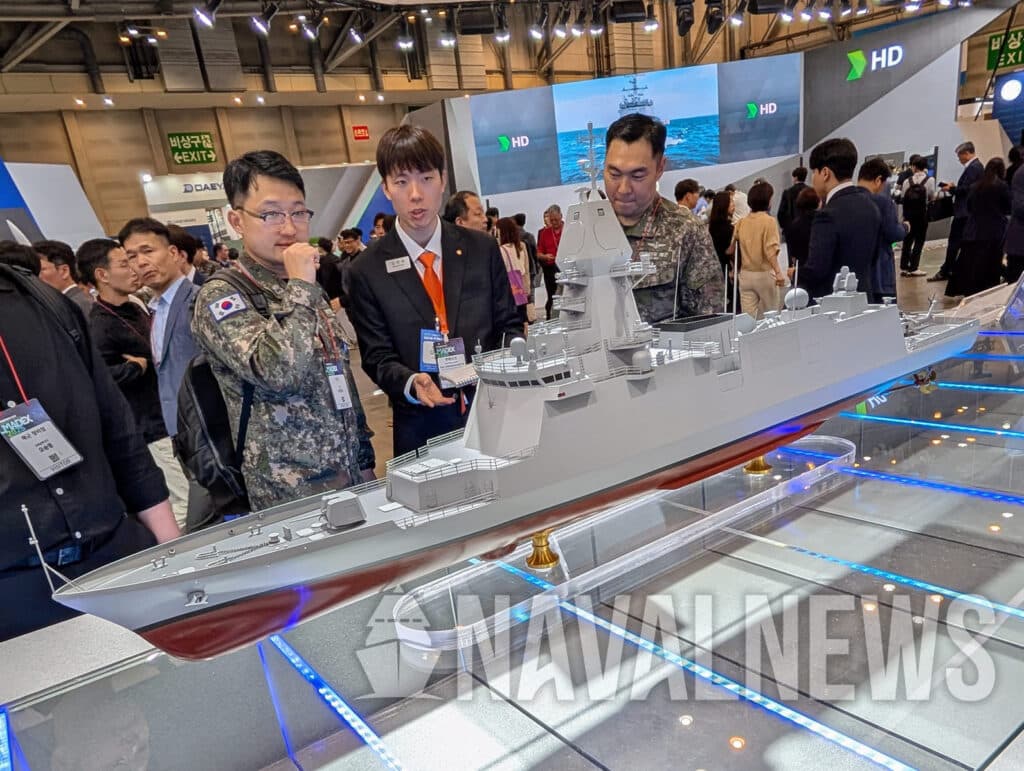
The next design is an export-oriented frigate based on the Republic of Korea Navy’s Chungnam-class (FFX Batch-III), with a full-load displacement of approximately 4,500 tons. Measuring 130 meters in length, 16 meters in beam, and 7.6 meters in draft, the vessel employs a CODLOG (Combined Diesel-Electric or Gas) propulsion system and reaches a top speed of 29 knots.
Key sensors include an AESA multi-function radar (MFR) and a towed array sonar system (TASS). Uniquely, a UAV antenna is installed at the stern to support unmanned operations. Inside the ship, an asymmetric warfare command center is installed, which utilizes AI-powered real-time 360-degree surveillance to detect asymmetric threats such as small boats and UAVs. Enhanced MFR performance combined with onboard jammers establishes a robust C-UAS capability.
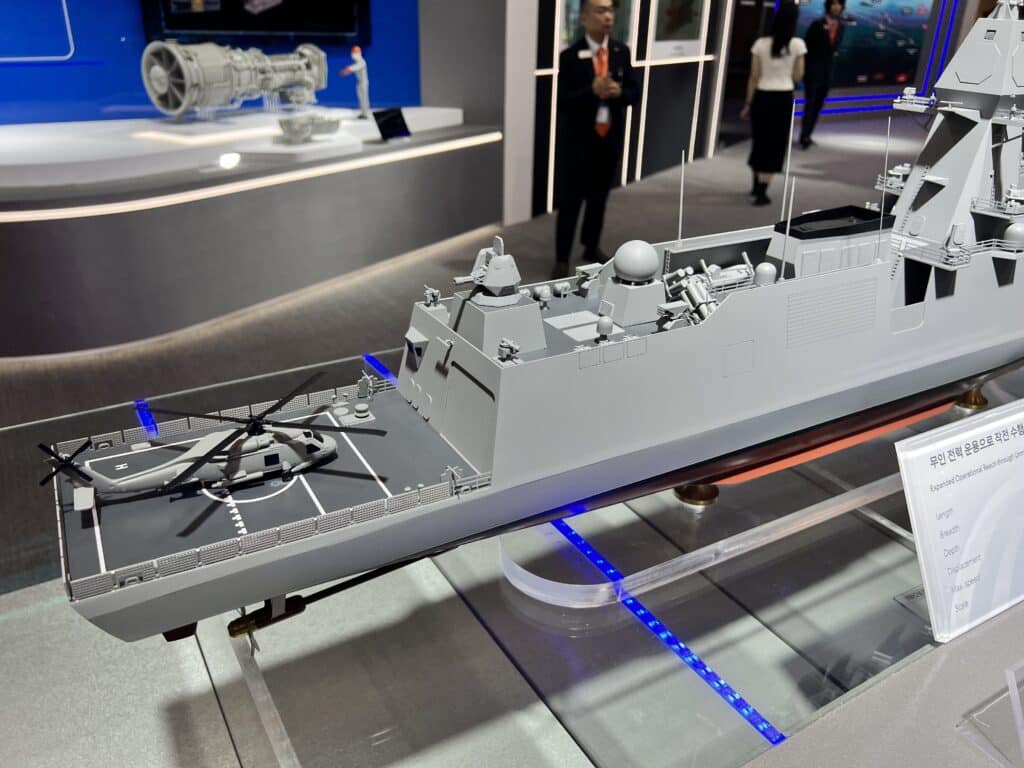
The ship is armed with what appears to be a Leonardo 76mm naval gun, 20mm RCWS, CIWS, SSM launchers, a 16-cell vertical launch system (VLS), and torpedoes. Leveraging the MFR’s long-range detection capabilities, the frigate is capable of countering ballistic missiles, aircraft, and surface threats. It also integrates UAVs and USVs, forming a manned-unmanned teaming (MUM-T) system optimized for modern maritime operations.
4,000-ton export frigate

The final model is a 4,000-ton export frigate based on the Bhumibol Adulyadej-class, which Hanwha Ocean previously exported to Thailand. The actual full load displacement of the model on display is 3,700 tons, with a length of 124 meters, a beam of 14 meters, and a depth of 8 meters. It features a Combined Diesel and Gas (CODAG) propulsion system, identical to that of the Royal Thai Navy’s Bhumibol Adulyadej-class frigate, and achieves a top speed of 27 knots.


Hanwha Ocean is promoting this design as a high-quality, fast-delivery, and proven-performance platform, leveraging the operational experience of the Royal Thai Navy. To enable rapid adaptation to evolving battlefield conditions, the frigate incorporates a modular design that supports future upgrades, additional armament, and flexible system reconfiguration. Positioned in the 4,000-ton class, the ship offers sufficient space and adaptability to accommodate a wide range of mission needs and future capability enhancements. Additionally, Hanwha Ocean has designed the platform to support a variety of foreign weapon systems and sensors, enabling tailored configurations based on customer requirements and budget constraints.
Check out our video coverage of the new ship designs by Hanwha Ocea at MADEX 2025: