Following the €3.7 billion contract signing, Naval News reveals the first platform, sensor, and weapon details of the Italian Navy’s new 13,500-tonne NG DDG (previously known as DDX).
The contract for Italy’s Next-Generation Destroyers (NG DDGs), signed on 24 September 2026 between OCCAR-EA Director Joachim Sucker and Orizzonte Sistemi Navali (OSN) CEO Giovanni Sorrentino, covers the development, production, and Initial In-Service Support (ISS) for the Italian Navy’s first DDX destroyer, with an option for a second vessel. OSN is the joint venture between Fincantieri (51%) and Leonardo (49%). Developed and built entirely by Italy’s shipbuilding and defense sector, and armed with next-generation national and European weapon systems, the program marks a major milestone in the Italian Navy’s modernization and stands as one of Europe’s most ambitious and technologically advanced surface combatant programmes.
The contract is valued at approximately €3.7 billion, including roughly €1.3 billion for the optional second ship, with subcontracting activities already underway at Fincantieri and Leonardo. Naval News understands that additional funding will be required to complete the procurement of the second vessel, alongside a 10-year support package for each ship and ancillary equipment. The armament package is also excluded from the current contract. Deliveries of the first and second units are scheduled for 2033 and 2035, respectively. Fincantieri is leading platform design and acting as whole-warship system integrator, while Leonardo is responsible for designing and developing the combat system.
Missions, Platform, and Propulsion
Destined to replace the two Ammiragli-class (Durand de la Penne-class) air defense destroyers, the NG DDGs are conceived as advanced multi-mission combatants capable of operating in complex, contested environments. Their mission profile spans fleet air and missile defense, long-range deep strike, command and control (C2), and anti-submarine warfare (ASW), ensuring full interoperability across national, joint, and NATO operations.
The new destroyers will feature robust Integrated Air and Missile Defense (IAMD) capabilities designed to counter current and emerging threats, including maneuvering anti-ship ballistic missiles (ASBMs), hypersonic cruise missiles, and hypersonic glide vehicles, through a new suite of sensors and interceptors. They will also introduce a deep-strike capability to the Italian Navy for the first time, contributing to the Italian Joint Armed Forces’ long-range strike posture currently assured by the Italian Air Force. Naval News understands that the Italian Ministry of Defense (MoD) and Navy plan to procure two additional NG DDGs in the future to eventually replace the two Andrea Doria-class Horizon destroyers, the first of which recently entered its Mid-Life Upgrade (MLU) program.
Building on the Risk Reduction Study and Definition contract awarded in December 2021, the NG DDG design has evolved to reflect lessons from recent conflicts (such as operations in the Red Sea and Black Sea) as well as homeland defense requirements against ballistic missiles and drones. Initial plans to equip the ships with the Leonardo Dual Band Radar (DBR), featured on the PPA/MPCS and FREMM EVO, were superseded by a new-generation, fully digital, long-range S-band phased array radar with large fixed-face antennas, currently under development by Leonardo along lines similar to the US Aegis architecture.
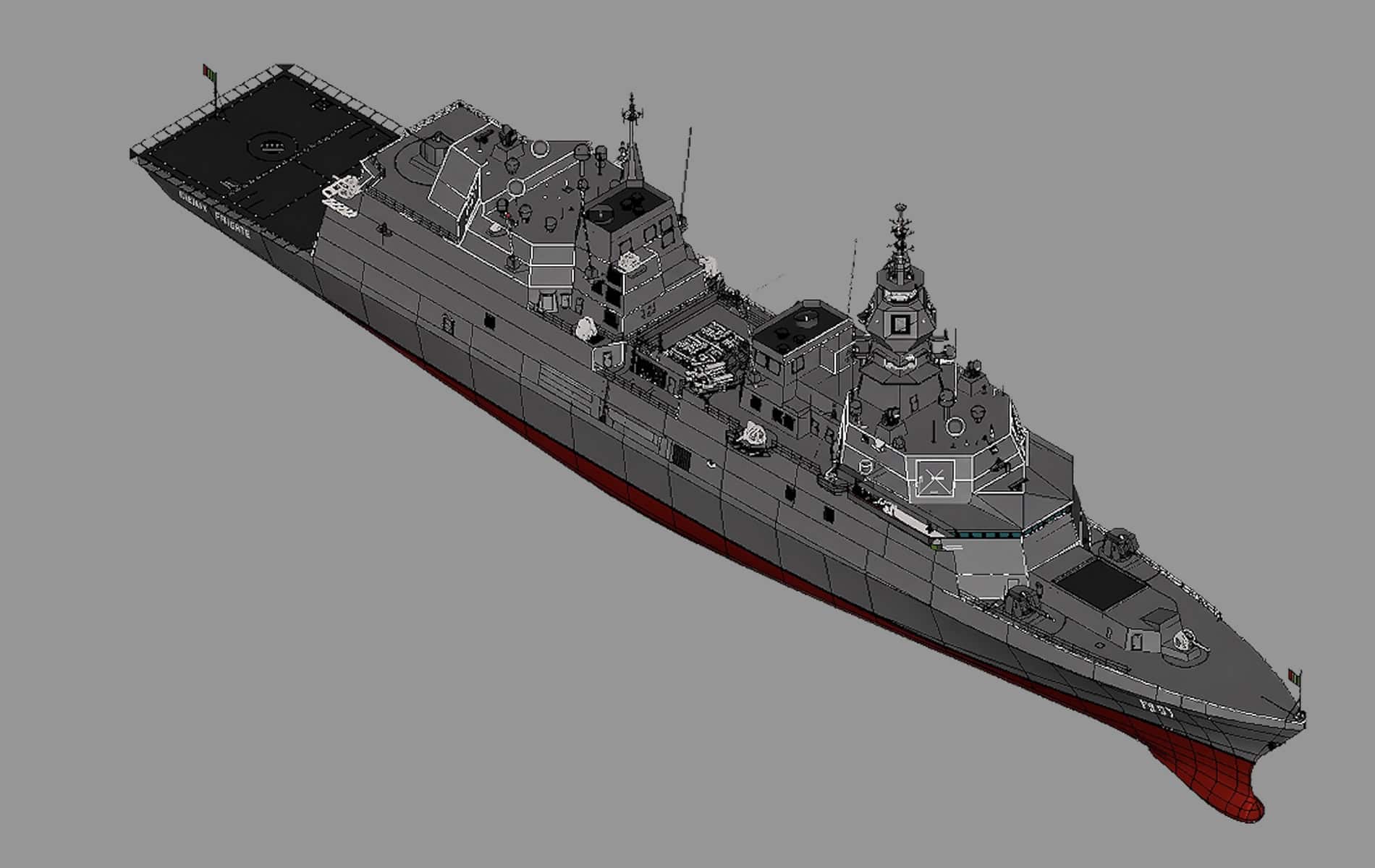
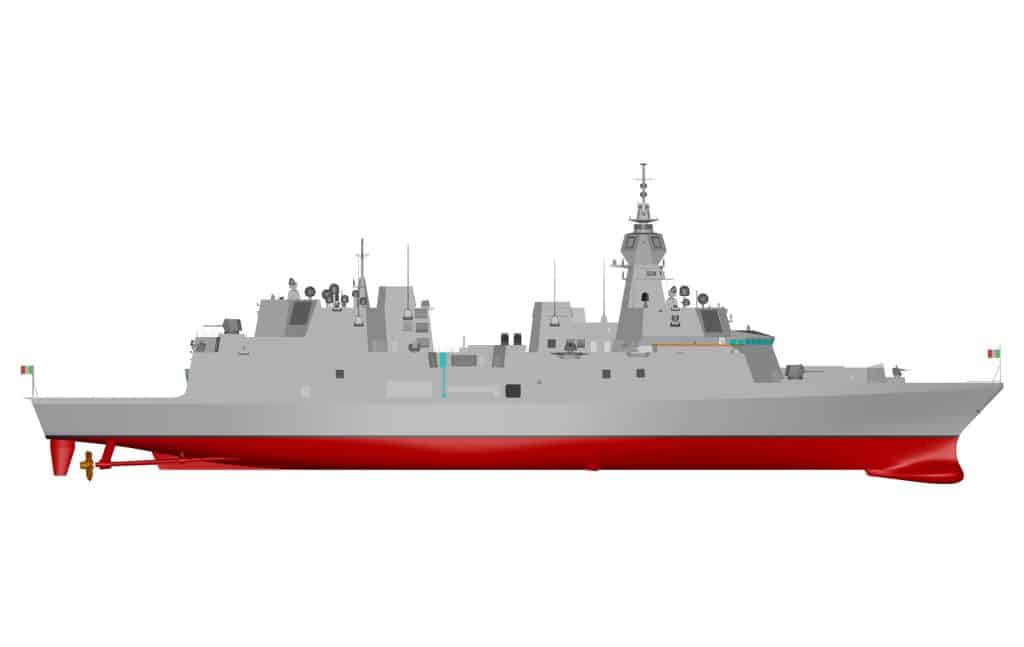
Working alongside the Italian Navy and the MoD’s Naval Armaments Directorate (NAVARM), the OSN joint venture redesigned the ship’s superstructures and upgraded both the combat system and electrical power architecture. According to released renderings and details obtained by Naval News, the vessel retains its baseline hull lines and main dimensions: a length of approximately 180 meters, a beam of 25 meters, and a full-load displacement (at the end of service life) of 13,500 tonnes. However, the redesigned superstructure incorporates light alloys to reduce topweight and optimize weight distribution.
The bow section resembles the FREMM design, featuring a large bulbous bow housing the bow-mounted sonar (BMS). Above, the forecastle deck accommodates the vertical launching systems (VLS) for deep-strike cruise missiles and next-generation interceptors, flanked by two 76/62 mm Super Rapido Strales main guns, with a Leonardo 30 mm Lionfish remote-controlled weapon station (RCWS) positioned forward of the forecastle for inner-layer air and surface defense.
Engineered to minimize radar and infrared signatures, the extended superstructure is split to house the four fixed faces (4FF) of the high-power S-band radar across the forward and aft deckhouses, reducing electromagnetic interference and improving weight balance. The forward superstructure features an octagonal base topped by an integrated mast carrying a 4FF X-band radar, upper and lower electronic warfare (EW) sensor suites, and communications antennas. The continuous amidships superstructure houses the forward and aft exhaust funnels, with dedicated spaces between them for inclined launchers for MBDA Italia Teseo Mk2/E missiles (forward) and additional VLS cells (aft). Unlike earlier iterations, the revised design introduces a secondary mast on the aft superstructure specifically dedicated to EW antennas.
Aft, the superstructure incorporates a large aviation facility with two hangars (one equipped for full maintenance), capable of housing two Leonardo AW101 (MPH-101) or NHIndustries NH90 (NFH90) helicopters, alongside fixed- and rotary-wing unmanned aerial vehicles (UAVs), operating from an expansive stern flight deck.
The propulsion system utilizes a CODOGOL (Combined Diesel Or Gas Or Electric) configuration. It comprises two gas turbines rated at roughly 32 MW each, two 8 MW main propulsion diesel engines, and two 3 MW reversible electric motors driving two shafts with controllable-pitch propellers and conventional rudders, delivering a maximum speed of 30 knots on gas turbines. According to the contract announcement, the destroyers will also feature an innovative stabilization system integrated directly with the steering suite.
Electrical power for platform and combat systems is generated by four 3.8 MW diesel generators, supplemented by the reversible electric motors when not engaged for propulsion. Naval News understands that industry proposals trend toward hybrid alternating current (AC) and direct current (DC) distribution grids. Per official statements, the ships will incorporate a DC power sub-network paired with an energy storage system (understood to be battery-based) to handle the high peak power demands of the new S-band radar, supported by advanced thermal and electrical load-management algorithms. OCCAR noted that the platform includes substantial growth margins to accommodate future technologies, such as Laser Directed Energy Weapons (LDEWs), alongside high survivability standards and seamless manned-unmanned teaming across multiple domains.
Alongside an upgraded Ship Management System (SMS) by Fincantieri NexTech, the destroyers will embody Fincantieri’s Navis Sapiens digital architecture. By aggregating and correlating data across all onboard systems, Navis Sapiens supports real-time operational decision-making and links the vessel to shore-based digital logistics, boosting operational availability and supply-chain responsiveness throughout its lifecycle.

Combat System, Sensors, and Armament
Designed to accommodate roughly 250 personnel (including dedicated spaces to serve as a task force flagship) the NG DDG combat system is centered on the fifth-generation SADOC 5 C5I suite. Built around a cyber-resilient, open, virtualized architecture with cooperative engagement capabilities, SADOC 5 leverages microservices to support extensive artificial intelligence (AI) integration, easing maintenance and future equipment upgrades under the Italian Navy’s Future Combat Naval Systems – Horizon 2040 roadmap.
The sensor suite is anchored by Leonardo’s new software-defined S-band AESA radar utilizing High-Voltage Gallium Nitride (GaN HV) technology. Based on released renderings and ship dimensions, each of its four fixed faces is estimated to measure roughly 10 square meters. It operates alongside a 4FF X-band radar derived from the family already deployed on modern Italian surface combatants. Both radars are tightly integrated via the CMS with an advanced EW suite supplied by ELT Group, comprising next-generation RESM/CESM/RECM/CECM capabilities for electronic defense and attack, including counter-UAS coverage.
Two Leonardo ODLS-20 decoy launchers provide anti-air and anti-torpedo countermeasures. Renderings indicate conformal, multi-band ECM antennas similar to the FREMM EVO fit. In addition, Naval News understands the ships will also carry ELT Group’s zenithal jammer to counter aerial and space-based synthetic aperture radar (SAR) satellites marking a novel capability in the maritime domain.
Communications and identification systems, largely supplied by Leonardo, include software-defined radios, multi-band SATCOM, a multi-data-link processor, and a conformal IFF antenna paired with a new Digital IFF Interrogator. Situational awareness and inner-layer tracking are reinforced by Leonardo’s Distributed Static Staring InfraRed Search and Tracking (DDS-IRST) system, while four Leonardo NA-30S Mk2 dual-band radar/electro-optical fire control systems direct the main guns. Underwater warfare systems center on the medium-frequency bow sonar (with mine/obstacle avoidance) and a passive towed array for torpedo defense, integrated into WASS Submarine Systems’ reaction management suite using ODLS-20-launched Mobile Jammer Target Emulators (MJTEs).
To defeat ballistic and hypersonic threats, MBDA Italia is developing a comprehensive weapon suite. Initially, the NG DDGs will pair an evolved SAAM-ESD air defense system (featuring next-generation C2 and firing units) with the Teseo Mk2/E anti-ship and land-attack missile. Deep-strike capability will be unlocked by a new national multi-missile VLS capable of housing both surface-to-surface and surface-to-air munitions. Confirmed in Italy’s 2026–2028 Multi-Year Defense Programming Document (DPP) for both the NG DDGs and FREMM EVO frigates, this launcher will be funded under an upcoming separate contract, though the destroyers are being built to accommodate it from the outset.
Once operational, the new VLS will fire the trinational (France/Italy/UK) MBDA Stratus LO future deep-strike cruise missile, which next development and qualification phase is slated for award by early 2027, as well as the Aster missile family (centered on the Aster Block 1NT) and the future Aquila endo-atmospheric interceptor being developed under the EU’s HYDIS²dp program against ballistic and hypersonic threats.
The NG DDG destroyer class is expected to be equipped with a total of 80 VLS cells, including 32 in the bow area and 48 amidship, industrial and military sources have confirmed to Naval News. The new national VLS system cells are set to be positioned in the bow area while the latest iteration of Naval Group Sylver A50 launchers will be installed amidship. The future destroyers will also be equipped with four 4-cell inclined launchers for the new MBDA Italia Teseo Mk2/E long-range high-subsonic anti-ship/land attack missile.
The gun armament is centred on three Leonardo 76/62 mm Super Rapido guns in the Strales configuration with DART guided projectiles against missile and asymmetric threats, being capable also to fire 76 Vulcano ammunitions (two at the bow and one atop the aft hangar). The Inner-layer defence consisting on four 30 mm Lionfish RCWSs with independent electro-optics director and air-burst munitions to cope with the challenging drone threat. The platform self-protection capability will register a significant development as the Italian Navy intends to replace two of these RCWSs with laser DEW (LDEW) as soon as they will be available. Leonardo and MBDA Italia are already working on a smaller power and shorter range LDEW system to deal with drones and asymmetric threats while a higher power and capable LDEW to address missile threats is long-term planned.
For ASW, the NG DDG is also expected to be equipped with two WASS triple torpedo launchers for MU90 lightweight torpedoes (LWTs). Embarked AW101/NH90 helicopters will also carry MU90s alongside nationally customized MBDA Italia Marte ER anti-ship missiles.
Finally, the destroyers feature two side launch-and-recovery stations, one for a 7.33-meter SOLAS boat and one for a 9.33-meter tender, designed to also handle 11-meter Special Forces RHIBs or Unmanned Surface Vehicles (USVs). Each ship will be fitted for, but not with (FFBNW) the roughly 9-meter USV currently under development by Fincantieri for the FREMM EVO and other Italian Navy platforms.