Sweden’s NATO membership is prompting the Royal Swedish Navy (RSwN) to re-shape its role and capabilities for delivering security in the Baltic Sea region, the RSwN’s Chief of Navy told Naval News.
Rear Admiral Johan Norlén added that the navy’s four planned air-defence frigates illustrate the service’s new strategic and operational emphasis.
Previously as a non-aligned country, Sweden focused on sea denial in the Baltic region, underpinned by capacity to conduct a short-duration but high-end, high-tempo war at sea to deny an adversary use of the Baltic while buying time to mobilise Sweden’s ground forces, Rear Adm Norlén explained.
However, a ‘sea change’ occurred on 7 March 2024, with Sweden’s formal accession to NATO – a national decision that followed Russia’s February 2022 invasion of Ukraine. Today, the RSwN is a central element of NATO’s naval force structure in the Baltic and wider North Atlantic region. Thus, Rear Adm Norlén continued, its operational focus now falls on generating sea control across the Baltic region including as a platform from which to project sustainment of forces and operations.
“To meet that new challenge, we need to ‘bump up’ sustained operations for a much longer period than we have been used to. That means, for example, larger surface combatants, because then you can go to sea for a much longer period,”
Rear Admiral Johan Norlén
Deploying for longer periods will also enable the RSwN to better support NATO and allies’ operations beyond the navy’s usual waters. Here, it is already building important links with allies, sending officers to the UK Royal Navy’s (RN’s) principal warfare officer (PWO) qualification course and posting an officer onboard the RN Type 45 air-defence destroyer HMS Dauntless during the UK’s continuing HMS Prince of Wales carrier strike group CSG25 deployment. “In five or six years’ time, we could send an air-defence frigate instead,” Rear Adm Norlén explained.
Alongside sustained operations, the RSwN must bring specific capability too – and air defence and wider integrated air and missile defence (IAMD) are pan-NATO requirements the RSwN must support.
“Almost every NATO country needs to ‘bump up’ its air defence. We have quite capable ground-based air defence: now, we’re moving into that area with the RSwN, too,” the admiral said.
In procurement terms, he continued, “We are in the final phase to decide and get into the acquisition for four new air-defence frigates.”
A key priority here is procuring platforms that can be delivered quickly.
The original procurement baseline was the purchase of four new Luleå-class surface combatants – under the Ytstridsfartyg 2030 (YSF2030) programme – with two vessels scheduled for delivery before 2030, and two before 2034. The Luleå vessels would be larger than the RSwN’s in-service Visby-class corvettes (the current primary surface combatant).
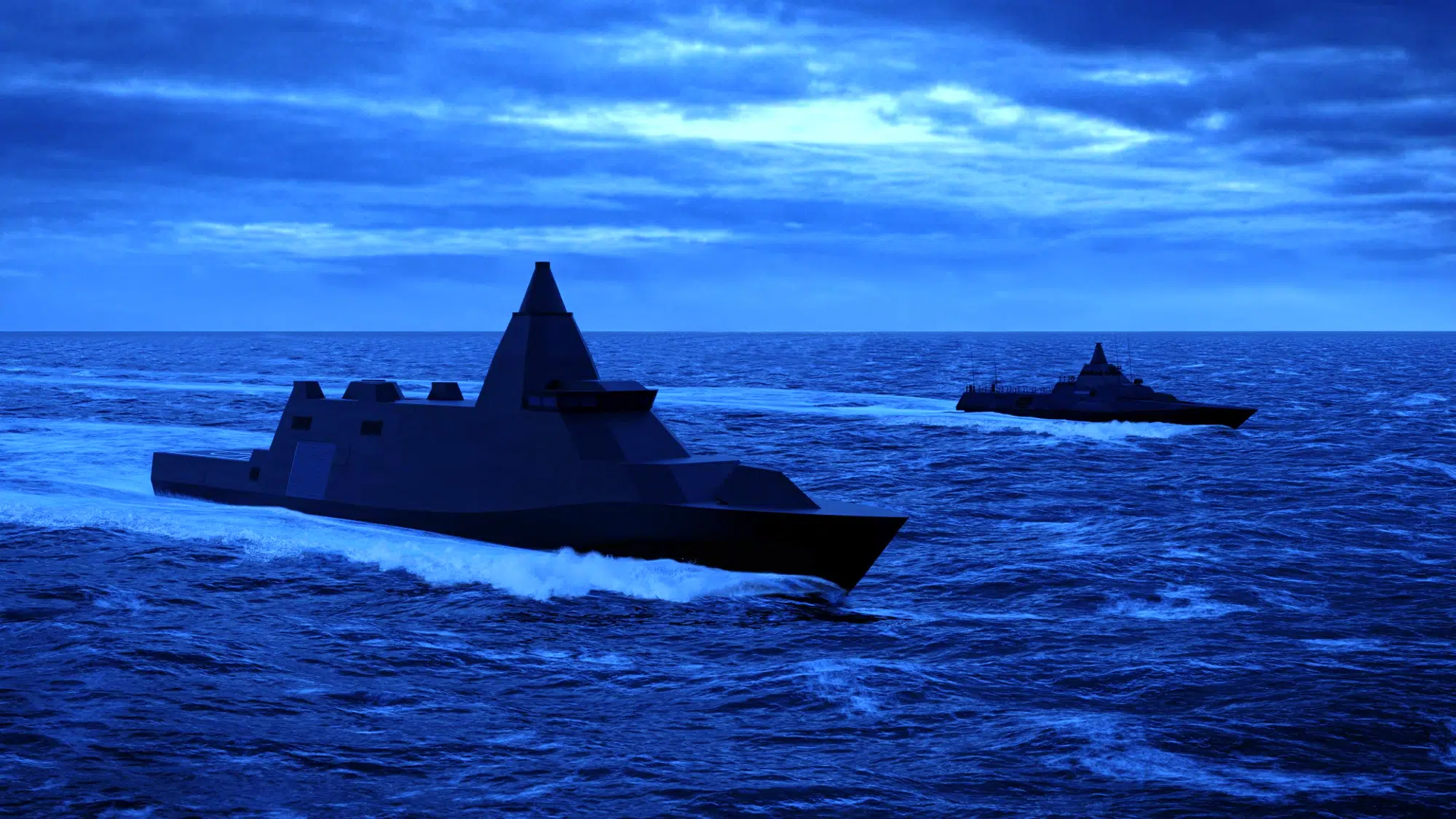
The enhanced capacity is designed to support NATO IAMD and anti-submarine warfare (ASW) requirements, and to build the navy’s ability to contribute to – and potentially command, in the medium term – NATO’s standing naval forces, including the North Atlantic-focused Standing NATO Maritime Group 1 (SNMG1).
However, earlier in 2025, the Swedish Defence Materiel Administration (Försvarets materielverk, or FMV) received new direction from the Swedish Armed Forces to also investigate procurement options based on existing, ‘off-the-shelf’ products.
According to Olof Öhrström, FMV’s head of surface warfare systems, “FMV has had dialogue with several different actors. We are now working intensively to process and evaluate the information received: this process extends until the end of 2025: the plan now is to sign a contract with a chosen supplier in the first half of 2026.”
Naval News understands the new direction includes vessel design and production, and that the first two vessels are scheduled for delivery during 2030.
Sustaining operations
Rear Adm Norlén explained that current Baltic region operations underline the need for sustained outputs.
NATO’s ‘Baltic Sentry’ activity, for example, was established in January 2025 to build capability to deter and defend against incidents involving critical undersea infrastructure (CUI) in the region. Even though the CUI risk subsequently subsided, ‘Baltic Sentry’ evolved to become an established part of NATO’s wider regional enhanced vigilance activity (EVA) framework; in September, it was harnessed to NATO’s new ‘Eastern Sentry’ activity, which – following several incidents – employs air-defence capability to deter uncrewed aerial vehicle (UAV) risks around civilian and military airports across the region.
The ongoing requirement to support the EVA underlined another capability the RSwN brings to NATO. “If that is some sort of description of [operational requirements needed] in the peacetime we have right now – peace, but with a crisis – you need persistent intelligence, surveillance, and reconnaissance [ISR] operations,” said Rear Adm Norlén. “We have, for instance, autonomous vehicles in every aspect – underneath the surface, on the surface, and in the air – that will enable us to complement crewed ships during such times so we can maintain operations for a much longer period.”
Another example of RSwN contributions to more sustained operations will be the use of its two new A26 Blekinge-class diesel-electric submarines (SSKs). Set for delivery in 2031 and 2033, these boats will bring improved endurance over the in-service A19 Gotland-class SSKs, the admiral noted.
Alongside equipment capabilities, other changes will be required to underpin the extended operational outputs, Rear Adm Norlén explained. “Ashore, we are creating combat support battalions to give the forces the opportunity to do just that – conduct sustained operations for much longer periods.”
However, he added, “The major change is conceptual – to really understand this new role we have been given inside the alliance, and I think we do. We’re working on that every day.”
Naval News Comment
The Baltic region is a key connector enabling NATO’s increased focus on security along its eastern border, ashore and at sea. In the event of any crisis potentially or actually escalating into conflict, sea lines of communication (SLOCs) across the Baltic Sea will be crucial for moving materiel and personnel. SLOC security is likely to be required for sustained periods, encompassing core tasks like IAMD and ASW. This reinforces the RSwN’s new surface combatant requirements.