After its recent successes in selling licenses for the Arrowhead 140 frigate design to Indonesia, Babcock is seeking to exploit further opportunities in the Asia-Pacific region.
Sir Nick Hine, Babcock’s Chief Executive, Marine, spoke to Naval News about its aspirations in places like Indonesia and New Zealand. “We’re looking at a number of areas, some sensitive, some less sensitive. But if I mentioned Singapore, Malaysia, if I mentioned Chile, those are all things that we’re looking at currently.” Furthermore, Hine stated his company is “looking at the Gulf particularly closely”.
Hine added that many Asia-Pacific navies are in a period of recapitalisation, and that these customers are sophisticated, especially as the hybrid-navy concept of crewed and uncrewed teaming gathers momentum. “They’re moving forward quickly, having recognised what the world is doing in terms of hybrid, and in terms of the way these things are changing. So we have to move quickly, we have to move with that in order to satisfy the requirement.”
Regarding the integration of uncrewed systems, the Babcock executive pointed out, “The world has changed, and we’ve moved already into what we’re calling hybrid navy. Some of the things we thought were right then aren’t right now, and therefore we’re having to adapt even through the design-and-build phase.” Unmanned platforms in the air, on the sea and under it bring a force-multiplying effect. “You’re not buying a frigate now, you’re buying a task force. That’s a differentiator between us and the competition. That’s not what’s on offer elsewhere,” he asserted.
Arrowhead 140 appeal
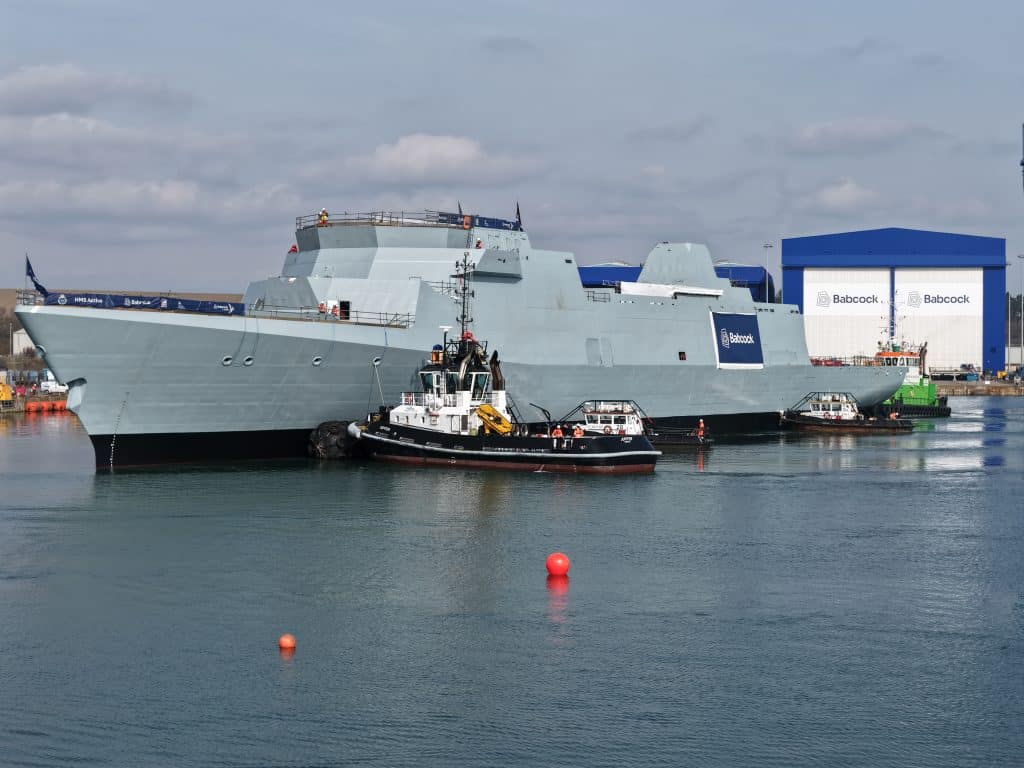
Hine, a former Second Sea Lord in the Royal Navy, shared: “We’re not offering a legacy platform, and therefore the opportunities that we see are increasing, particularly in the region because many of the countries we’re talking about see the benefit of this combined crewed-uncrewed offering. And they like the idea that Arrowhead 140 is in production and it’s a relatively cheap platform.” He acknowledged that navies never have enough money or people.
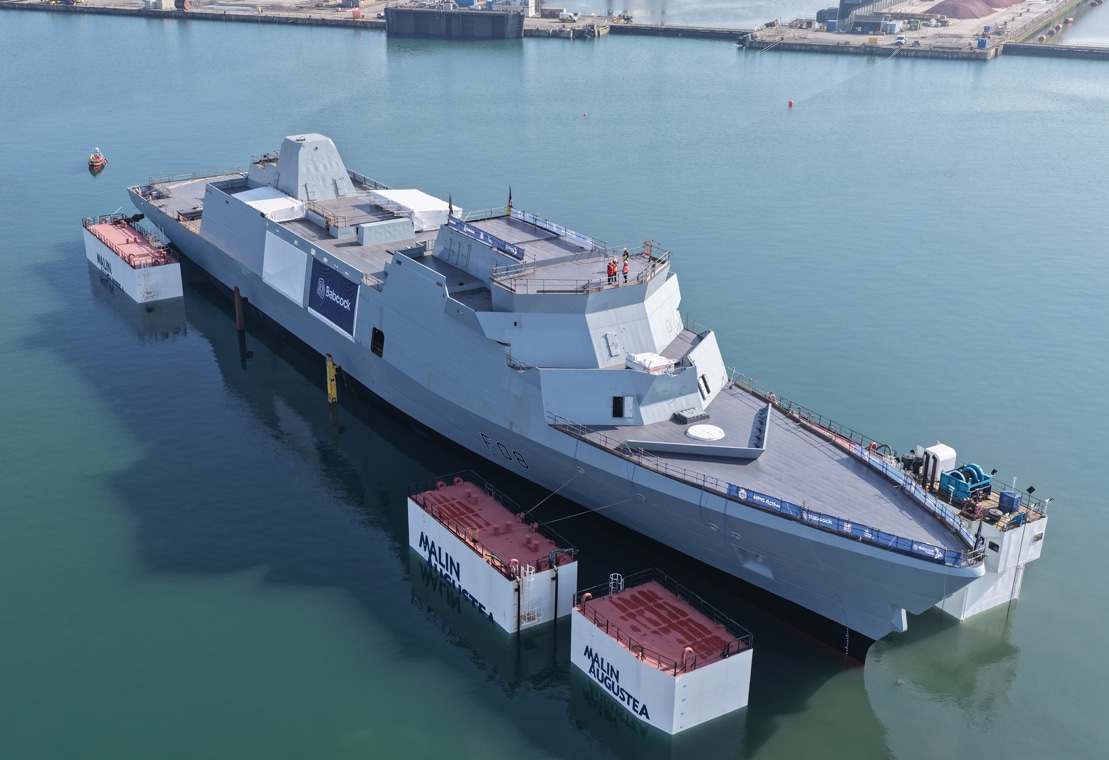
Hine remarked that, for these reasons, the Arrowhead 140 is an ideal solution, especially with its ability to combine with uncrewed platforms as part of a hybrid navy. “You get more for your money, and it takes fewer people to deliver,” he claimed. Babcock is building five Type 31 frigates for the Royal Navy based on the Arrowhead 140, plus the design was selected by Indonesia and Poland.
With the Arrowhead 140, “We have a series of different [production] models. We can either build the whole thing, we can help build under license, or we can just sell the license and then allow them to do it. Our relationship with Indonesia, which is significant, and PT PAL means that we offer engineering and design support as the platforms are being built. We do the same with PGZ in Poland.”
Hine added that such a flexible approach “is of interest to other countries in the region. The key here is that the more this happens, the more routine it becomes, the more the benefit of the global supply chain, the more the benefit of that data sharing, that interchangeability that comes as part of it.”
Indonesian intentions
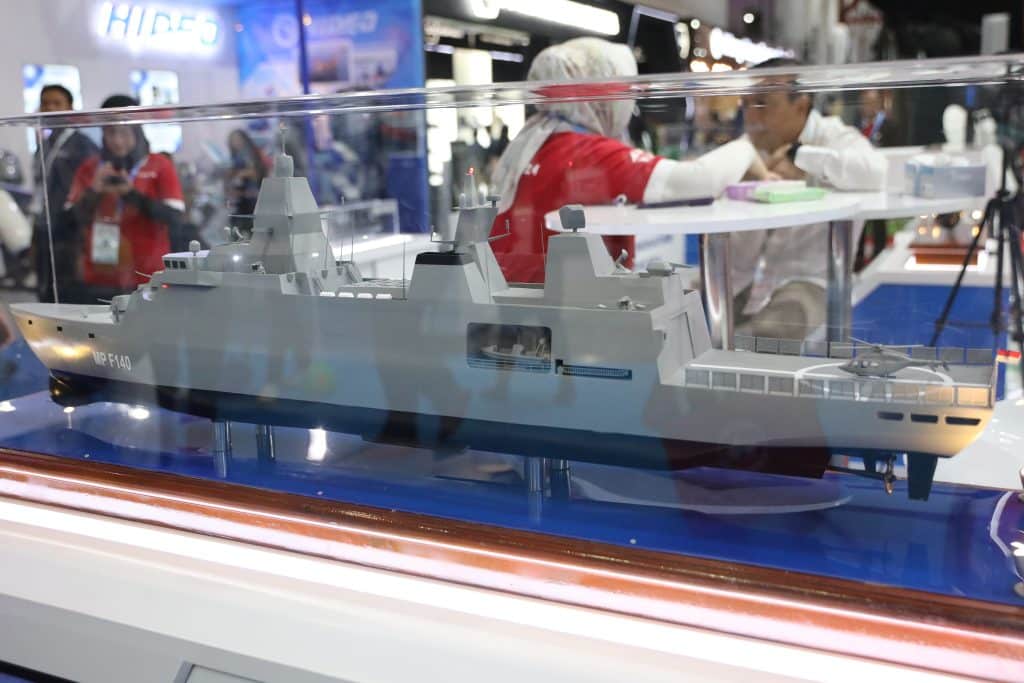
The Indonesian market presents huge opportunities, spurred by the signing of an initial agreement for the Maritime Partnership Programme (MPP) between Babcock and Jakarta as announced on 21 January 2026. Alongside it, a letter of intent added two extra Arrowhead 140 licenses to the pair sold earlier in 2021. Under the latter, PT PAL is constructing two Balaputradewa-class frigates (also known as Fregat Merah Putih, which literally means “Red White Frigate”) for the Indonesian Navy.
PT PAL launched the first of these frigates in Surabaya on 18 December 2025, and both warships are projected to be commissioned in 2028-29. According to PT PAL specifications, the frigates measure 140m long, have a 19.75m beam and 4.96m draught. They displace 5,996 tonnes, and approximately 60% of the reference design was changed to meet Indonesian Navy requirements.
Discussing the MPP agreement, potentially worth GBP4 billion (US$5.4 billion), Babcock stated: “The letter of intent, that paves the way for further agreements, was recently signed…and follows the landmark MPP that was announced in November 2025 between Babcock and the Indonesian government to jointly develop maritime capability for Indonesia’s navy, fishing industry and, in turn, food security. In this short period, significant progress has been made between Babcock and Indonesia’s Ministry of Defence.”
The MPP aims to boost investment in Indonesian shipbuilding, revitalise Indonesia’s fishing industry, and enhance Jakarta’s defence and maritime security. Babcock will thus have a strategic role in helping meet these ambitious aims.
David Lockwood, Babcock’s CEO, said at the time: “The Maritime Partnership Programme between Babcock and Indonesia is focused on advancing Indonesia’s defence and maritime capabilities, infrastructure and supply chain.” He added, “As the lead industrial partner in this programme, we are creating a strong and enduring alliance that will not only support Indonesia’s maritime goals but will sustain and grow jobs in both countries. This first work order, within this landmark framework, signals the importance of the pace and progress needed to deliver President Prabowo Subianto’s maritime transformation and underpins the growing success of our Arrowhead 140 export design.”
Providing an update on the MPP, Hine explained, “We’re still in conversation. Our Maritime Partnership Programme with Indonesia is really significant, and it works right from the fishing vessel, protein to plate – the idea that you need economic security, that’s about feeding your population. They need protection, they need protection inshore, they need protection offshore, they need protection from IPVs [inshore patrol vessels], OPVs [offshore patrol vessels] and Arrowhead 140s.”
“They need maritime domain awareness that allows you to then coordinate all those things. So the whole programme is a total package, and that’s something that we’re saying to potential customers, ‘Look, here’s a whole suite of things that we can draw together, and Babcock’s really good at integrating all of this stuff.’ And it doesn’t mean that we make all of this stuff, quite the opposite. We use indigenous supply chains and opportunities.”
Indeed, it is notable that Babcock does not list any IPVs or OPVs in its catalogue on its website. It lists only the Arrowhead 140, the associated Type 31 for the Royal Navy and the smaller Arrowhead 120. However, it has experience in constructing OPVs – for example, it constructed four 90m-long Samuel Beckett-class OPVs for the Irish Naval Service around a decade ago.
Hine said he regularly visits Indonesia as the MPP coalesces. “That particular programme has to run between now and 2029; it’s quite a short period. It’s underwritten by UK Export Finance, so it’s a way of making sure that that’s all delivered quickly, and it’s going well.”
Kiwi competition
As for New Zealand, the Arrowhead 140 has been shortlisted alongside the Japanese Upgraded Mogami as a potential replacement for the Royal New Zealand Navy’s (RNZN) two ageing Anzac-class frigates.
Hine noted the Royal Navy’s Type 31 was “born out of a requirement to reduce a whole bunch of things: reduce the cost of purchase, reduce the cost of ownership through life, reduce the resource bill in terms of the number of people it was employing, but also give you this adaptable platform that allows you to grow through life”. That is why, he argued, it is suitable for the RNZN.
Regarding its prospects in the upcoming Kiwi competition, Babcock’s executive expressed, “All we can do is put our best foot forward, but we think it’s a really good offering. We know the New Zealand navy really well; we think we understand the requirement. We’ve got a platform here that’s actually well suited, but we’re not selling products here, we’re selling partnerships.”
Certainly, one possible advantage of Babcock’s position is that it is well bedded into New Zealand’s defence ecosystem. In fact, Babcock Australasia has been acting as the navy’s Strategic Maritime Partner since 1995. The company has 600 local suppliers and, in the past two years alone, NZ$220 million (US$128 million) of activity was directed into this industry network. Hine believes the combination of uncrewed systems and the Arrowhead 140 would meet the RNZN’s requirements. “That’s where this hybrid-navy thing is really important, because you’re getting a scalable system that allows you to veer and haul on how many capital platforms and how many uncrewed surface platforms you need in order to deliver an outcome.”