Story by Ensign Charena Camacho
RAN and the U.S. Navy joined together to deploy high-end training tactics and improve proficiencies in advanced kinetic and non-kinetic capabilities, capable of projecting dominant defensives against a multi-domain threat environment.
“Conducting advanced kinetic and non-kinetic bilateral exercises with our allies and partners increases our collective ability to outthink and outfight any adversary threatening our open seas,” said Rear Adm. Dan Martin, commander of Carrier Strike Group One. “Our long-term alliances and partnerships in the Indo-Pacific region preserve maritime prosperity and international order, and enable seamless integration, communication, and collaboration across the region.”
The bilateral, multi-phase exercise was conducted over several weeks and included events such as enhanced maritime communication tactics, electronic warfare operations and integrated anti-air, anti-surface operations.
Participating naval units conducted and evaluated joint integrated surface and air engagements to further increase collective war-fighting readiness, maritime superiority, and power projection in the Indo-Pacific.
“The Australia-US alliance increases our ability to protect ourselves and our interests and we work as like-minded countries to address security challenges in the Indo-Pacific,” said Rear Adm. Mark Hammond, commander of the Australia Fleet. “Opportunities to practice and prove our tactics and rapidly build shared understanding in order to respond together, further our interoperability. We have sustained a comprehensive program of navy-to-navy engagement with the United States Navy throughout 2021 and I look forward to continuing to work as partners in years to come.”

HMAS Warramunga (FFH 152) represented the Royal Australian Navy in the bilateral training exercise.
U.S. Navy units included aircraft carrier USS Carl Vinson (CVN 70); Ticonderoga-class guided-missile cruiser USS Lake Champlain (CG 57); Arleigh Burke-class guided-missile destroyer USS Stockdale (DDG 106) of Destroyer Squadron (DESRON) 1; Henry J. Kaiser-class Fleet replenishment ship USNS Rappahannock (T-AO 204) and USNS John Ericsson (T-AO 194); and nine squadrons of embarked Carrier Air Wing (CVW) 2.
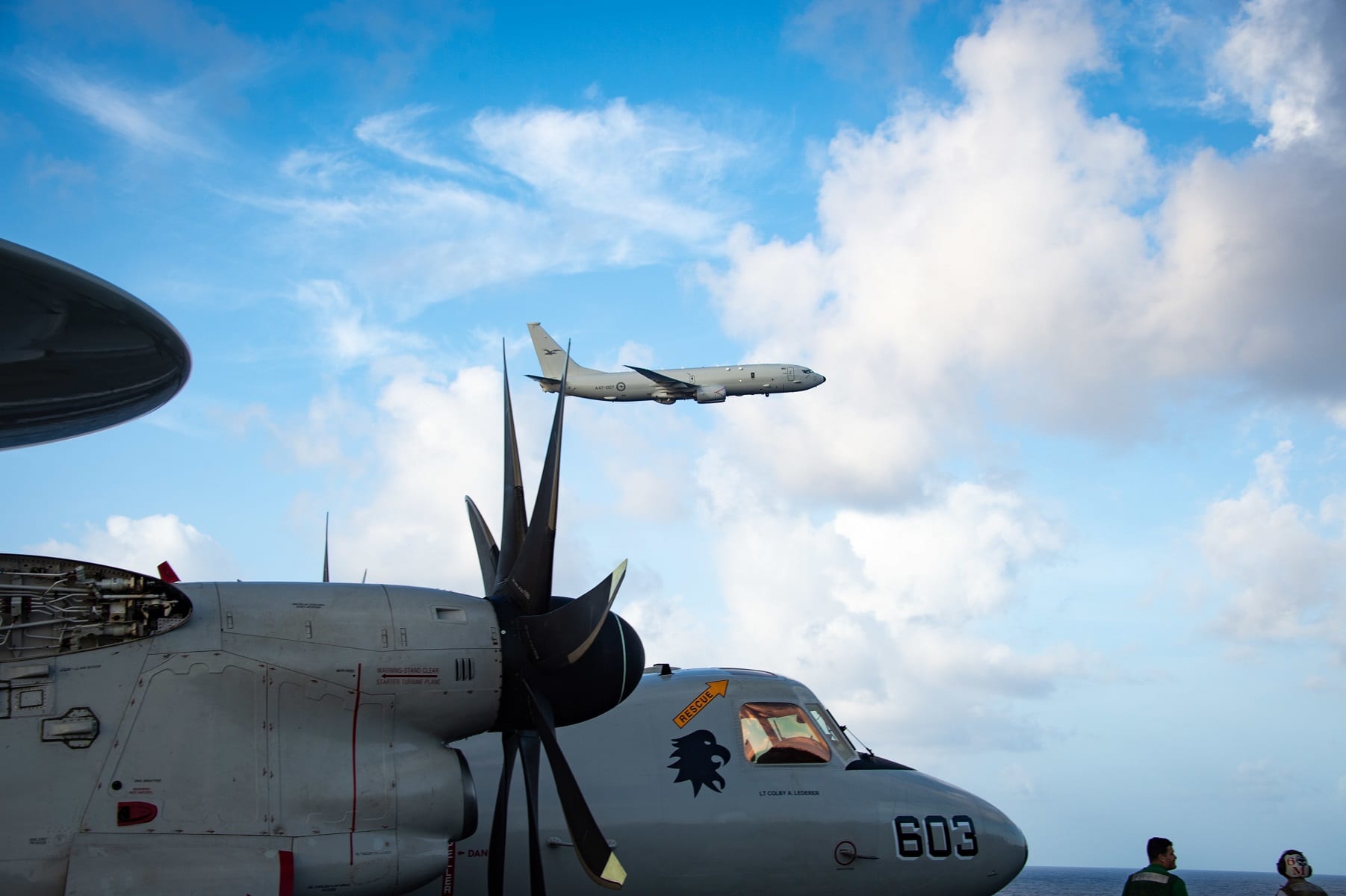
CVW-2 consists of an F-35C squadron, the “Argonauts” of Strike Fighter Squadron (VFA) 147; three F/A-18E/F Super Hornet squadrons, the “Bounty Hunters” of VFA-2, the “Stingers” of VFA-113, and the “Golden Dragons” of VFA-192; the “Gauntlets” of Electronic Attack Squadron (VAQ) 136, operating the EA-18G Growler; the “Black Eagles” of Airborne Command and Control Squadron (VAW) 113, operating the E-2D Advanced Hawkeye; the “Titans” of Fleet Logistics Multi-Mission Squadron (VRM) 30, operating the CMV-22B Osprey; the “Black Knights” of Helicopter Sea Combat Squadron (HSC) 4, operating the MH-60S Sea Hawk; and the “Blue Hawks” of Helicopter Maritime Strike Squadron (HSM) 78, operating the MH-60R Sea Hawk.
CSG 1 is deployed to the U.S. 7th Fleet area of operations in support of a free and open Indo-Pacific region.