The Royal Swedish Navy (RSwN) has deployed a Gotland-class diesel-electric submarine (SSK) on NATO Allied Maritime Command’s (MARCOM’s) major annual North Atlantic-based anti-submarine warfare (ASW) exercise, ‘Dynamic Mongoose’. The exercise is running for two weeks from 29 April, in Norwegian Sea waters between Norway and Iceland.
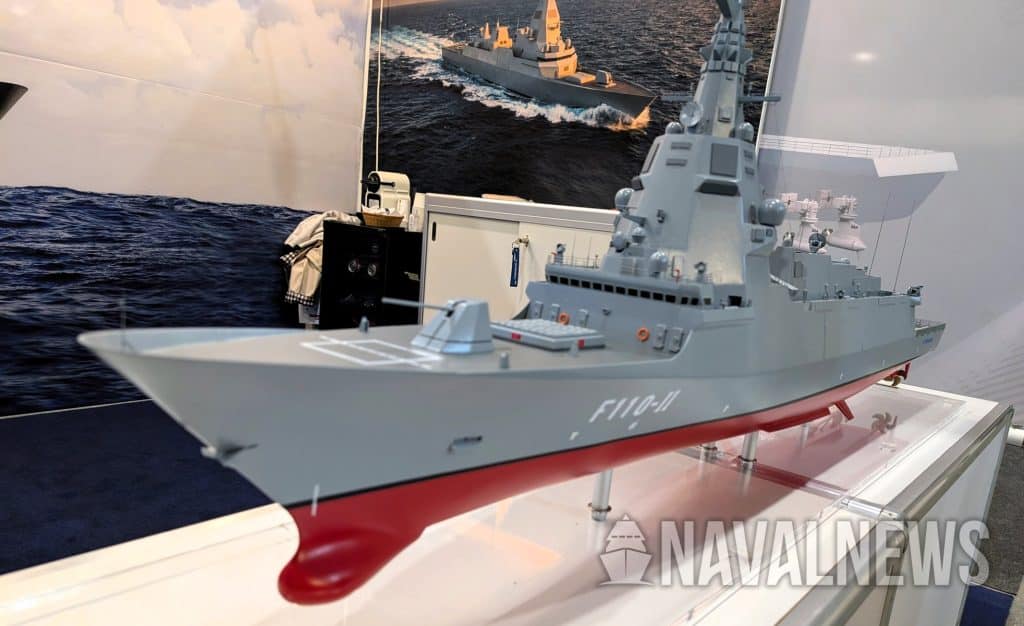
While the RSwN has participated in ‘Dynamic Mongoose’ before, in 2015, this is the first time the navy has joined a MARCOM exercise as a NATO member, Rear Admiral Thomas Wall – a US Navy submariner posted as Commander, Submarines NATO (COMSUBNATO) at MARCOM – told a press conference onboard the Spanish Navy F-100 Alvaro de Bazan-class frigate ESPS Almirante Juan de Borbon in Stavanger, Norway on 29 April.

Sweden formally joined NATO in March 2024, having applied in May 2022 – a move precipitated by Russia’s invasion of Ukraine in February 2022.
The press conference took place as Standing NATO Maritime Group 1 (SNMG1) and various other alliance naval platforms prepared to sail for ‘Dynamic Mongoose’. The Spanish frigate is SNMG1’s current flagship, and for ‘Mongoose’ is leading a collective NATO naval group numbering 10 surface ships, eight maritime patrol aircraft, and five submarines.
The RSwN submarine present is HSwMS Gotland, one of three boats in the navy’s A19/Gotland class. The A17 SSK HSwMS Södermanland completes the navy’s four-boat fleet.
Rear Adm Wall told the press briefing:
“We’re excited to incorporate the stealth of one of Sweden’s advanced, silent, Gotland-class submarines into this exercise,”
“We’ve been collaborating with the Swedish navy for many years, so the interoperability is already there,” he continued. “The Swedish navy brings the experience of a submarine crew well-versed in shallow-water operations. So, to have them in our allied maritime force composition firmly enhances our collective defence in the region.”
‘Dynamic Mongoose’ is focused on conducting ASW in the North Atlantic’s deep, open-ocean waters. The RSwN’s submarine skills encompass operations in the Baltic Sea’s archipelagic and littoral shallows. In these waters, its tactical- and operational-level expertise provides another piece in NATO’s wider geostrategic picture.
“There are fourteen submarine-operating countries in NATO. Each submarine country brings a different capability, and it’s based on where they normally operate and what they normally practice,” Rear Adm Wall told Naval News, during a visit onboard Gotland at the Royal Norwegian Navy’s Haakonsvern naval base on 28 April. “Because RSwN submarines usually operate in the Baltic Sea region, their crews are used to operating in shallow waters and unusual environmental conditions related to submarine sonar.”
“So, having them incorporated into ‘Dynamic Mongoose’ really does give us a phenomenal ASW capability,” Rear Adm Wall added.
Onboard Gotland,the boat’s commanding officer (CO) Lieutenant Commander Viktor Moberg underlined to Naval News the benefits that Sweden’s submarine capability brings to NATO. “The biggest takeaway is our experience in the Baltics …. It’s our home waters. No-one operates there as much as we do.” Such experience relates to technology, capability, and operational outputs, the CO explained: the boat is built to operate in the region, and the crew knows the waters and how to use them, as well as understanding the region’s routine patterns of life at sea.
“The primary factor for a submarine is to stay undetected. That’s where the knowledge comes in of how to use the waters,” said Lt Cdr Moberg. Such knowledge is supplemented by a boat designed to operate in the region, he added, with this combination giving the navy – and, now, NATO – an operational edge there.
As regards offensive outputs in the Baltic, the RSwN’s boats prioritise targeting an adversary’s fleet, alongside building an intelligence picture, said Lt Cdr Moberg during a media tour onboard. The submarine’s torpedoes (which include both heavyweight and lightweight weapons) can be reloaded at sea, when a boat is operating in sheltered, archipelagic waters. Moreover, the boats can carry uncrewed underwater vehicles. Exploiting this overall capability package is enabled by the boats’ Stirling air-independent propulsion (AIP) system, which adds clear operational advantage, the CO explained: “The greatest benefit is that, with [AIP] on patrol, we don’t need to ‘snort’ for several weeks.”
For Gotland, the key aim in ‘Dynamic Mongoose’ is to build understanding of the operating environment. “For our part, it’s getting to know these waters – but hopefully we will be able to bring an outside perspective and do things differently from the rest of the submarines that are used to operating here,” Lt Cdr Moberg told Naval News. “Maybe our different methods might be unpredictable to the practice ‘enemy’.”
At tactical and operational levels, the RSwN’s presence as a NATO navy will improve exercise integration, for the RSwN and NATO alike. For the navy, “working as a fully integrated NATO member … will be the main takeaway,” said Lt Cdr Moberg. For NATO, “The biggest advantage is at an operational level, because exercise control can manage us in the same way they manage all the other boats,” he added.
Lt Cdr Moberg explained that the A19 boats’ design and capabilities enable them to operate in any waters.
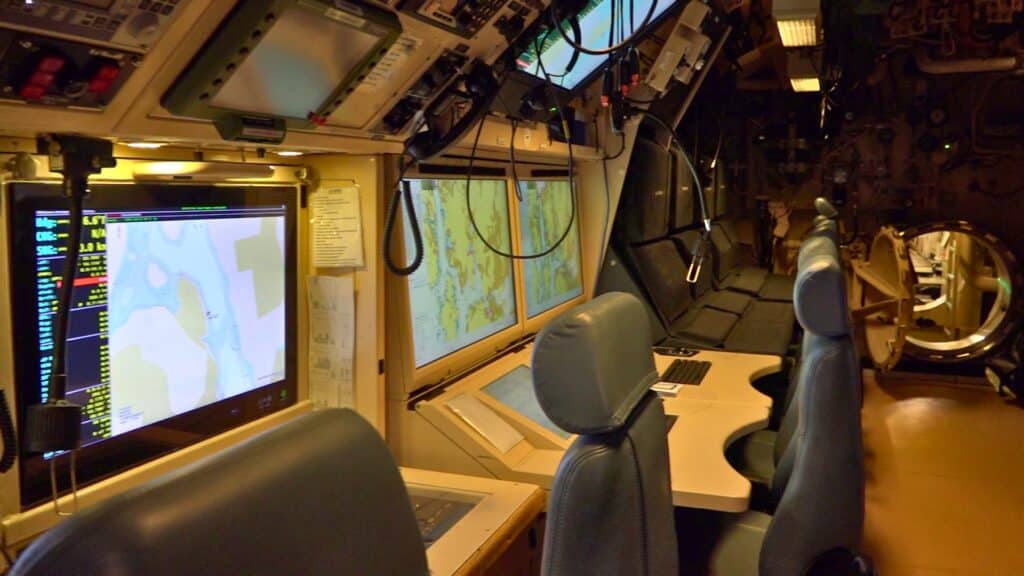
The class began a mid-life upgrade (MLU) programme in 2015. Gotland was the first boat to go through the process, returning to service in late 2019. A contract for the last boat to go through MLU, HSwMS Halland, was issued in September 2022. MLU work includes a new sonar suite, new non-penetrating optronic masts and a new combat management system (CMS). With the boats designed to operate in any waters, and carrying new sonar and CMS systems, the boats were ready in technology terms for operating in the North Atlantic’s deep waters, for example during ‘Dynamic Mongoose’. Nonetheless, a lot of preparation has been conducted across a lot of areas to prepare the boat and the crew for the exercise, said Lt Cdr Moberg: such areas have included sonar operators and watch teams.
Watch our video coverage of Dynamic Mongoose 2024: