Progress advances on future BR71 Mk II light corvettes for the Angolan Navy, with all three vessels under simultaneous construction in France and the United Arab Emirates. Equipped with advanced electronic systems and heavy armament for their size, these ships will rank among the most capable warships in their class on the African continent.
Various published photos during the last months showcase the progress on the new BR71 MKII light corvettes being built for the Angolan Navy, simultaneously at the Constructions Mécaniques de Normandie (CMN) shipyard in Cherbourg, France, and the Abu Dhabi Ship Building (ADSB) facilities in the UAE. Some of the photos reveal a fully assembled vessel at CMN, offering intriguing insights into its configuration.

This stems from a €1 billion contract signed in February 2023 between the EDGE Group—a UAE-based advanced technology and defense conglomerate comprising 25 companies—and the Angolan government. Under the agreement, Abu Dhabi Ship Building (ADSB), an entity of EDGE, will construct, three advanced 71-meter light corvettes for the Angolan Navy as well as a number of inshore patrol vessels and transport ships, incorporating technology transfer from CMN. An integrated logistic support (ILS) package is included in the deal. Two will be manufactured in Cherbourg and one in Abu Dhabi. These ships will be some of the most advanced warships in their class in Africa.
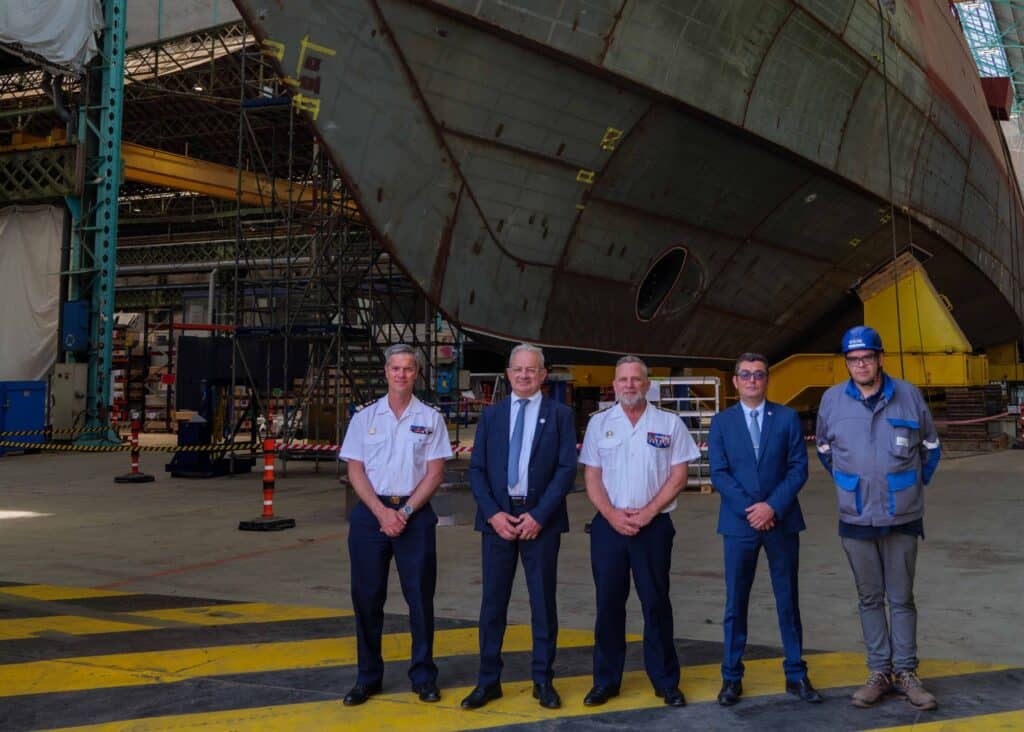
Steel for the first corvette was cut in December 2023, and the hull was laid down in March 2024. Fitting out of the vessel has begun, with delivery expected in 2026, followed by the remaining ships by 2027.
Simultaneous shipbuilding in France and United Arab Emirates
In late 2024, CMN and ADSB shipyards successfully simultaneously laid keels of the new BR71 corvettes for the Angolan Navy. The events conducted in Cherbourg and Abu Dhabi, with high-level attendants from both shipyards and Angolan Navy.


ADSB announced this significant event in a social media post, stating the following:
ADSB, in collaboration with CMN – Constructions Mécaniques de Normandie, proudly marked the simultaneous keel laying for the C200 blocks of the Angola BR71 Corvette programme. Held in Abu Dhabi and Cherbourg, this achievement underscores the seamless synergy between both shipyards and their shared commitment to advancing the programme through a fully integrated approach. The milestone ceremonies were attended by key leadership from ADSB, CMN, and the Angolan Navy, reflecting our unwavering dedication to delivering advanced naval capabilities on schedule and showcasing international cooperation at its finest.
The BR71 MKII Design

The ADSB 71-metre Combattante ΒR71 MK II is a significant evolution and upgrade of CMN’s proven Baynunah-class (BR71 MKI design) corvette, which is currently in service with the UAE Navy with six vessels. Designed by CMN Naval for littoral warfare, the BR71 corvette is engineered to counter air and surface threats while also excelling in surveillance missions. The company highlights it as a fast, powerful, compact, and modular warship.
The MKII platform is a highly versatile and proven design, characterized by core modularity and relevant components, making it suitable for a wide range of operational scenarios. The ship is designed to support missions such as coastal and offshore patrolling, intelligence, surveillance, and reconnaissance (ISR), and law enforcement applications, including anti-piracy, smuggling prevention, and border control. The platform can also contribute to naval task force deployments, particularly in anti-surface and anti-air warfare, as well as exclusive economic zone (EEZ) monitoring and surveillance to secure maritime resources.

Additionally, the MKII platform excels in scouting operations in tactical areas, providing reconnaissance capabilities for actionable intelligence, and is equipped to handle deterrent strike operations to neutralize potential threats. Furthermore, it supports land force operations, extending the operational reach and enhancing the effectiveness of joint missions. With its adaptability and mission-specific configurations, the MKII platform stands as a suitable solution for addressing modern maritime and multi-domain challenges.
Technical Characteristics and Capabilities

With a length overall (LOA) of about 71 meters and a length between perpendiculars of 62.3 meters, it features a maximum breadth of 11 meters and a depth to the main deck of 6 meters. The vessel’s full load displacement is approximately 900 tons, with a maximum draught of around 3 meters.
Performance-wise, the platform achieves a maximum speed of 30 knots (at half load) and a cruising speed of 12 knots, offering a range of 2,500 nautical miles at 12 knots cruising speed. Its fuel capacity is 100 tons, providing an endurance of 15 days, and it accommodates a crew of 50. Propulsion is powered by four MTU diesel engines located in two engine rooms, driving four Kongsberg waterjets, with two steering jets and two booster jets ensuring exceptional maneuverability and speed.

The vessel features a steel-constructed hull and deck, with an aluminum superstructure designed to minimise radar cross section (RCS) and optimised wheelhouse arrangement with wide visibility, ensuring MK II is ready for all coastal patrol and surveillance, mine detection, helicopter operations, maritime interdiction, and friendly forces support operations. The platform also carries multidimensional anti-air and anti-surface capabilities.
The platform’s hallmark is its operational adaptability, featuring Class II UAS operations and a 5-ton helicopter. The UAS is believed to be among the naval unmanned VTOL systems included in EDGE’s portfolio. The corvette’s expansive modular layout supports diverse mission requirements, while two 7.5-meter rigid hull inflatable boats (RHIBs) with davit launching and recovering systems, enhance versatility for boarding, rescue, and inspection tasks.
The Weapon Systems

The armament includes eight MBDA MM40 EXOCET Block 3C surface-to-surface missile (SSM) housed in quad launchers positioned amidships. Given EDGE Group’s partnership in the MANSUP missile project, the MANSUP-ER may be chosen over the EXOCET as the preferred missile system. At the bow, a Leonardo OTO76/62 Super Rapido naval gun provides unrivaled performance and flexibility in any air defense and antisurface role, particularly in anti-missile role. Directly behind the gun at the bow area is an anti-air missile silo with a row of eight vertical launching system (VLS) cells for the MBDA VL MICA/VL MICA NG surface-to-air missiles (SAM). Atop the RHIB hangar, two MBDA SIMBAD-RC trainable launchers are mounted, carrying a total of four fire-and-forget MISTRAL 3 SAM.
Located amidships, between the main mast and the SSM launchers, are two Leonardo LIONFISH remote weapon stations (RWS), likely the LIONFISH 20mm variant, which will also be installed on the Greek Kimon-class (FDI HN) frigates and the upgraded Island-class coastal patrol vessels. Near the SSM launchers, two decoy launching systems (DLS), resembling the Lacroix SYLENA Mk2, are present, featuring Lacroix’s new-generation SEACLAD naval decoy range and CANTO anti-torpedo decoys.
Here is Naval News’ video coverage from NAVDEX 2023 including BR71 Corvettes for the Angolan Navy.
The Electronic Equipment
Assuming the ADSB mockup (in NAVDEX 2023 and 2025) is the most accurate representation of the vessel—based on the fact that EDGE Group has built the 62-meter Falaj 3 missile-armed patrol vessels with a likely similar equipment configuration, and that its brochure features a CMN rendering identical to the ADSB mockup—the onboard electronic systems can be described accordingly.

The electronic equipment likely includes a Leonardo KRONOS NAVAL HP C-band multi-function radar (MFR) enclosed within the conical radome of the integrated mast atop the bridge, along with fire control radar (FCR) that looks very similar to a Leonardo electro-optical gun fire control system NA-25X (which might turn out to be the more sophisticated NA-30S Mk2) positioned forward of the radar dome. Additional systems include two navigation radars, at least one electro-optical sensor (EOS) or a HGH IRST system based on two SPYNEL-X 8000 EOS fixed on the mast, and four uplink antennas for guiding VL MICA SAM. A small mast at the rear and above the RHIB bay is fitted with communication equipment.
Above the radar dome, the ELT/332 integrated radar and communications electronic support measures (R-ESM & C-ESM) and communications intelligence (COMINT) sensor is installed, that will be provided by ELT Group (Elettronica). The ELT/332 system is also deployed on the two Musherib-class fast attack craft (FACM) of the Qatari Emiri Navy and the two Bani Yas-class (GOWIND 2800) corvettes of the UAE. The equipment may also include a mine and obstacle avoidance sonar (MOAS) and a naval laser warning system (NLWS). If the electronic systems are supplied by Leonardo, the combat management system (CMS) is likely the ATHENA C Mk2. Overall, as it was already mentioned earlier, the electronic equipment layout closely resembles that of the Falaj 3-class armed offshore patrol vessels (OPVs).