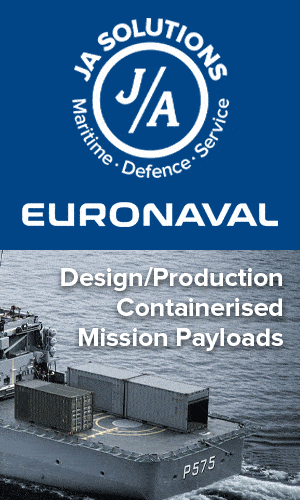
A new line item in the U.S. Navy Fiscal Year 2026 budget is supporting a containerized Mark 48 Advanced Capability (ADCAP) torpedo launcher for use on unmanned surface vessels (USV) and small combatants.
The U.S. Navy has allocated $50 million towards the development of a containerized launcher, titled “Liberator”, a launcher designed to enable alternative methods of launching torpedoes. Liberator was named for the first time in Fiscal Year 2026 Research, Development, Test, and Evaluation (RDT&E) documents published by the U.S. Navy and Office of the Undersecretary of Defense last week.
Program Executive Office, Unmanned and Small Combatants (PEO USC) is leading the effort and will deliver a 3.5 hour presentation about Liberator and a related unmanned undersea vehicle (UUV) payload, Hunter, to industry partners next week. Hunter is a lethality enhancement payload designed for Boeing’s Orca XLUUV joint emergent operational need (JEON).
It is unclear if Hunter will integrate ADCAP torpedoes for Orca as well, but the combination of both suggest it is a possibility.
“The Liberator provides for the development of alternative methods for launching torpedoes or similar devices. [Funding increased] in FY 2026 for Containerized Delivery System Liberator software and hardware development.
U.S. Navy FY2026 Budget Documentation
Project Liberator leverages the U.S. Navy’s Mark 48 heavyweight torpedo, a submarine-launched torpedo currently deployed in its latest variant, the MK48 ADCAP Mod 7.

The Mark 48 ADCAP torpedo is the U.S. Navy’s primary submarine-launched heavyweight torpedo (HWT), used since 1972 in its earliest forms. Since its introduction, it has received a number of upgrades to enhance range, lethality, acoustic, and sensor performance to deliver in its current form. The Navy expects even more iterations of the Mark 48 including a major capability boost with new propulsion and new software.
The Lockheed Martin-built HWT has a 650 pound (295 kilogram) warhead that can be delivered to the keel of a ship, delivering lethal effects, despite having a smaller warhead than some anti-ship missiles. The effect comes with a more effective delivery location, detonating under the ship’s keel to compromise structural integrity rather than striking a the waterline like an anti-ship missile.

Work on Liberator is being done within the U.S. Navy’s Naval Undersea Warfare Center Newport Division. Budget documents offer no insight on test schedules, development timelines, or future plans for the launching system.
ADCAP-carrying USVs would offer an extremely potent short to medium range capability against high value targets, given the lethality and difficulty in destroying and deceiving incoming torpedoes. Jane’s Defense estimates the range of the ADCAP at 31 miles (50 km) at 40 kts, giving small, stealthy USVs like the Leidos Sea Specter a reasonable standoff range against a surface action group or carrier strike group.