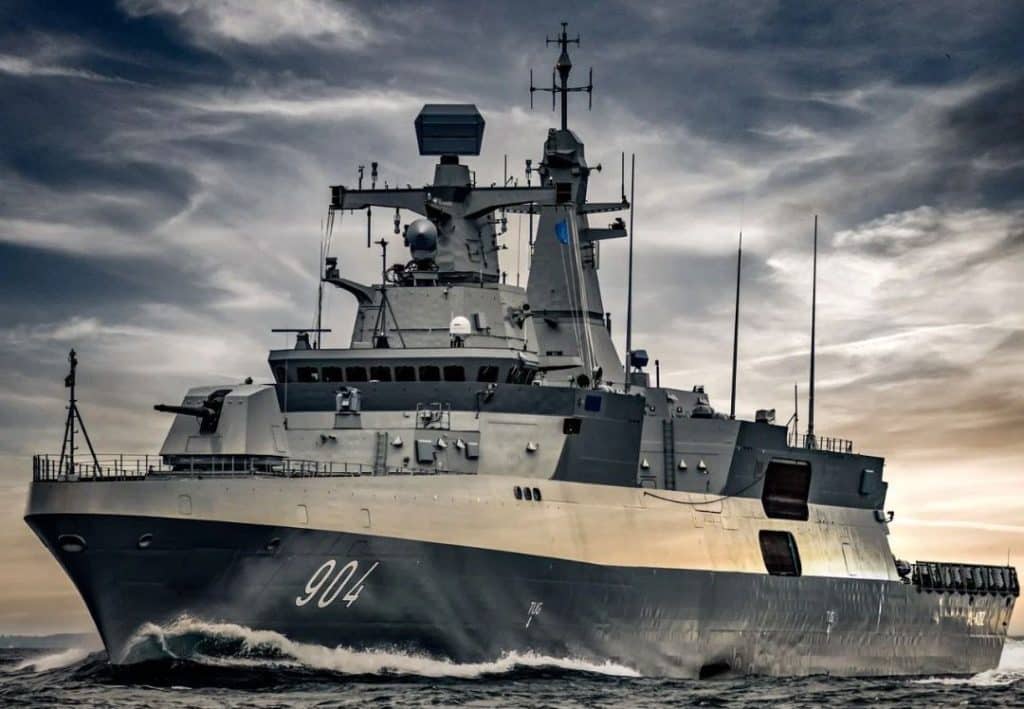
The Russian Navy recently concluded a fleet wide naval exercise, with the exception of the Black Sea Fleet, called July Storm. The exercise took place between July 23-27 and included a notable event during with the deployment of two new Russian unmanned surface vessels (USVs) that engaged and destroyed a floating surface target.
This event demonstrates that the Russian Navy is experimenting with the use of USVs in its naval arsenal and how to incorporate these new weapons into its naval doctrine. If developed and employed properly, these new USVs in Russian service might give the Russian Navy an upper hand against Western warships in the near future, especially in enclosed waters such as the Baltic Sea.
Lessons from the Russo-Ukrainian War
The Russian Navy, and more specific its Black Sea Fleet, has been on the receiving end of a targeted Ukrainian naval campaign that saw the use of unmanned surface vessels and cruise missiles. As a result of this naval campaign, several vessels of Russia’s Black Sea Fleet were damaged and destroyed and the fleet itself was forced to abandon its bases at the Crimea and withdrew to the naval base of Novorossiysk in Southern Russia.
Ukraine attacked the Russian fleet inside the port of Novorossiysk in the past, demonstrating that Ukrainian USVs have the range to reach this base from the shores of Western Ukraine while Ukraine still has the capability to coordinate its drone attacks once the USVs have reached Novorossiysk. During the attack on August 04, 2023, Ukrainian USVs damaged the Ropucha class landing vessel RFS Olenegorsky Gornyak while it was located inside the bay of Novorossiysk. The vessel was later towed to a drydock and has undergone repairs.
Russia’s Black Sea Fleet probably found some degree of protection inside the port of Novorossiysk as Ukrainian USV attacks shifted away from this region as USV attacks then shifted to interdict Russian naval movements between Southern Russia and the Crimea. On January 31, 2024, Ukrainian USVs sank the Tarantul class missiles boat RFS Ivanovets at Lake Donuzlav on the western side of the Crimea. This attack was followed up 15 days later with USVs sinking the Ropucha class landing ship RFS Czesar Kunikov south of the Crimea on February 15. On March 5, the Russian Bykov class patrol vessel RFS Sergey Kotov was sunk by Ukrainian USVs near the port of Feodosia at the eastern end of the Crimea.
Ukraine’s naval campaign has proven that USV attacks against conventional warship can be extremely successful and forced Russia to evaluate on how to best protect its vessels against such attacks. Analysis of Ukraine’s naval campaign indicates that Ukrainian USV attacks were the most successful when they targeted Russian warships operating independently. Attacks against a large formation of warships proved to be less successful as Russian warships were able to coordinate their responses and make it difficult for Ukrainian USV operators to find an opening to press home their attacks. perhaps this explains why the Black Sea Fleet has been relatively safe inside its naval base at Novorossiysk as it can concentrate its naval defenses in a sufficient manner to fend off Ukrainian drone attacks.
Russia’s transition from defense to offense

Over the past two years, Russia’s focus when it came to USV attacks was solely aimed on how to defend against them. Exercises involving USV were designed to train the Russian Navy on how to defend their bases and warships when they were at sea or at an anchorage. During these exercises, Russia used USVs that were modelled on the ones that are in use by the Ukrainian armed forces. Possibly Russia modeled Ukrainian USVs and tactics during these exercises, allowing the Russians to tap into their knowledge and experience gained from the Black Sea and distribute set knowledge and experience across its other fleets.
It is possible, that over time, these exercises have been morphed with the Russians trying out new tactics in deploying USVs as they gained more experience in the offensive use of USVs during these naval exercises. As such, Russia could be shifting its current naval position and start using USVs as an offensive weapon systems, rather than a training system. Such a shift would increase the offensive capabilities of the Russian Navy not only by adding a new weapon system to the Russian Navy but also new capabilities and manners of attacking hostile vessels.
The July Storm naval exercise ended with Russia demonstrating the use of two new types of USVs in an offensive role. Maritime defense expert H I Sutton observed that these two newly deployed USVs in use by the Russian Navy are of a new design, different from the ones that were previously observed to be in use with the Ukrainian armed forces and the Russian Navy. This could be an indication that Russia is now starting to build out its own offensive USV capabilities in earnest.
Implications for NATO
Ukrainian naval campaign, which was successful in the Blak Sea, took place in a maritime region with a single point of access, restricting the movement of naval forces to and from this region. Ukrainian drones were operating in general at distances up to 600 and 700 kilometers away from Ukrainian controlled shores in Western Ukraine.
Similar conditions exist in the Baltic Sea which is also a restricted maritime region with the Danish Straits being the area where vessels can enter and leave the area. Within the Baltic Sea, the Russian enclave of Kaliningrad occupies a central location. Leveraging existing USV technology and designs, Russian USVs deployed from Kaliningrad over a distance of 600 to 700kilomters would be able to reach the Danish Straits as well as the entrance to the Gulf of Finland which leads to Saint Petersburg, Russia’s second largest city and economic hub.

Within the Baltic Sea, the Russian Baltic Fleet is severely outnumbers compared to the available NATO naval forces of Baltic Sea nations. The Baltic Fleet also largely operates from Kaliningrad which is an exposed location, surrounded and isolated by neighboring countries which are part of NATO. It is not expected, that in the current situation, the Baltic Fleet would be able to put up much resistance given the overwhelming directly available NATO forces within the Baltic Region.
As such, USVs could be a force multiplier for the Russian Baltic Fleet , increasing its offensive capabilities and addressing the current naval balance of power. Russian USV attacks would put pressure on NATO naval deployments within the Baltic Sea and force NATO to develop reliable defenses against coordinated Russian USV attacks in the advent of a war between Russia and NATO. Thus Russia would be able to force NATO naval forces more on the defensive with the use of USV attacks, thereby prolonging the naval campaign in the Baltic Sea.
However, NATO naval forces wouldn’t be completely defenseless in the advent of a Russian offensive USV campaign. NATO forces will undoubtedly also have studied Ukrainians USV campaign in the Black Sea and probably have direct access to data and knowledge from Ukraine itself.
NATO forces also have extensive experience on how to deal with an asymmetric threat based on their deployments in the strait of Hormuz. In this region, the Iranian Revolutionary Guard operates a large number of fast attack craft designed to harass, swarm and overwhelm conventional warships. While fast attack craft are in use different from USVs as they engage their targets from a distance, either with machine guns, rockets, machine guns and light weight torpedo’s, they have the same operational characteristics. Fast attack craft, just like USVs, are small, fast, highly maneuverable, hard to detect and pose a threat at close ranges.
NATO forces are also learning from their engagements in the Red Sea where the drone threat posed by the Houthi rebels are also pushing NATO warships to evaluate their close range defenses against small targets. While the Houthi rebels mainly use UAVs, rather than USVs, the NATO forces have discovered the need for additional close in weapon systems to deal with drones, rather than relying on expensive missiles to counter this threat. Already, several NATO warships have been experimenting by deploying more light and heavy machine guns at their outer decks.
NATO forces do however lack real practical experience on how to fight of a concentrated USV attack, unlike Russia who gained its experience and knowledge during the 2023-2024 Ukrainian naval campaign in the Black Sea. In addition, the Russian Navy for the past two years have made drone defense exercises a regular occurrence across it fleets. By making use of tactics and drones modeled after the Ukrainian ones, as well as coming up with their own tactics and USVs, the Russians can already count on over two years of on hands experience on how to deal with USVs. NATO forces would need to overcome a learning curve on how to effectively deal with USV attacks against an enemy that has had time to develop it USVs and tactics.
It is unclear how fast NATO can overcome this learning curve once it finds itself on the receiving end of a Russian USV campaign against NATO naval forces in the Baltic Sea. Regardless of how long it would take NATO to overcome this learning curve, in the meantime, it represents a window of opportunity for Russia to strike NATO naval forces when they aren’t fully capable in defending themselves. It is possible that Russia is already training and preparing for such a scenario given the recent demonstration of its new offensive USVs during the ‘July Storm’ naval exercise.
NATO not completely defenseless

NATO naval forces might be, temporarily, at risk from a coordinated Russian USV campaign. This does not mean that NATO naval forces would be completely defenseless. There are several important factors that need to be taken in account that will benefit NATO naval forces.
First, NATO naval forces tend to operate mostly in formations whereby the ships in the formation are able to provide direct assistance in the case of an USV attack. This is a different approach from what Russia did in the Black Sea Fleet where most of its vessels were operating independently. When looking at successful Ukrainian USV attacks in the Black Sea, we can see that most of them targeted Russian warships that were sailing alone and did not have the benefit of nearby warships being able to provide assistance.
Secondly, combat readiness on board of NATO warships tends to be higher than on board of Russian warships. NATO forces often leverage better technology, maintenance and training compared to their Russian counterparts. This is in part due to a higher degree of professionalization of NATO naval personnel, allowing NATO naval forces to leverage experience and knowledge that has been accumulated over a long time. Russia by contrast relies heavily on conscripts which cycle through the fleets. Each new batch of conscripts has to be retrained starting with basic skills on living on board and operating the vessel while underway while only in later stages are conscripts ready to be trained in combat roles and scenarios before leaving the fleet. This conscript system doesn’t allow Russia to build up professionalism inside its navy at the same rate as NATO forces can.
Thirdly, NATO forces are also learning by observing Russian naval exercises. These observations allow NATO to assess on how Russia is dealing with fending off USV attacks. Studying these exercises show that the Russian solution includes increasing the amount of heavy machine guns on the outer decks of the warships to provide for a 360 degree coverage of the vessel. Additionally, the crews are trained on repelling USV attacks with the use of small arms fire, grenade launchers and rocket propelled grenades. Helicopters, either operating from land or from the warships are also frequently used in Russian naval exercises to fend off simulated USV attacks against Russian warships. Russia also makes use of fast patrol boats such as the Raptor-class patrol boats, also known as Project 03160 in Russia. Equipped with machine guns, grenade launchers, and dedicated crews, these vessels can be used to intercept and engage simulated hostile USVs. Fast patrols boats are highly maneuverable meaning that they can close the distance to the USVs to allow for accurate small arms fire against them, while also being maneuverable enough to stay clear of them. Russian warships also make use of electronic warfare, both passive and active, during these USV defense exercises. Since these USV defense exercises are quite common, the frequent use of electronic warfare by Russian warships could explain in part why GPS signals are frequently jammed in the Baltic Region.
A fourth important factor would be the surveillance of Kaliningrad by NATO forces at a regular interval. This surveillance allows NATO to detect the buildup of a USV arsenal inside the enclave as well as identify the storage facilities. In the advent of a war between Russia and NATO, these storage facilities would become prime targets to be neutralized and thus diminish the threat posed by Russia’s USV capabilities. However, as seen with the aerial and missile campaigns against the Houthi rebels in Yemen, it would be impossible to destroy all storage facilities as these drones can be hidden at various locations due to their limited size.
NATO surveillance of Kaliningrad would however allow NATO to detect when an USV attack is launched from this enclave and provide advance warning to naval forces operating in the Baltic Sea. This advanced warning would give NATO warships the necessary time to prepare themselves against such an USV attack. Russia on the other hand often lacked this surveillance and detection capability in the Black Sea, allowing the Ukrainians to strike Russian warships with little to no warning.
In conclusion we can assume that Russia’s USV capabilities are an offensive force multiplier, especially in a restricted maritime region such as the Baltic Sea. This capability allows them to address the current balance of power in the Baltic Sea, placing NATO naval forces more on the defensive as they are overcoming the learning curve on how to practically deal with USV attacks. It is unclear if a Russian offensive USV capacity allows them to gain an upper hand in the Baltic Sea. While a window of opportunity exists in theory, any advantage Russia might have by using USVs offensively will be temporarily. NATO forces are better prepared compared to Russian forces in the Black Sea in 2023 in terms of knowledge, the leverage of technology and surveillance capabilities.