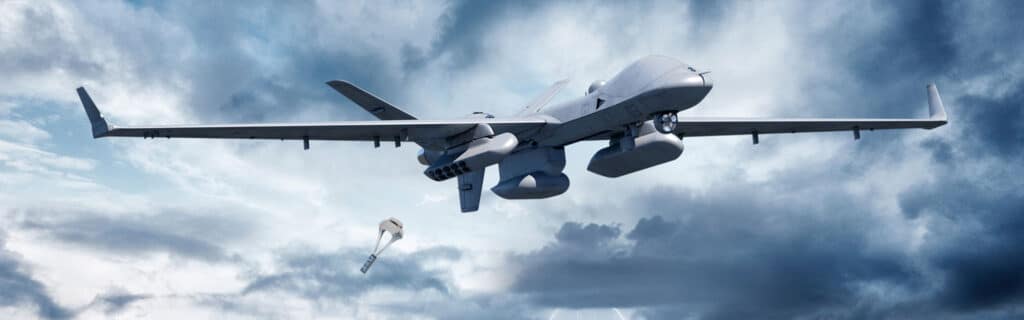
General Atomics’ MQ-9B SeaGuardian was on display at NAS Whidbey Island in Washington for an open house event last month, familiarizing sailors and base personnel on the aircraft ahead of a 2026 INDOPACOM operational evaluation that will test its maritime domain awareness capabilities in the region.
The SeaGuardian drone deployed from Palmdale, California without direct control from an operator, instead using its onboard Detect and Avoid System to “operate in the national airspace like any other piloted aircraft”, according to a General Atomics press release. The DAS system allows for more relaxed UAS controls that enables operation in national airspace without direct control and contact otherwise needed.
According to General Atomics, the MQ-9B also demonstrated its autonomous landing and takeoff capability. It flew to Whidbey Island to familiarize base personnel with the aircraft that will begin operations in 2026 for a NAWCAD operational evaluation.
Whidbey Island was home to previous MQ-9B SeaGuardian deployments for various carrier workups, Northern Edge 2023, and Integrated Battle Problem 2021 and 2023. The INDOPACOM deployment is being led by Naval Air Warfare Center Aircraft Division (NAWCAD) AIRWorks which also supported SeaGuardian deployments to RIMPAC 2024 in an Intelligence, Surveillance, Reconnaissance, and Targeting demonstration.

SeaGuardian, in operational deployments, would enable distributed and persistent anti-submarine warfare capabilities using lower cost platforms, combining the sensors and processing equipment of the P-8A with a distributed network of MQ-9Bs to maximize sea control and maritime awareness. The MQ-9B can also deploy to more contested environments without the risk of losing a manned aircraft.
“I’m pleased to support the Navy’s continuing public engagement efforts with our MQ-9B and appreciate NAS Whidbey leadership’s ongoing support of SeaGuardian operations. I look forward to continuing to work together as we demonstrate the capability of this multi-faceted UAS and fill critical capability gaps.”
GA-ASI President David R. Alexander
The SeaGuardian platform provides the fleet with a 30-hour endurance group 5 UAS. It carries a range of podded capabilities, including a multi-mode 360° maritime surface search radar, sonobuoy deployment system, and self defense jammers, as well as 9 different pylons for weapons and podded capabilities in a plug-and-play configuration. General Atomics is also working on a self-funded air-to-air laser for its MQ-9 fleet to shoot down other drones and missiles.