The Philippine Navy’s latest exercise in the South China Sea included missile drills from the fleet’s latest assets.
The Philippine Navy’s newest assets sortied into the South China Sea for missile drills last week in what the service described as a “milestone” in Manila’s naval modernization program.
BRP Miguel Malvar (FFG-06) led a formation of Acero-class patrol gunboats and Multi-Purpose Attack Craft off Western Luzon during a demonstration of the fleet’s Spike Non Line Of Sight (NLOS) missiles. Initially procured for the service’s two AW-159 Wildcats, the Israeli anti-tank system has become the most widely used missile system in the Philippine Navy thanks to the introduction of the Acero-class fast attack boats.
Last week’s missile drill was the first time that the Philippine Navy conducted an aerial launch of the system, which provides the frigate-embarked helicopters with a surface strike capability out to 50 kilometers. The Philippine Navy stated that the Rafael missiles “enhances rapid response, protection of strategic areas, and flexible operations across the archipelago.”
“Showcasing precision and technological advancement, the AW159 struck and destroyed its designated target with accuracy, underscoring the growing capability and lethality of the Philippine Navy’s aviation assets,” read a release from the Naval Strike Wing.
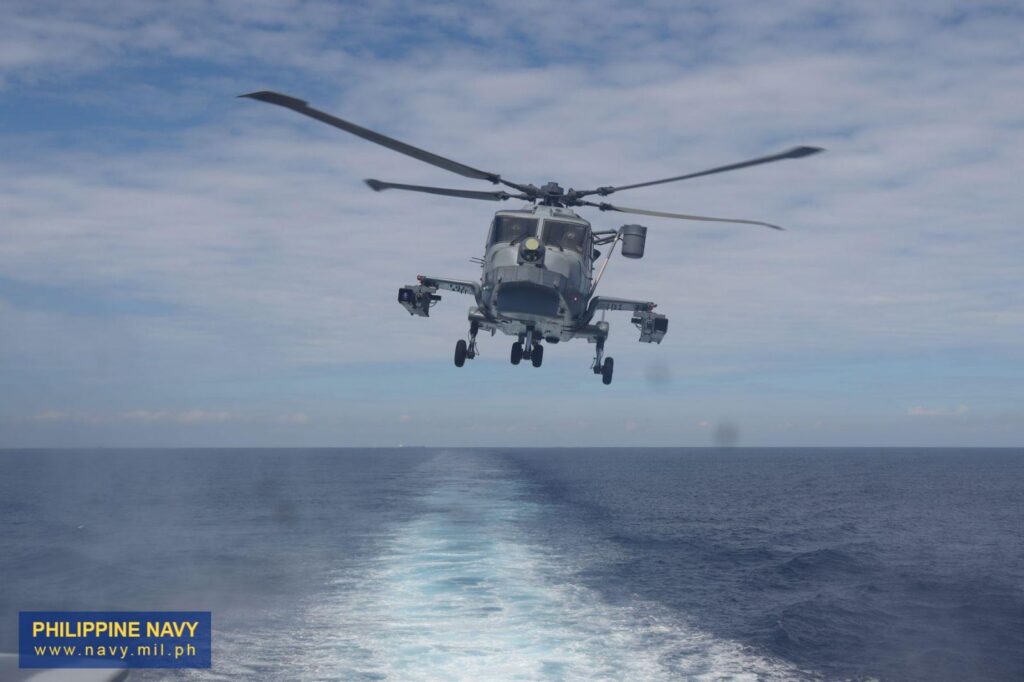
Manila plans to procure six additional helicopters to support anti-submarine warfare operations on the country’s growing frigate fleet. Aside from the Jose Rizal-class, the service has recently received two missile frigates and is planning to procure another four vessels under the next phase of military modernization. Six incoming offshore patrol vessels from South Korea are also set to come with aviation facilities, potentially increasing this requirement.
Between 2023 and 2028, the service’s air arm plans to bolster its maritime domain awareness and intelligence, surveillance, and reconnaissance capabilities via several modernization programs. Among the Naval Air Wing’s aspirations are plans for seaplanes and dedicated maritime patrol aircraft by 2027.
The participating Acero-class gunboats included BRP Laurence Narag (PG-907), BRP Tomas Campo (PG-908) and BRP Albert Majini (PG-909), the last vessel only having joined the fleet in May during the Philippine Navy’s 127th anniversary celebration at Naval Operating Base Subic.
Tomas Campo engaged another target in coordination with the AW-159 launch during the missile drill. The service claimed that the engagement demonstrated “the Navy’s ability to conduct multi-domain strike operations.”
This class of Israeli-designed and built fast attack boats were procured to replace the Littoral Combat Force’s aging fleet of Cold War-era patrol boats. Their increased range and seakeeping abilities have allowed the gunboats to be deployed to the disputed waters of the South China Sea. Two Aceros visited Thitu Island, Manila’s most developed outpost in the Spratlys, last year.
These missile drills were the latest show of force fueled by Manila’s military modernization program, which has brought numerous aerial and naval assets to the country’s beleaguered forces in recent years. These initiatives come amid tensions in the South China Sea between the Philippines and China, with the latter claiming the majority of Manila’s westernmost exclusive economic zone in a territorial dispute. The People’s Liberation Army Navy – alongside the China Coast Guard and Chinese Maritime Militia – frequently operate within the disputed waters and have even constructed three fully-fledged air and naval bases near the Philippine province of Palawan.