Eureka Naval Craft’s Richard Byno has provided Naval News with additional information about their ongoing efforts to field their new series of USVs with the U.S Armed Forces, with new information about the AIRCAT Bobcat USV revealed.
The Bobcat itself is an optionally manned light supply vessel with a catamaran hull. Bobcat can carry up to 10 tons at a maximum range of 350 nautical miles and can achieve a “sprint” speed of 50 knots, and standing with a length of 57 feet (17 meters) and a draft of 1.6 feet, Bobcat can carry a variety of payloads into austere and previously unreachable regions.
Promising to be highly serviceable, Bobcat capitalizes on ideals such as a fully transferable power-pack, enabling a quick turnaround, a larger potential pool of capable personnel, and decreasing the maintenance footprint needed to keep logistics on an even keel.
The design is currently production ready, slotting in at $16 million dollars per hull and can be produced with a variety of ship yards depending on partnerships, making production rapidly scalable with both large and established shipyards and within smaller tier 2 and 3 shipyards. A figure given by Richard Byno, Eureka’s EVP of Defense, slates the design as being operational within 16 months of a potential partnership.
“We can build it wherever out of aluminum using whatever resources are available and get it to the war-fighter, because time is of the essence.”
Richard Byno, EVP of Defense at Eureka Naval Craft

Bobcat primarily targets the U.S Marines through a current lack of a widespread, fast, and serviceable supply vessel, offering a cheaper and more scalable alternative. As such, Bobcat can carry a variety of payloads from an entire platoon of Marines to light vehicles, including the Marine’s JLTV based NMESIS anti-ship missile system, offering an extremely mobile method of transport to supplement existing lethality.
Bengal
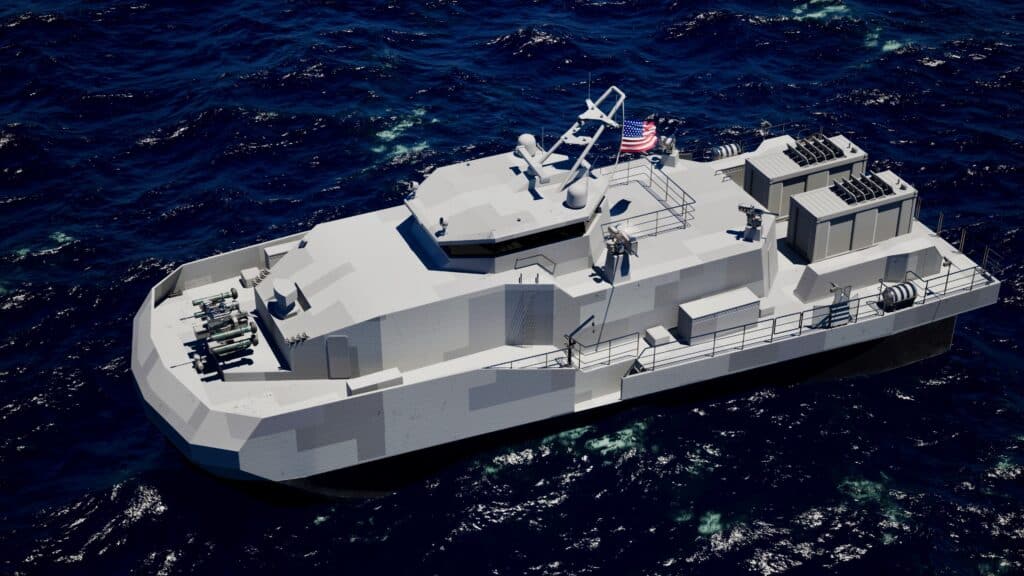
Bobcat is borne of Eureka’s past experiences with their Bengal series of supply catamarans. Bengal and Bengal MC offer a larger alternative to Bobcat, with a proven design taken from commercial use, with 6 Bengals currently active in private service.
Bobcat and Bengal draw on similar elements, including integration of a breadth of weapons through the utilization of OEMs, with both featuring the ability to carry remotely operated small arms. Bengal can accomplish a larger variety of mission sets due to the possible implementation of C-UAS systems, anti-ship missiles, mines, and potentially torpedoes as well as a larger payload.
Ergonomics on board both vessels and reductions in downtime are further enhanced by a partnership with SH Defence, who have provided a modular deck locking system which enables a low profile design with optional remote weapons systems, counter-UAS systems, and appliqué armor.
“Our craft is agnostic. So we can put anybody’s autonomous stack on it, anybody’s weapons and OEMs.
Richard Byno, EVP of Defense at Eureka Naval Craft
Specifics for the Bengal put it a 1,000 nautical miles of range at 38 knots in seas up to Sea State 4, with a payload of 40 tons. Following a similar principle, it offers a quicker option to move men, material, and fires around an austere battle space, with the capability to move heavier vehicles such as Marine HIMARs launchers or a larger volume of cargo, although at a larger cost of a $31.14 million for the Bengal-MC variation with full autonomy integration.