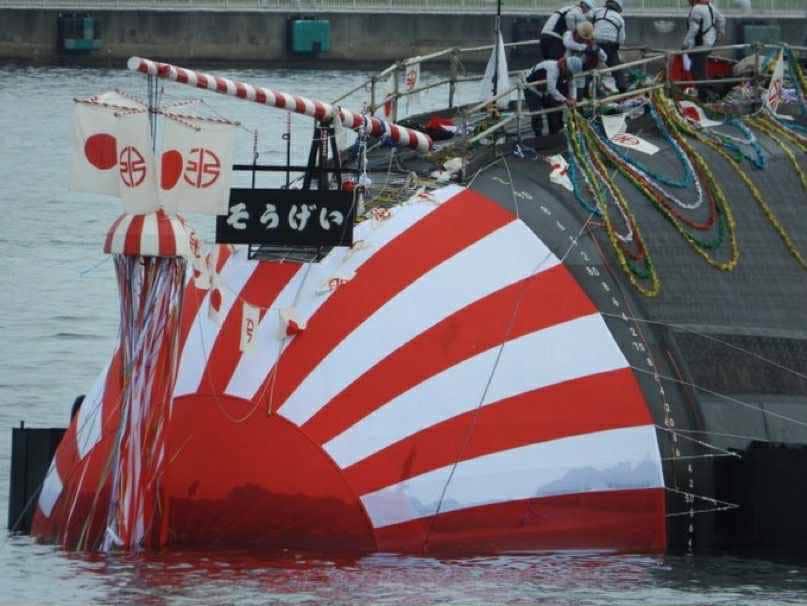
Japan’s Kawasaki Heavy Industries (KHI) has launched the sixth Taigei-class diesel-electric attack submarine “Sogei” 「そうげい」 for the Japan Maritime Self-Defense Force (JMSDF).
The new 3,000-tonne diesel-electric submarine (SSK), which has been named 「そうげい」 Sogei (with pennant number SS 518), entered the water on October 14 in a ceremony held at KHI’s shipyard in Kobe City. The newly launched SSK will use the new Kawasaki 12V 25/31 diesel engines with high output power, following the fourth Taigei-class submarine “Raigei” and the fifth, “Chogei.”
Sogei, which cost about 73.6 billion yen ($484 million) to build, is expected to enter service in March 2027. “Sogei” means a blue whale. This is the first time that the Maritime Self-Defense Force has named a vessel “Sogei,” and the former Imperial Japanese Navy had no vessel with this name.
The Taigei-class submarines all incorporate “Gei” (whale) into their names, following the “Shio” (tide) and “Ryu” (dragon) series seen in previous JMSDF submarines. “Taigei” itself means “big whale.”
According to the JMSDF, the new submarine has a crew complement of about 70, an overall length of 84 meters, a beam of 9.1 m, a draught of 10.4 m, and a standard displacement of about 3,000 tonnes. It is just slightly larger than the preceding Soryu-class SSKs, which have a standard displacement of 2,950 tonnes.
The Taigei-class features female-only compartments such as a living space for up to six women, according to the JMSDF. This is the first time for a Japanese submarine to have dedicated living quarters for female crew members.
New diesel engines
Until the third Taigei-class submarine Jingei, two Kawasaki 12V 25/25SB diesel engines were used as the main engines, but Raigei started to use new Kawasaki 12V 25/31 diesel engines with a high output power for the first time. These new diesel engines are compatible with a new snorkel system with enhanced power generation efficiency.
The Taigei-class is powered by a diesel-electric engine generating 6,000 hp. It has a maximum speed underwater of 20 knots.
Lithium-ion batteries
The JMSDF said that the Taigei-class is equipped with lithium-ion batteries in place of lead-acid ones, just like the final two Soryu-class boats for the JMSDF: Oryu (SS 511) and Toryu (SS 512).
GS Yuasa, a Kyoto-based developer and manufacturer of battery systems, provided the lithium-ion batteries for those new submarines. So far Japan is the only country known to have fitted lithium-ion batteries into SSKs, with South Korea expected to be the next country to do so with three 3,600-ton Jang Bogo-3 Batch 2 submarines. These vessels are scheduled to be commissioned from 2027.
New CMS and snorkel
The class also employs a new combat management system (CMS) combining advanced integrated sensors, command-and-control, and weapon engagement systems, the Japanese MoD said.
In addition, it adopts an enhanced snorkel system to reduce signatures, and a new-generation sonar system based on fiber-optic array technology to enhance detection capability.
Submarine sonar
The Taigei-class sonar suite features the high-performance ZQQ-8, which has improved capabilities over the Soryu-class’ ZQQ-7.
Taigei-class SSK weapons
The Taigei-class employs the same torpedo counter-measures system that has been incorporated into the last four Soryu-class boats. It uses Japan’s newest torpedo, which is called the Type 18, succeeding the previous Type 89. The new torpedo features improvements in a number of areas, including propulsion, target detection, and processing.
The class is also capable of deploying the UGM-84L Harpoon Block II anti-ship missile against surface targets. This missile range is 248 km – enough to provide Japan with a “counterattack” capability.
Taigei-class submarine program so far
The lead submarine of the Taigei-class, named Taigei (SS 513), was commissioned in March 2022. The second of the class, named Hakugei (SS 514), entered service in March 2023. The third of the class, named Jingei (SS 515), entered service in March 2024. The fourth of the class Raigei (SS 516) entered service in March 2025. The fifth boat, the Chogei(SS 517), which was launched in October 2024, is currently undergoing outfitting and various tests in preparation for commissioning in March 2026.
With China in mind
Chinese Navy’s third aircraft carrier, the Fujian, is expected to be commissioned within the year, forming a three-carrier task force with the Liaoning and the Shandong. Nowadays, the Chinese Navy frequently passes through the so-called first island chain between Japan’s Kyushu and Philippines, which mainly consists of Japan’s southwest islands, and is most likely to operate more frequently in the Western Pacific Ocean around Japan. Japanese submarines, as the “ninjas of the sea,” are expected to check the assertive actions of the Chinese Navy.