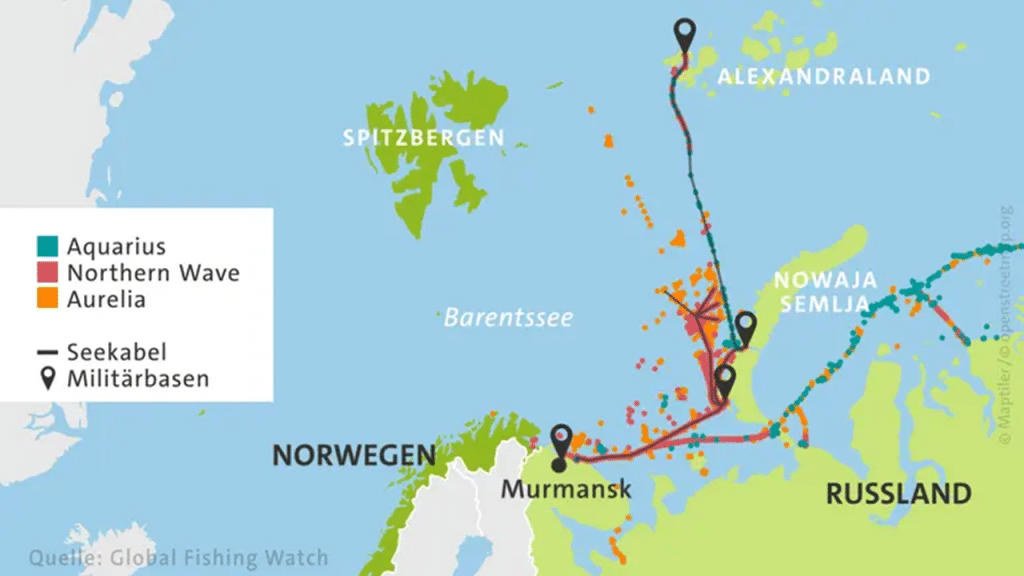
Journalistic investigations by the Washington post and several other European news agencies have revealed that Russia might be operating a network of sonar systems in the Barents Sea designed to detect submarines. The detection network, called “Harmony”, appears to be an equivalent of the famous SOSUS network that exists in the Greenland-Iceland-United Kingdom (GIUK) Gap. The Harmony network is composed of several detection devices arrayed in an arc stretching from Murmansk, via Novaya Zemlja to Franz Josef Land.
In order to build the Harmony network, Russia acquired Western technology via shell companies based in Cyprus. The operation to acquire the components to build “Harmony” reportedly took place over a decade and was only recently uncovered.
The Harmony network is reportedly arrayed in an arc starting from Murmansk, heading towards the entrance of the White Sea before bending north to Novaya Zemlya and ending at Franz Josef Land. The journalistic investigation came to this conclusion based on the movements of three survey vessels operating in the area since 2016. These vessels are reported as the Aquarius Dignitus, Northern Wave, and Aurelia. All three vessels also made extensive trips along the Northern Sea Route though it is not reported if these later trips were linked to the deployment of the Harmony array or just regular surveys aimed to further develop the Northern Sea Route.
In its current reported deployment, the Harmony array does not control the entrance to the Barents Sea itself in a similar manner as the SOSUS network covered the GIUK gap and the entrance to the Northern Atlantic, instead it provides detection of vessels and submarines already operating in the Barents Sea.
The reason the Harmony array is arranged in this configuration is in part due the local geography as the array might require several shore stations for its operations. The array itself does not serve as an advanced warning system to alert the Russians of Western submarines heading towards the Barents Sea. For this function, the array would need to be deployed closer to the entrance of the Barents Sea on a line running from the North Cape to Svalbard. Both locations are however Norwegian territory, hence the reason why Russia didn’t deploy the array in this area.
The array does however increase Russia’s maritime awareness of Western submarines once they are inside the Barents Sea. It’s arc shape deployment aids in better triangulating detected sounds and plot their position more accurately in the Barents Sea.
As such, it allows for earlier detection of Western submarines by Russia and allows Russia to respond better and faster against intrusions of Western submarines in the Barents Sea. Once detected and the general area of where the submarine is operating from is being plotted, Russia can start directing additional assets to keep tracking and possible engaging the detected contacts. Harmony thus provides an earlier detection and allows Russia to deploy additional assets such as maritime patrol aircraft and antisubmarine platforms to the area to keep shadowing or expelling the Western submarines. Alternatively, the array also allows Russia to move valuable naval assets such as nuclear powered ballistic missile submarines out of the general area where the Western submarines are operating, ensuring the secrecy if these Russian nuclear patrols and increase the survivability of these platforms in times of war.
Secret acquisition of sensitive Western maritime technology
Russia reportedly was able to build the Harmony array thanks to the acquisition of sensitive maritime technology from Western countries. This acquisition was done in secrecy via several shell companies. Central in the acquisition network is the company Mostrello Commercial Ltd. with its headquarters based in Cyprus and which served as a front for Russia’s military industrial complex. Mostrello reportedly acted as an intermediary for the Russian defense firm Kometa, which allegedly led the construction of the Harmony array.
The secret project of acquiring Western military technology was only uncovered recently via a trail in Germany of a Russian citizen, identified as Alexander Shnyakin, who violated German trade laws while coordinating purchases for Mostrello.
Documents listing Mostrello transactions revealed that the company has been acquiring Western maritime technology for over a decade. Mostrello reportedly purchased technology from several firms in the United States, Germany, Norway, the United Kingdom, Sweden and Italy. Among the acquisitions were sonar systems made by EdgeTech in 2015 as well as seabed systems from Kongsberg in 2015. The attempted purchase of what is described as “High-speed acoustic positioning system” from Kongsberg last year was blocked once Norway’s domestic security service gave warning to Kongsberg.
Other purchases by Mostrello include sonar systems to map the seabed, which could have been used to determine where to install the Harmony Array, as well as the purchase fiber optic cables and underwater antennas. The company also acquired several vessels for mapping the seabed such as the former survey vessel MV Aquarius Dignitus from Germany. Satellite antennas, special drill bits and underwater robots capable of diving down to 3.000 meters in depth were also among the reported acquisitions made by Mostrello.
In total, Mostrello and its sister companies, acquired underwater technology and research vessels for a value of 50 million USD since 2013. It should be noted that the purchases took place during a time when no sanctions were in place against Mostrello. All purchases made by Mostrello in the past decade seemed legit and did not raise any suspicion. Only in 2024 was Mostrello sanctioned by the United States. All acquired maritime materials and technology are labeled as dual-use, meaning they can be used for both civilian as military purposes.
Strategic Weakness
The fact that the Harmony array is built by secretly acquired Western components reveals a strategic weakness within the Russian military industrial complex. The acquired technology and machinery often includes high end electronic devices and very specific materials. By using shell companies and secret acquisitions for over a decade, Russia reveals that it is not technologically and economically capable to develop and produce these components itself. It is known that Russia’s military industrial complex struggles with developing and deploying high-end military gear without resorting to the use of foreign partners to supply critical components. The development of the Harmony array thus follows known patterns when it comes to Russia fielding high-end military technology.
With the Russian military industrial complex being unable to produce the components of the Harmony array itself, the major question is not how Russia has been able to deploy the array but how it will be able to maintain it over the next years. As sanction tighten and Western intelligence services become more aware of how Russia is evading sanctions, it becomes harder and harder for Russia to keep acquiring Western technology and spare parts for the Harmony array.
The sanctions are tied to Russia’s invasion of Ukraine and it doesn’t look like they will be eased any time soon, making it more and more difficult for Russia to keep the Harmony array operational as time progresses. Should economic sanctions against Russia be lifted in the future, it still remains to be seen if individual countries will be able to sell dual-use high-end maritime technology to Russia, knowing how Russia is using this technology to gain military advantages over NATO.
While the Harmony array might give Russia an operational edge in the maritime domain of the Barents Sea it also signals the strategic weakness of the Russian military industrial complex as it was unable to develop technology and components of the array independently.
Possible broader implications for the Pacific Region
The Journalistic Investigation was unable to determine if the Harmony array was limited to only the Barents Sea of if other arrays are also active in other parts of Russia’s maritime domain. It makes sense for Russia to give priority on setting up a Harmony array in the Barents Sea as this area is the most important for the Russian Federation. Russia’s Northern Fleet is the most developed of all Russian Navies based on its allocated resources and mission parameters. The Northern Fleet enjoys direct access to the Northern Atlantic Ocean via the North Cape and is thus positions to strike both the European and American maritime domains. In a more defensive posture, the Northern Fleet is able to defend Russia’s Artic holdings and project power across the Northern Sea Route which Russia is hoping to develop into a major maritime shipping route. The Northern Fleet also field the most advanced Russian warships and submarines such as the modernized Kirov-class battle cruiser RFS Admiral Nakhimov, the ocean-going frigates of the Admiral Gorshkov-class, modern nuclear submarines of the Yasen-M-class and Borei-A-class. The fleet also operated until recently Russia’s sole aircraft carrier, the RFS Admiral Kuznetsov. The Northern Fleet also operates a wide array of maritime bases from Murmansk to Severodvinsk and can also count of the most efficient shipyard within the Russian Federation, Sevmash, which is capable of building nuclear powered submarines.
Areas such as the Baltic, Black, and Capsian Seas are to enclosed to benefit from a Harmony system and does not have the operation threat of Western submarines that warrant the need of a Harmony system. The Baltic Sea could be an exception though Russia lacks the maritime room to install such a system undetected. This only leaves the Pacific Fleet bases as the only candidate that could benefit from a Harmony array though at the moment there are no indications that such an array is deployed in the Pacific Ocean or in the Sea of Japan.

Another important Pacific angle to take into account is the People’s Republic of China. Though the Chinese were not involved in the acquisition and development of the Harmony array it cannot be ruled out that part of this technology might make its way to China. The economic cooperation between Russia and China might result in Russia turning to China to develop and build spare parts for the Harmony array based on technical information that Russia provides from the components it already acquired from the West.
The fact that no acquisitions of maritime technology from China was uncovered during the journalistic investigation against Mostrello could suggest that China, just like Russia, is currently unable to produce these components itself. Then again, Mostrello was set up specifically in Cyprus to ensure contacts with the European Union and other western countries. A similar company probably could exist to gain access to Asian markets though no hard evidence for this hypothesis exists.
Nevertheless, China has proven in the past as being able to quickly copy Western technology. It cannot be ruled out that a closer Russian-Chinese cooperation could result in China producing the components needed to maintain the Harmony array. Should this happen, the Chinese would possess the necessary technologies and equipment to set up its own Harmony array. The South China Sea would be a most likely candidate for hosting a Chinese version of the Harmony array. China has a large strategic claim on this region which is known to be rich in hydrocarbon resources and through which a lot of maritime trade passes. The Chinese armed forces already operate several military bases in the South China Sea, all of them possible candidates for setting up shore stations to support a Harmony array. It was previously reported that China is already working on setting up a large scale surveillance network, called the “Invisible Web” as part of its Transparent Ocean strategy. This invisible web also focusses on developing the capabilities for detecting US and Western submarines operating near China.