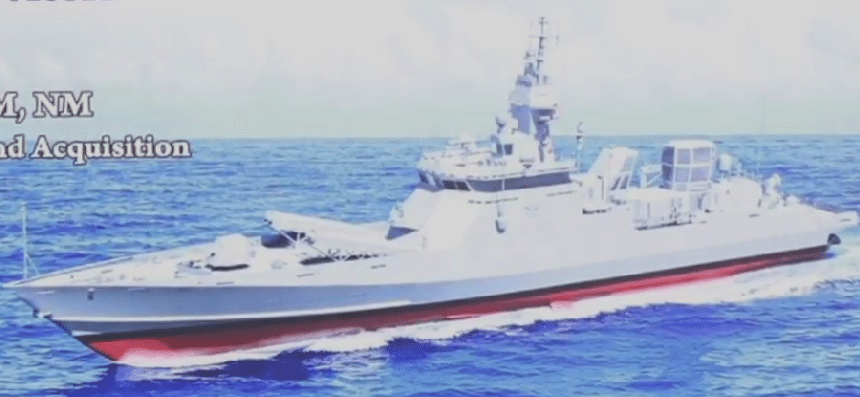
The Royal Thai Navy has officially accepted the MARCUS-B unmanned aerial vehicle to operational service, marking the first air asset to operate aboard HTMS Chakri Naruebet (CVH-911) since the retirement of the carrier’s AV-8S Harrier jets in 2006. The drone was displayed at the Defense & Security 2025 exhibition in Bangkok, where project managers confirmed its delivery following successful trials in 2024.
The MARCUS-B is a fixed-wing vertical takeoff and landing (VTOL) drone developed by the Naval Research and Development Office (NRDO) in collaboration with Thai private companies including Oceanus Research and Development, X-Treme Composites, and BJSupply 2017. The project represents a significant step in Thailand’s efforts toward defense self-reliance.
According to the project manager at the exhibition the drone was delivered to the Royal Thai Navy in 2025 and mass production is currently awaiting budget approval. Naval News previously reported about its carrier trials aboard HTMS Chakri Naruebet in 2022.The Thai Navy has opted to keep the project low-cost by maintaining the MARCUS-B as a reconnaissance platform rather than weaponizing it. However, a kamikaze variant has been developed as part of the broader MARCUS drone family.
Technical specifications for the new version of the drone show notable improvements over the prototype tested in 2022. The drone now has a wingspan of 4.8 meters and a length of 2.8 meters, with a maximum takeoff weight of 50 kg. It is powered by a 4-stroke 125cc electronic fuel injection engine with start-generator capability, consuming 1.2 to 1.8 liters of fuel per hour. The standard 11-liter fuel tank can be extended to 20 liters for longer missions.
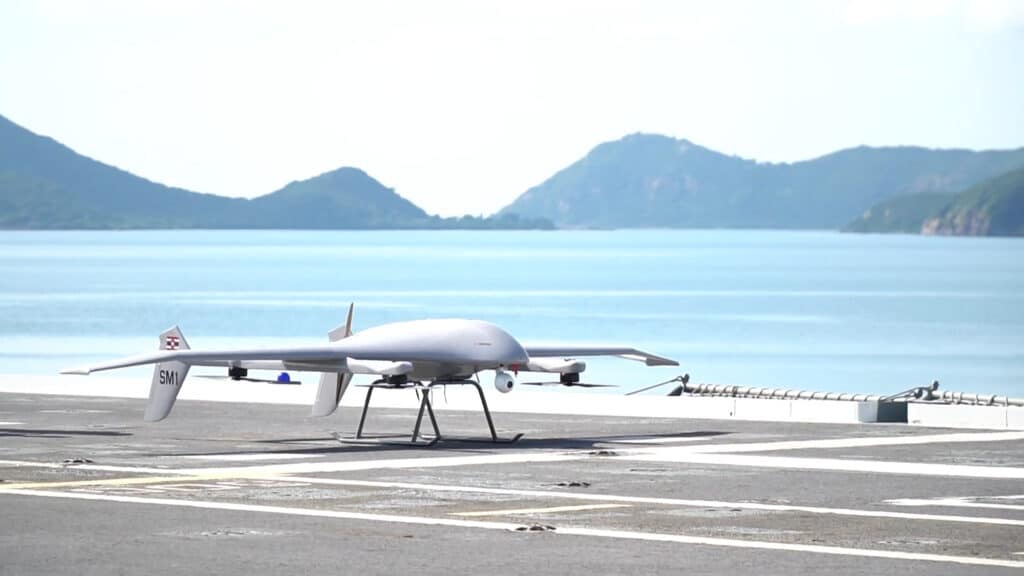
The MARCUS-B can cruise at 50 to 70 knots with a flight ceiling of 5 km above mean sea level. Its payload includes a 30x electro-optical/infrared sensor with a 5 km laser rangefinder, though the payload is customizable depending on mission requirements. The drone features an ultra long-range phased array data link with mesh network capability, providing a range exceeding 200 km. It is equipped with jamming and GNSS-denial resilience, an ADS-B transponder with selective operation, and a C4ISRNCW-ready companion processor.
The engine is Czech-oriented and the data link was provided by Norway, demonstrating the international collaboration behind the project. Funding for the prototype came from the National Research Council of Thailand (NRCT), with research and development led by NRDO.
Transforming Chakri Naruebet into a Drone Carrier

The Royal Thai Navy is reportedly planning to convert HTMS Chakri Naruebet into a drone carrier, with discussions underway with several companies that have not been publicly disclosed. This aligns with a broader trend among navies worldwide to leverage unmanned systems for cost-effective carrier operations. The carrier has been without fixed-wing aircraft for nearly two decades, operating primarily helicopters such as the S-70B Seahawk for maritime surveillance, search and rescue, and disaster relief missions.
The MARCUS-B’s operational deployment comes as the Royal Thai Navy modernizes its flagship. In November 2025, the Navy signed a contract with Thales and Universal Communication Systems to replace the carrier’s Integrated Platform Management System, a 15-month project expected to extend the 28-year-old vessel’s service life into the next decade.
Naval News comments
The MARCUS-B’s entry into service represents a practical solution for the Royal Thai Navy’s long-standing challenge of operating an aircraft carrier without fixed-wing aircraft. While the drone’s specifications are modest compared to larger military UAVs, its VTOL capability and naval-specific design make it well-suited for operations from the carrier’s limited deck space.
The decision to develop a kamikaze variant rather than weaponize the reconnaissance platform is noteworthy. This approach maintains the base platform’s simplicity and cost-effectiveness while still providing a small strike capability through expendable units. It reflects a pragmatic approach to capability development within budget constraints.
The Thai Navy’s interest in converting HTMS Chakri Naruebet into a dedicated drone carrier follows similar initiatives by other navies, most notably Türkiye’s conversion of TCG Anadolu to operate TB3 Bayraktar drones. However, the Thai Navy’s approach appears more incremental, focusing on increasing indigenous development capabilities and gradual capability expansion rather than a wholesale conversion program.