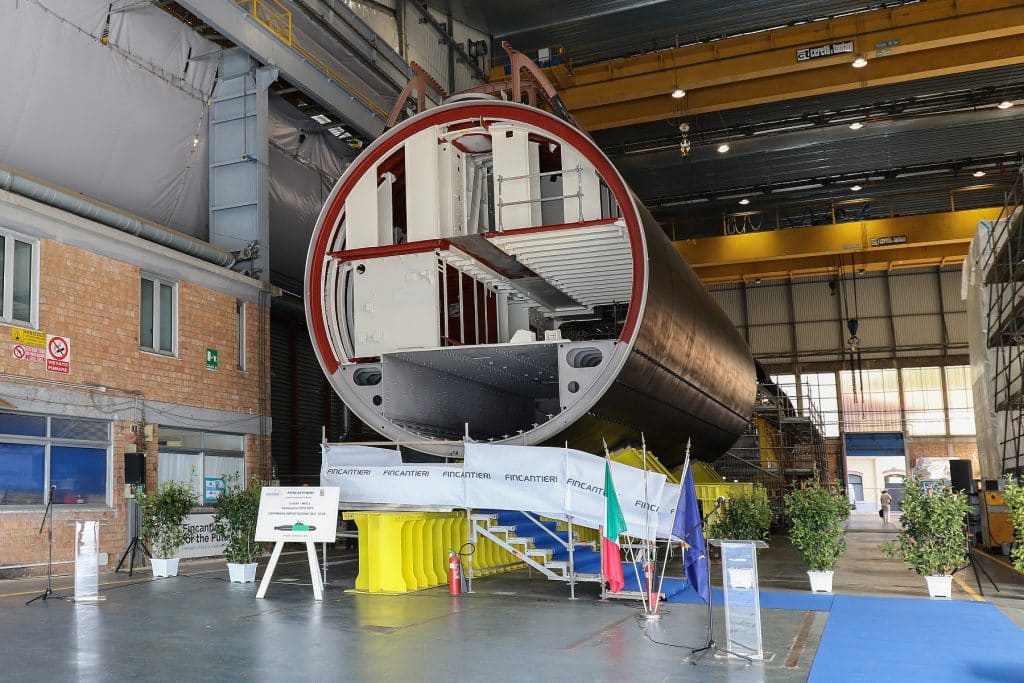
The delivery ceremony for the ship “Atlante”, the second Logistic Support Ship (LSS) for the Italian Navy, took place on 19 December at the Fincantieri shipyard in Castellammare di Stabia. This delivery is part of the fleet renewal program managed under the aegis of OCCAR (Organisation for Joint Armament Cooperation).
Fincantieri press release
The ceremony was attended by Admiral Vincenzo Montanaro, Logistic Commander of the Italian Navy; Mr. Joachim Sucker, Director of OCCAR; Admiral Giuseppe Abbamonte, Director of NAVARM; Rear Admiral Fabio Gregori, Deputy Chief of Staff of the Navy and President of the CVCA; Biagio Mazzotta, Chairman of Fincantieri; Eugenio Santagata, General Manager of the Naval Vessels Division; Luigi Matarazzo, General Manager of the Merchant Ships Division; and Francesco Lubrano, Director of the Fincantieri Castellammare Shipyard.
“Atlante”, together with the ship “Vulcano” delivered in 2021, will strengthen the national fleet’s capabilities, ensuring operational readiness in multiple sectors: from the defense of the country’s vital interests and Euro-Atlantic spaces, to contributing to international peace and security, and providing assistance in the event of public emergencies.

The Logistic Support Ships, built as part of the Navy’s fleet renewal plan entrusted to the Temporary Business Grouping (RTI) formed by Fincantieri and Leonardo, are characterized by a high level of innovation that ensures flexibility and efficiency in multiple operational scenarios. In addition to military functions, they can be employed in complementary activities such as supporting Civil Protection, humanitarian aid, and rescue operations. Furthermore, the adoption of low-emission generation and propulsion systems, together with advanced technologies for the control of biological effluents, ensures a reduced environmental impact.
From a technical standpoint, the unit has a displacement of about 27,000 tons, a length of 193 meters, and a speed of about 20 knots. It can accommodate up to 235 people, including crew and specialists, is equipped with hospital and medical facilities, and can transfer liquid and solid cargo to other naval units, carry out repair and maintenance operations at sea, and support rescue operations using helicopters and special boats. The unit is also equipped for the recovery of vehicles and materials from the surface and seabed, and can serve as a base for intelligence and electronic warfare operations.
The Castellammare di Stabia shipyard, the oldest among Fincantieri’s sites, directly employs 605 people and, thanks to its supply chain, generates over 3,200 jobs overall. Currently, the site is mainly dedicated to the construction of naval vessels, but it also actively participates in the Group’s production network by building sections and blocks for the cruise ship sector.
– End –
About Logistic Support Ship (LSS)

The LSS is a vessel that provides logistics support to the fleet, endowed with hospital and healthcare capabilities thanks to the presence of a fully equipped hospital, complete with operating rooms, radiology and analysis rooms, a dentist’s office and hospital rooms that will be capable of hosting up to 17 seriously injured patients. The ship combines capacity to transport and transfer to other transport vessels used for liquids (diesel fuel, jet fuel, fresh water) and solids (emergency spare parts, food and ammunitions) and to perform at sea repairs and maintenance work for other vessels.
The defense systems are related to the capacity of command and control in tactical scenarios, communications and dissuasive, non-lethal defense systems. The vessel is also capable of embarking more complex defence systems and becoming an intelligence and electronic war platform.
- 193 meters long
- speed of about 20 knots
- 235 persons including crew and specialists
- 4 replenishment station abeam and 1 astern
- Capacity to supply drinking water to land
- Capacity to provide electricity to land with 2500 kw of power
- Possibility of embarking up to 8 residential and healthcare modules
- Capacity to perform rescues at sea, through recovery and seabed operations (the ship is equipped with an 30 tons offshore stabilized crane stabilized)
- Base for rescue operations through helicopters and special vessels