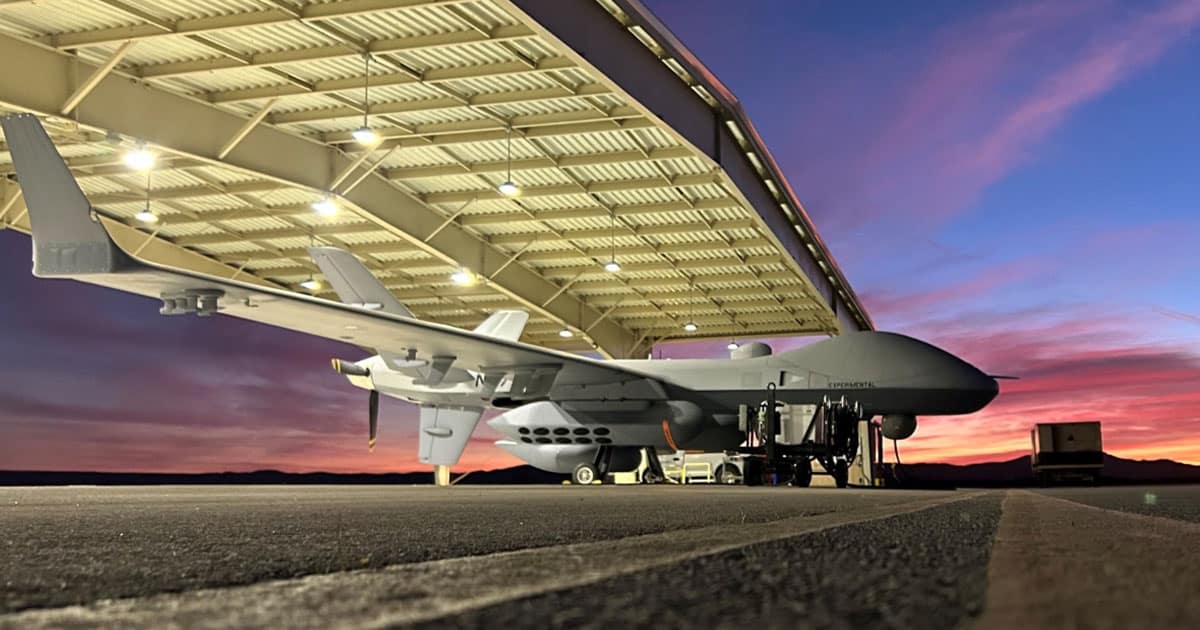
General Atomics Aeronautical Systems, Inc. (GA-ASI) and the U.S. Navy continue to expand the Anti-Submarine Warfare (ASW) capability of the MQ-9B SeaGuardian Unmanned Aircraft System (UAS).
GA-ASI press release
The flight test was performed on December 17 and featured Sonobuoy Dispensing System (SDS) pods, more than previously tested, doubling the number of sonobuoys available.
“Expanding sonobuoy capacity, including Multi-static Active Coherent (MAC) technology for SeaGuardian, has been an integral part of our advanced ASW strategy to broaden and enhance search areas,” said GA-ASI President David R. Alexander. “The wider maritime coverage our MQ-9B’s ASW capability provides is extremely valuable to our customers.”
Sonobuoys are naval sensors that drop from an aircraft into the ocean and help detect submarines. The SeaGuardian deployed AN/SSQ-36 Bathythermal, AN/SSQ-53G Directional Frequency Analysis and Recording (DIFAR) (passive), and AN/SSQ-62F Directional Command Activated Sonobuoy System (DICASS) (active) buoys. This was the first time Multi-static Active Coherent (MAC) buoys have been dispensed from an uncrewed aircraft. The MAC buoys are better at detecting submarines over large areas and require fewer buoys compared to using DIFAR and DICASS.
Sponsored by the U.S. Navy, the flight tests were specifically aimed at certifying the SDS. This flight testing supports the Commander, U.S. Pacific Fleet’s Operational Evaluation deployment to SEVENTH Fleet and enjoyed additional support and governmental supervision from the Naval Air Warfare Center Aircraft Division (NAWCAD) AIRWorks.
Upon completion of the testing and data review, the U.S. Navy is expected to give GA-ASI deployment flight clearance for ASW operations using MQ-9B SeaGuardian in January 2026.
SeaGuardian has also been used by the U.S. Navy in various recent exercises, including Northern Edge, Integrated Battle Problem, RIMPAC, and Group Sail.
– End –