ARLINGTON, Va. — The U.S. Navy’s next-generation of missiles are set to support missions that include hypersonic strike and long-range offensive counter air through a modular propulsion approach, according to the service’s top surface warfare official.
Amid new air and missile threats from adversaries such as Russia and China, the Navy is working on a successor to the Standard Missile series. Previously developed to face Cold War-era threats, these surface-to-air missiles have been the mainstay of the fleet’s launchers for decades.
RAdm. Derek Trinque, director of the service’s surface warfare development office (N96), highlighted how this upcoming system will increase the capacity of the fleet’s vertical launching system (VLS) cells through an open system architecture approach in his warfighting capabilities seminar at the 38th Surface Navy Association national symposium on Tuesday.
While Trinque noted that the service was receiving SM-6s at a faster rate than was stipulated by contract obligations over the last half year, he noted that the next-generation of missiles would not only have to be better, but also become more efficient with the Navy’s vertical launch cells.
“We have to continue building not just better missiles, but finding better ways to use our vertical launchers,” said Trinque.
According to Trinque, the missile will utilize a common third stage interceptor alongside differing combinations of propulsion stacks to create variants of the missile that can conduct hypersonic strike roles and various air and missile defense missions.
“So by using up a full-sized propulsion stack, one that takes up an entire VLS cell, I can now have a long-range offensive counter air weapon or another option for hypersonic strike. With smaller propulsion stacks that allow me to dual-pack and then quad-pack inside one Mark 41 VLS cell, I can greatly increase the capacity of a given launcher. And I can cover the engagement envelope from the highside of the ESSM (Evolved SeaSparrow Missile) to SM-6.”
Trinque’s brief comments on the next-generation missile follow a notice from last fall for an industry day on the Navy Modular Missile, which also highlighted the multi-packing requirement as well as its potential to be a hypersonic strike weapon.
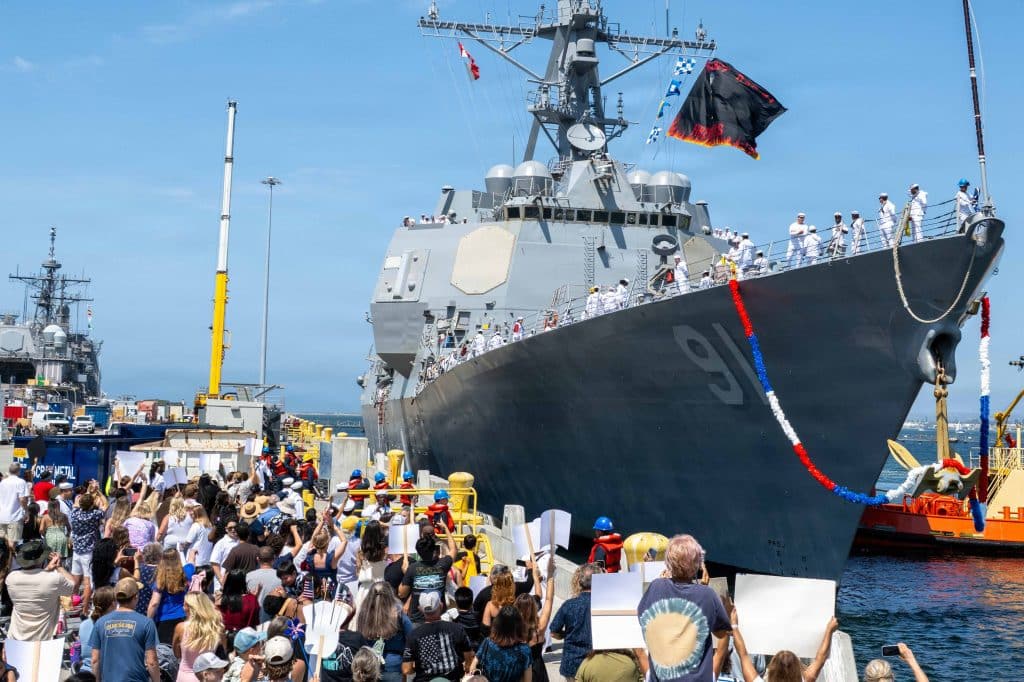
Lessons from the Red Sea, 12 Day War and China’s increasingly expansive and sophisticated arsenal of supersonic, ballistic and hypersonic missiles have driven calls for enhancing the U.S. Navy’s air defense capabilities. The fleet’s force of Arleigh Burke-class destroyers and aging Ticonderoga-class cruisers rely on VLS banks to carry munitions for strike and defensive missions. These new threats have highlighted a need for more cost-effective interceptors and faster methods to reload VLS cells to fully maximize the magazines of the service’s warships.
Since the early 2020s, the fleet has pursued efforts to reload its VLS banks at an increased rate and even at-sea. Industry has also presented new affordable interceptors and guided-munitions to deal with drones, giving commanders an option to save their valuable SM-2s and SM-6s for more high-end threats. Former Secretary of Navy Del Toro mentioned the Naval Modular Missile alongside the development the Transferable Rearming Mechanism under the service’s broader efforts to bolster warship missile power.