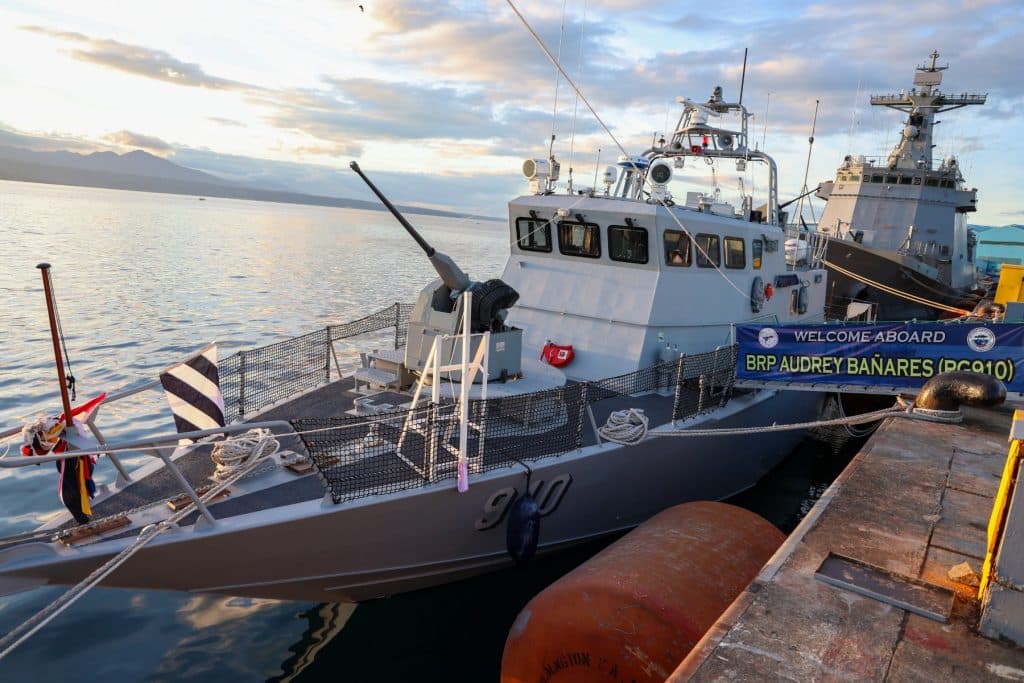
Two of the Philippine Navy’s newest ships entered active duty during a commissioning ceremony at the Naval Operating Base in Subic Bay on Tuesday. The offshore patrol vessel BRP Rajah Sulayman (PS-20) was inducted into service alongside the fast attack interdiction craft BRP Audrey Bañares (PG-910).
The BRP Rajah Sulayman, named after a pre-Hispanic ruler who led Tagalog forces during the 1570 Battle of Manila, is the first of six 2,400-ton ships under a ₱30 billion ($573 million) contract signed with South Korean shipbuilder HD Hyundai in 2022. Its commissioning follows post-delivery activities and technical inspections after its delivery last month. The BRP Audrey Bañares, meanwhile, is the last of nine Acero-class Shaldag Mk. V gunboats acquired for P10 billion ($180 million) from Israel Shipyards Ltd. in 2021. The boat was named after a Navy commando who was killed off Zamboanga City in September 2013 following a sea battle with Moro National Liberation Front extremists.
“The christening and commissioning of BRP Rajah Sulayman and BRP Audrey Bañares represent more than the addition of two ships to the fleet. They signal the continuing maturation of our defense posture and the deepening of our national resolve to safeguard what is ours—peacefully, lawfully, and with dignity,” Armed Forces of the Philippines chief of staff Gen. Romeo Brawner Jr. said during the ceremony.
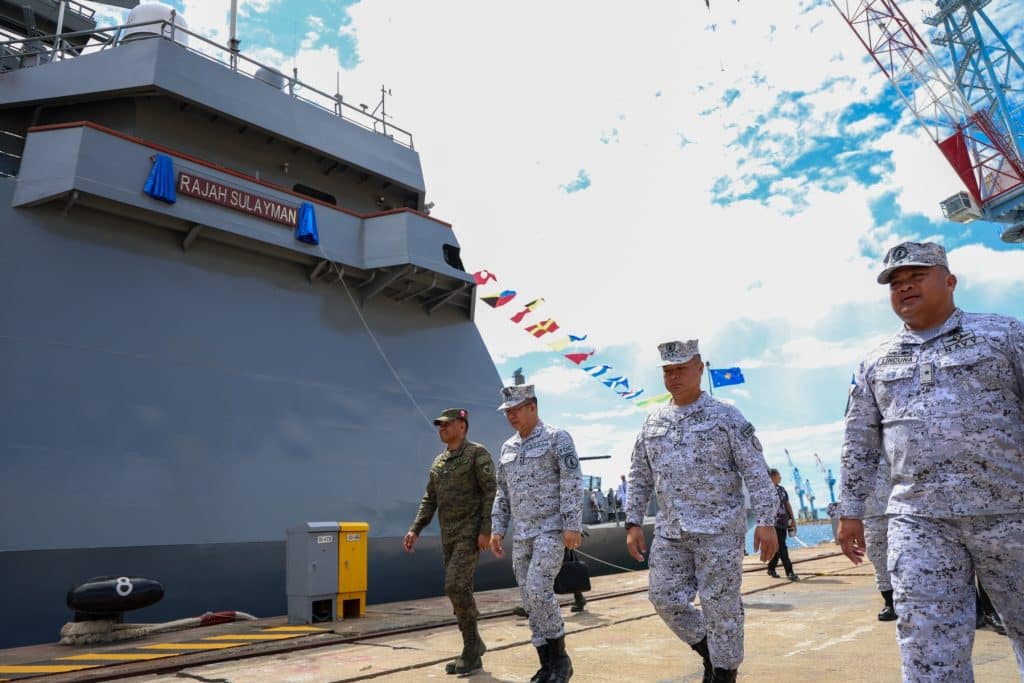
The Sulayman-class ships measure 94 meters in length and 14 meters in beam. They have a cruising speed of 15 knots and an operational range of 5,500 nautical miles. These OPVs are fitted with a Leonardo Super Rapid 76mm main gun, an Aselsan SMASH 30mm secondary gun, Terma C-Guard decoy launching systems, a Leonardo SPS-732 search radar, and a Safran Paseo XLR EO/IR system. As previously reported by Naval News, the Philippine Navy will acquire modular towed-array sonar systems (TASS) for three of its six OPVs.
The Israeli-designed Shaldag MK V patrol boats, meanwhile, are all-aluminum patrol vessels with a full-load displacement of 95 tons and a shallow draft of 1.25 meters. They are crewed by 10 personnel and are capable of reaching speeds of up to 40 knots. The boats have an operational range of up to 1,000 nautical miles when cruising at 12 knots. They can be equipped with a variety of weapons systems, including naval guns and missile launchers. Four of these are armed with Rafael’s Spike Non-Line-of-Sight missiles.
HD Hyundai, in a separate statement, expressed pride in delivering the BRP Rajah Sulayman five months ahead of schedule. The remaining ships will be delivered at a rate of two per year from 2026 to 2028.
“The early delivery reflects our commitment to reliability, schedule excellence, and long term support for our partners, contributing to the Philippine Navy’s fleet modernization and early force readiness,” it said. Pre-delivery training was also conducted in collaboration with the Republic of Korea Navy to help ensure operational readiness.
Brawner said these two new vessels will participate in joint exercises, humanitarian assistance and disaster response operations, maritime patrols, and regional engagements.
In a congressional hearing also on Tuesday, Department of National Defense Undersecretary for Acquisition and Resource Management Salvador Melchor Mison Jr. called for more naval and air bases as the military expects an influx of additional equipment.
“We need more naval bases, air bases, more presence to be seen as a good partner in the region and carrying our own weight and not just relying to our partners,” he told lawmakers.
Mison said Nabasan Wharf, the former munitions pier of the US 7th Fleet, is being considered as the Philippine Fleet’s future base due to insufficient infrastructure at Hanjin Shipyard.
He said plans include building fuel depots and naval magazines, noting that a frigate can load up to one million liters of fuel in a single replenishment — facilities that are not currently available at Hanjin.